Experience Needs A Job Before It Needs A Product
Your Experience Needs A Job before you worry about PDFs, courses, websites or selling anything online.
Your Experience Needs A Job Before You Build Anything
Start with one useful lesson, one person and one problem rather than trying to invent a digital product.
Experience Needs A Job Someone Else Actually Needs
The first question is not what you can sell. It is what your experience could help another person understand, avoid or decide.
Before AI Starts Building Your Experience Needs A Job
Let your judgement choose the useful lesson first. Then let AI help with the repetitive work of turning it into something another person can use.
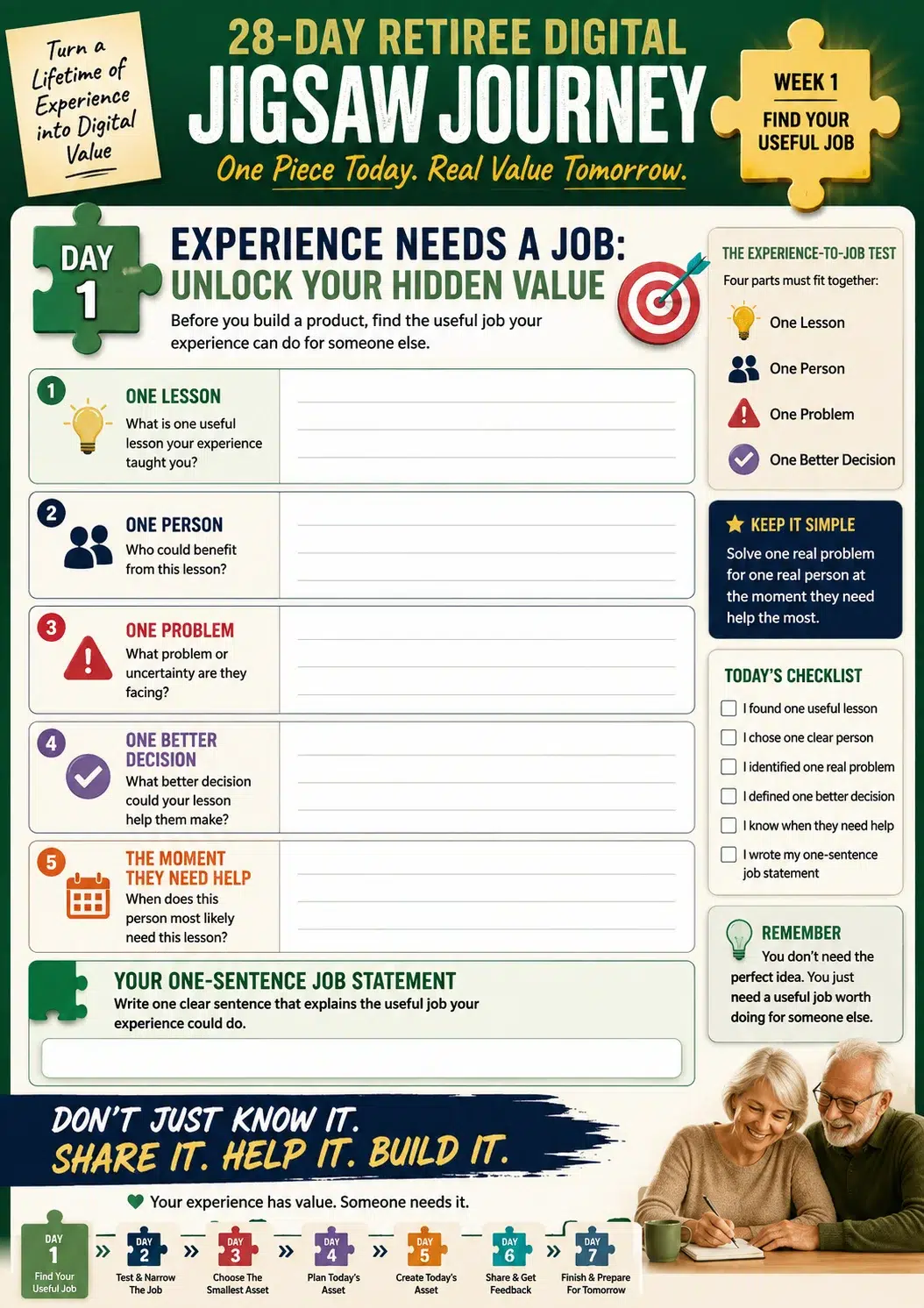
Your Printable 28-Day Jigsaw Journey Starts Here
Print or save the Jigsaw Worksheet below and keep it beside you as you work through the series. (Each day adds one small piece, one simple task and one finished result. Tick off your progress as you go, and by Day 28 you will be able to see how all the pieces fit together.)
A peculiar moment arrives when somebody decides they might create something online. They can have forty years of useful experience behind them, problems solved, mistakes survived, and shortcuts learned the expensive way, yet the first question that pops into their head is often, “What could I sell?” Within ten minutes they are thinking about ebooks, courses, websites, prices and whether a logo ought to be blue or green. The poor old experience that was supposed to make it worthwhile has barely shed its coat before somebody tries to turn it into a product.
We can make the beginning considerably easier. Forget the product for a moment. Before deciding what shape your knowledge should take, ask what job it could do for somebody else. Could something you learned help a person avoid a mistake? Could it clarify a confusing decision? Could it shorten a job that once took you hours? Could it help somebody know which questions to ask before spending money? That change sounds small, but it moves us away from trying to invent something impressive and towards finding something useful. And usefulness gives us a much better place to begin.
Stop Asking What You Can Sell And Find The Job
 Imagine a retired heating engineer sitting at the kitchen table trying to think of a digital product. “Heating” is enormous. Forty years of installations, repairs, quotations, customers, suppliers and regulations could disappear down a rabbit hole large enough to keep him occupied until his ninety-third birthday. He might decide he needs to write the Complete Homeowner’s Guide To Central Heating. Then comes research, chapters, diagrams, covers and the growing suspicion that retirement was supposed to involve slightly more sitting in the garden. The problem isn’t a shortage of knowledge. He started with far too much of it.
Now change the question. Instead of asking what product a retired heating engineer could create, ask what useful job one piece of his experience could perform. Perhaps he remembers how uncertain homeowners became when comparing replacement-boiler quotations. They didn’t necessarily need to understand the entire heating industry. They needed to know which questions would help them understand what they were being offered. Suddenly, forty years of experience has a much smaller job: help a homeowner ask better questions before accepting a quotation. We haven’t created the product yet. We have discovered why one might deserve to exist.
Your Experience Needs A Job With Four Clear Parts
This gives us a simple way to examine an idea before wasting time building it. Take one piece of experience and look for four things: one lesson, one person, one problem and one better decision. I call that the Experience-to-Job Test. The lesson is what life or work taught you. The person is somebody who hasn’t learned it yet. The problem is the uncertainty, mistake or frustration they are facing. The better decision is what your experience might help them do differently. If we can’t see those four parts clearly, choosing whether the finished thing should be a PDF, video, or checklist is getting ahead of ourselves.
Notice how different this is from asking AI for “ten profitable digital product ideas for retirees.” That sort of prompt can certainly produce ten tidy-looking suggestions. The difficulty is that the suggestions may have very little connection to what you genuinely know, who you could credibly help or why anybody would need the thing. The Experience-to-Job Test starts at the other end. We supply something real first. Only then do we use AI to help us inspect it. That keeps the machine working with our raw material instead of asking it to manufacture a pretend working life because we couldn’t think what to type.
One Lesson Is Easier To Use Than An Entire Lifetime
This is particularly important for retirees because experience rarely arrives neatly labelled. You probably didn’t spend your working life thinking, “I’ll save this lesson because one day it might become a downloadable PDF.” You learned to do the job. What once required concentration gradually became obvious. You learned which customer needed more explanation, which tool saved time, which warning sign deserved attention and which apparent emergency could wait until morning. After enough repetition, much of that judgement became automatic. And because it now feels ordinary to you, it is surprisingly easy to assume that it would be ordinary to everybody else.
That assumption can hide some of the best raw material. A retired bookkeeper may think checking an invoice for three particular mistakes is merely common sense. A first-time sole trader may not. Somebody who organised weddings for twenty years may instinctively know which questions expose a vague supplier quotation. A couple arranging their daughter’s wedding for the first time may be terrified of missing something. The opportunity isn’t created because the retiree knows everything about bookkeeping or weddings. It appears when one person knows something useful before another reaches the decision point where that knowledge matters.
Look For The Moment Before The Mistake Happens
One of the easiest ways to find that useful job is to stop searching for grand expertise and remember the moments when somebody used to ask, “What would you do?” Think about younger colleagues, customers, neighbours, family members or people starting a hobby you have enjoyed for years. What repeatedly confused them? Where did they spend money too quickly? Which mistake could you see coming because you had already made it yourself? Those moments are valuable clues because they reveal the gap between experience and uncertainty. We are not looking for proof that you are the world’s leading authority. We are looking for a problem you recognise earlier than the person currently facing it.
That gives us another useful test: find the moment before the mistake. A useful digital asset often earns its place immediately before somebody has to choose, buy, attempt, organise or avoid something. The homeowner has three quotations on the table. The beginner gardener is about to prune the wrong plant. The new caravan buyer is standing in a dealer’s yard. The newly retired hobbyist is buying equipment before knowing what is necessary. Experience becomes especially useful at these moments because the reader doesn’t want an encyclopedia. They want enough clarity to make the next decision without feeling completely in the dark.
Your Experience Needs A Job Before It Gets A Format
Only after we understand that moment should we start discussing what to create. The heating engineer’s useful job might eventually become a one-page quotation checklist. The gardener’s lesson might become a seasonal decision sheet. The caravan buyer may need a printable viewing checklist they can carry around. Another lesson may work better as a five-minute explanation or a simple article. The format follows the job. That is the opposite of deciding, “I’m going to create an ebook,” and then wandering through your memories looking for enough material to fill twenty pages. We aren’t feeding pages. We are solving one defined piece of uncertainty.
That’s today’s Jigsaw piece. We are deliberately stopping before the cover, PDF, sales page or price. By the end of today, we only need four things worth carrying forward: one genuine lesson from your experience, one person who could use it, one problem they face and one better decision your lesson could help them make. Tomorrow, those four pieces give us something solid to work with. Instead of asking AI to invent a business from nothing, we can put your real experience on the table and ask a much more useful question: what is the smallest thing we could build that would do this job properly?
Test The Job Before You Build The Asset
Once you have one lesson, one person, one problem and one better decision, the temptation is to start creating immediately. I would resist that for a few minutes. A useful idea becomes stronger when we test whether the job is specific enough. “Help retirees with money” is still too broad. “Help a newly retired couple compare three home-maintenance quotations without feeling rushed” is much easier to understand. The clearer the situation, the easier it becomes to create something useful later. Today we are not trying to prove there is a giant market. We are trying to make sure the job itself is real enough to deserve the next step.
This is where specificity becomes a friend rather than a restriction. Beginners often worry that narrowing an idea means losing people. In practice, the opposite can happen. The more clearly somebody recognises their situation, the more likely they are to pay attention. A general guide to “making better decisions” feels distant. A short guide for a first-time caravan buyer who is about to leave a deposit feels immediate. We are not reducing the value of the experience. We are making it easier for the right person to recognise when that experience could help them.
Your Experience Needs A Job With A Real Moment Attached
Another useful question is: when would this person need the lesson? Timing sharpens value. The lesson may matter before they buy, before they sign, before they repair, before they publish, before they choose a supplier or before they make a mistake that is hard to undo. If we can identify that moment, the eventual digital asset has a much clearer purpose. It is no longer general advice floating around the internet. It becomes something somebody might reach for at a particular point when uncertainty is high and a better decision matters.
Take the retired bookkeeper again. “Helping small businesses with invoices” is broad. But imagine the moment more precisely: a newly self-employed tradesperson is about to send their first proper invoice and is unsure what they may have forgotten. That moment gives the lesson a job. The bookkeeper’s experience could help the tradesperson avoid obvious omissions and feel more confident before pressing send. Whether the finished asset becomes a checklist, short guide or template comes later. Today, we identify the situation where the lesson earns its right to exist.
Use One Problem Instead Of Trying To Fix Everything
There is another trap worth avoiding. Once people realise their experience can help, they often try to solve the whole subject. The gardener wants to explain soil, pruning, watering, pests, seasons and tools. The retired manager wants to teach communication, leadership, recruitment and meetings. That enthusiasm is understandable, but it weakens the first asset. A beginner reader usually needs one useful answer before they need your entire life’s work. So choose one problem you can describe in a sentence. If the sentence contains three separate problems joined together with “and,” there is a fair chance you have more than one Jigsaw piece.
This single-problem rule also makes AI more useful. If you give an AI assistant a vague request such as “help me create something about gardening,” it has to invent the boundaries. If you say, “My lesson helps a first-time gardener decide what not to prune in early autumn,” the machine has something much more useful to organise. The human has supplied the judgement and the boundary. AI can then help clarify wording, suggest a structure or point out where the idea still sounds vague. The quality of the AI output improves because the human decision improved first.
Look For Evidence In Ordinary Conversations
You do not need formal market research to begin testing whether the job makes sense. Start with the evidence already around you. Have people asked you this question before? Did customers regularly misunderstand the same thing? Have family members or friends ever said, “How do you know that?” Do beginners in a Facebook group repeatedly ask something you learned years ago? These don’t guarantee people will buy anything, but they are useful clues that the uncertainty is real. We are simply looking for signs that the problem exists outside our imagination.
Search behaviour can help later, but ordinary conversations are often the quickest first filter. If nobody has ever asked about the issue, that does not automatically make the idea bad. It may mean the wording is wrong or the need is less obvious. But if you can remember five different people struggling with the same decision, pay attention. Repeated confusion is often a better starting point than a clever title. The strongest digital assets frequently begin with something very ordinary: “People keep getting stuck at this exact point.”
Separate What You Know From What You Assume
This matters because experience can make us overconfident without noticing it. We may know the lesson very well but assume too much about the person who needs it. We think retirees want a long PDF when they prefer a one-page sheet. We assume a beginner knows certain terminology when they do not. We believe the main problem is cost when the real problem is uncertainty. So today’s exercise should separate two things: what your experience tells you and what you are currently guessing about the reader.
That distinction protects the quality of what we build later. Your real experience is strong evidence for the lesson itself. It is not automatic evidence for how another person wants to receive it. This is where comments, questions and reader feedback become useful. We can create a sensible first version, put it in front of real people and learn from what they do. That is a calmer way to build than trying to predict every preference before anything exists. Experience gives us the starting judgement. Response gives us the refinement.
Your Experience Needs A Job AI Can Help Clarify
Now we can bring AI into today’s Jigsaw piece properly. The useful job for AI is not to tell you what career you had or manufacture a story you never lived. Its job is to help inspect the material you give it. Feed it the lesson, person, problem and better decision. Ask whether any part is too broad, vague or mixed with another problem. Ask it to rewrite the job in one clear sentence without adding claims. Ask it to identify what is known from your input and what it is merely inferring. That is AI working as an assistant rather than a ventriloquist.
This is especially helpful for beginners because clarity is difficult when the knowledge feels obvious to you. You may write, “I help people choose better equipment.” AI can respond that the person, equipment and decision are all still vague. You can then sharpen it to, “I help first-time hobby photographers choose which basic camera accessories they actually need before buying extras.” That sentence has a person, a situation and a decision. It is not a product yet, but it’s useful enough to guide someone.
Write The Job In One Sentence Before Moving On
By the end of today, I want the reader to be able to write one sentence that explains the job their experience could do. Something like: “My experience can help a first-time caravan buyer spot obvious warning signs before leaving a deposit.” Or: “My experience can help a newly self-employed tradesperson check their first invoice before sending it.” That sentence is more valuable than a fancy product name because it keeps us anchored to usefulness. If we cannot explain the job clearly, we are not ready to decide what to build.
There is also a practical reason for saving this sentence. Tomorrow it becomes the input for the next Jigsaw piece. We can give it to AI and ask a much stronger question: what is the smallest useful asset that could perform this job well? Because we have already thought it through, the machine no longer has to invent the audience, the problem or the purpose. It can concentrate on helping us choose the simplest useful format. That is how the Jigsaw builds. Each day leaves behind something solid enough for the next day to use.
Open to See This Video, And This Is What’s Already Built,
Trained & Waiting For Your First Command.
Your Apprentice Task: Finish Today’s Experience-To-Job Test
Write down your four answers now: one lesson, one person, one problem and one better decision. Then add a fifth line: when does this person need the lesson? Keep the answers plain. Do not try to sound like a marketer. If your person is “everyone,” narrow it. If your problem takes three sentences to explain, simplify it. If the better decision is unclear, ask what you would want the person to do differently after using your experience. The goal is not clever wording. The goal is a useful job you can recognise immediately.
Finally, write your one-sentence job statement and save it somewhere you can find tomorrow. That sentence is today’s completed Jigsaw piece. You haven’t built the PDF, checklist, article, or video yet, and that is deliberate. You did something more important first: you decided what the eventual asset should achieve. Tomorrow we can ask what the smallest useful thing is that can do that job. For today, if your experience has one clear lesson, one clear person, one clear problem and one clear better decision, the piece fits.
Your Apprentice Task gives you today’s job. The printable Jigsaw Worksheet below helps you actually complete it. Fill in today’s piece, keep your answers, and bring them forward because tomorrow’s lesson will build directly on what you write today.