
Build Trust With Blogging Using This E-E-A-T Guide
Why You Must Build Trust With Blogging After 60

It needs E-E-A-T.
That stands for Experience, Expertise, Authoritativeness, and Trustworthiness, and while it may sound like corporate jargon, it’s quietly reshaping who shows up on the first page of Google… and who disappears.
What It Really Means for Bloggers
If you’ve ever thought, “Why is no one reading my blog when I’m clearly more experienced than that top result?” you’re not alone. The answer may lie in this framework. Google now uses E-E-A-T to measure the quality of content and its source.
It’s not enough to write a great post about retirement income or low-carb cooking. Google wants to know:
- Did you actually live this?
- Are you the kind of person readers should trust?
- Do other websites or people refer to you?
- Does your site feel safe, human, and up to date?
It’s not just what you write, but also who they believe is behind it.
Building Trust With Blogging After 60
Here’s the beautiful part. This framework favours you if you’ve lived a bit.
Google is shifting toward content that reflects real-world experience. If you’ve been a teacher, builder, mum, investor, or simply someone who’s walked the road, your content can carry more weight than a 23-year-old SEO intern spinning summaries from Reddit.
But only if you show it.
That’s the kicker. E-E-A-T rewards people who tell their story, prove their background, and write with human detail. The kind that makes readers nod and say, “Yep, this person’s been there.”
Next: Section 2: How to Demonstrate E-E-A-T Without a Single Credential
How to Build Trust With Blogging Without Credentials
If the word “expert” makes you picture lab coats or framed degrees, let me offer a shift in perspective. E-E-A-T doesn’t mean you need a PhD to blog. What Google (and your readers) want to see is proof that you know what you’re talking about, and that proof comes in many forms.
Start With Your Lived Experience
Experience isn’t academic, it’s personal.
If you’ve spent 20 years managing family finances, you’re more qualified to write about budgeting than someone with an MBA who’s never missed a credit card payment.
So how do you show that?
- Tell real stories in your posts: a mortgage you paid off, a health journey, a business you ran.
- Use “I” language when it’s honest: “When I retired in 2017, I discovered…”
- Explain what didn’t work. Being open about failures builds more trust than pretending to have all the answers.
This isn’t bragging. It’s blogging with backbone.
Create an Author Bio That Feels Human
If your blog doesn’t include an author section, or it’s just a name in italics, you’re missing one of your biggest trust signals.
Instead:
- Add a headshot that’s friendly, not flashy.
- Include 2–3 lines about your experience, life or work that relate to your blog’s topic.
- Link to other posts you’ve written that demonstrate knowledge.
- Optional: Mention any places you’ve been featured (forums, podcasts, interviews).
Don’t hide behind a faceless blog. Show up as you, the person behind the words.
Use Stories to Build Trust With Blogging
Generic content is where good blogs go to die.
If your post says “Start budgeting by listing your expenses,” you’re not adding value. But if you say, “I started tracking my coffee habit and realised I spent £1,200 a year on takeaway lattes,” suddenly the reader leans in.
Details prove experience. Experience builds authority. Authority fosters trust.
Reference Others to Boost Your Own Trust Level
Even seasoned bloggers forget this part and cite others.
If you mention a fact, statistic, or product, link to the source. When you show that your ideas are grounded in something real, whether it’s a government report or a BBC interview, it tells readers you’re careful and connected.
And believe it or not, Google notices.
Why Experience Helps Build Trust With Blogging Takeaway?
E-E-A-T isn’t about proving you’re the smartest voice in the room.
It’s about showing up like a human, offering value from experience, writing with clarity, and doing the little things that say, “You can trust me.”
And the best part?
Most bloggers are still ignoring this.
Which means that if you start now, you have the advantage.
Hidden Ways to Build Trust With Blogging Today
You could write the best blog post of your life, packed with insight, experience, even a touch of humour, and still wonder why it’s not ranking. The reason? Google isn’t just reading your words. It’s scanning your site for signals that say: “This is a real person, with real knowledge, who’s worth showing to real people.”
Let’s unpack the invisible trust signals Google pays attention to, and how you can send them, even if you don’t know a line of code.
Signal #1: Secure, Human-Friendly Website Design
Let’s start simple. Is your website secure?
Look at your blog address, does it start with https or just http? That little “s” matters. Google gives preference to secure websites. Most hosting platforms, such as SiteGround and Bluehost, now offer free SSL certificates. It’s a one-time switch, and it’s worth doing.
Next, how human-friendly is your site?
- Can someone find your About page in two clicks or fewer?
- Does it load quickly on mobile?
- Are your fonts readable without squinting?
Google can’t feel how your blog feels, but it can measure bounce rates and page speed. These are subtle trust cues.
Signal #2: The Power of Your About Page
Most bloggers treat their About page like a throwaway. But it’s actually one of your most powerful E-E-A-T weapons.
Here’s what to include:
- A short narrative that explains who you are, why you started the blog, and what readers can expect.
- Personal touches, a photo, a mention of your dog, a quick story about why you’re passionate about your topic.
- A call-to-action (CTA), even if it’s just: “Start here with my most popular post.”
A good About page makes your blog feel alive, not anonymous. It’s the difference between a handshake and a shrug.
Signal #3: TDesign Choices That Build Trust With Blogging
You don’t need to be on the BBC to build authority, but Google loves to see your blog connected to the wider web.
You can:
- Get quoted in a roundup post (look for requests on LinkedIn or HARO).
- Leave thoughtful comments on blogs in your niche, with your name and site attached.
- Join forums or groups where your name appears alongside insights.
Each mention builds a web of trust, and Google’s spiders follow those threads.
You Don’t Have to Be Technical, Just Thoughtful
You don’t need to install plugins or learn schema markup (though that helps). You need to show that you’re:
- A real person
- With real insights
- Doing real things in the real world
That’s the soul of E-E-A-T. And most of your peers aren’t doing it, which makes it a massive edge if you do.
Next: Section 4 – Real-Life Examples of E-E-A-T in Action (What Google Loves to See)
Real Examples That Build Trust With Blogging
Sometimes the best way to understand a framework like E-E-A-T is to see it in action. So let’s look at a few real (and realistic) examples of how bloggers over 60 can implement E-E-A-T without reinventing the wheel.
These aren’t theories. They’re subtle shifts that help Google, and your readers, see your blog as a trusted voice in a noisy world.
Example 1: “I’ve Lived This” – “I’ve Read About This”
Let’s say you run a blog about downsizing in retirement.
One version of a post might read:
“It’s smart to declutter before moving. Start by sorting items into piles and donating what you don’t need.”
That’s fine… but it’s flat.
Now compare it with this:
“When we downsized in 2018, I had to part with 35 years of memories in one garage. I created three bins: Keep, Donate, and ‘Sit With It’; the last one helped me pause before tossing something meaningful. It worked wonders.”
Same advice, but packed with experience and authenticity. Google picks up on that specificity. So do readers.
Example 2: The E-E-A-T Author Page
Anne, a retired nurse, writes a blog about navigating the UK healthcare system. She includes:
- A short author bio: “Anne spent 25 years in the NHS as a matron. Today, she helps people understand medical letters and hospital pathways.”
- A warm headshot
- A link to a podcast interview where she shared her story
Her site isn’t fancy. But she’s real, and it shows.
Google gives weight to that kind of clarity.
Example 3: External Validation Without Big PR
George runs a blog about growing vegetables in retirement. He doesn’t have a book deal, but:
- He’s listed as a moderator in a popular Facebook gardening group.
- His “Guide to Balcony Tomatoes” is linked in three different blog comments on other sites.
- A local gardening club featured one of his tips in their email newsletter.
That’s enough for Google to see he’s not just writing into the void, he’s part of the conversation.
Example 4: Using “Trust Signals” Subtly
Mary’s finance blog has a homepage that includes:
- A friendly photo of her at her desk
- A short line: “As a retired accountant, I help others make sense of pensions and passive income.”
- A button that says: “Read my most honest post.”
She didn’t overthink it. But those elements combined scream trust. Not in a salesy way, in a human way.
Your Blog Is Already Enough – Personal Proof That Builds Trust With Blogging
Your blog has more credibility than you think. The issue isn’t the content; it’s the presentation.
Google needs to see who you are, what you know, and why you’re worth showing to others.
Your readers need to feel that, too.
And the best way to prove it?
Just be real.
Real stories. Real layout. Real presence.
You don’t need tricks. You need transparency.
Next: Section 5 – The Simple E-E-A-T Checklist That Elevates Every Blog Post You Publish
Your Checklist to Build Trust With Blogging Fast
By now, you’ve seen how E-E-A-T isn’t about showing off, it’s about showing up.
Consistently. Authentically.
But let’s make it even easier.
Here’s a straightforward checklist you can follow every time you hit “publish.” Think of it as a quiet ritual, a way to tell Google and your readers, “This post comes from someone who’s lived it.”
✅ 1. Use Your Voice, Not the Internet’s
Every post should sound like you, not like AI or someone else’s template.
If you’ve been through something, let it show.
If you’ve changed your mind about something, say so.
Google’s getting better at spotting generic posts. But more importantly, humans feel the difference. Write like you’re talking to a friend who trusts you.
✅ 2. Add a Real Author Box
Before readers scroll, make it obvious:
- Who wrote this
- Why they’re worth listening to
- Where can they learn more
If you’re not using one yet, even a simple “Written by [Your Name], [Your background]” at the top or bottom helps. Bonus points for linking it to your full author page.
✅ 3. Include Details That Only an Insider Would Know
Whether you’re writing about investing, baking, or mobility tips, add something only someone who’s been there would say.
That could be:
- A timeline (“When I tried this in March…”)
- A consequence (“That mistake cost me £420 over six months.”)
- A unique solution (“I used sticky notes on my freezer to track meals.”)
Details = depth. Depth = trust.
✅ 4. Internal Links Build Trust With Blogging
Don’t let great content live in isolation.
If you reference something you’ve written before, link to it.
This helps:
- Google build a map of your expertise
- Readers stay longer and get more value
- You quietly build topical authority without needing SEO jargon
✅ 5. Check the Little Trust Markers
Before you publish, ask:
- Is my site secure (https)?
- Is the font big enough to read comfortably?
- Is the layout uncluttered and welcoming?
- Does my About page feel human?
- Would I trust this if I stumbled upon it as a stranger?
If you’d say yes to that last one, you’re doing E-E-A-T right.
The Final Word: Don’t Be Polished, Be Present
In a sea of AI noise, Google and your readers are craving something simple:
A real person, sharing real value, in a real voice.
That’s what earns trust. That’s what ranks.
And if you’ve made it this far, that person… is you.
Now, here’s your final CTA as per Riley’s system:
👇👇👇
Want to Know My Real Advantage?
■ A multi-millionaire mentor who’s walked the walk and still shows up daily to guide us.
■ A like-minded community of over 600 people who understand the journey and have your back.
■ And my greatest digital ally… My AI PA, Riley, is on call daily, helping me write, build, and launch ideas faster than ever.
■ If you’re tired of guessing your way through digital income…
■ If you want something that works for people over 60, by people over 60…
■ If you want help, that helps… Then let me gift you the same first step I took:
👉 Get Your 5 Free Beginner Training Videos.
Why Build Trust With Blogging Is a Signature Move
There’s a moment in every blogger’s journey, often late at night, staring at a blinking cursor, where you wonder if what you’re saying even matters.
You’ve written the tips. Shared the story. Optimised the headline.
And still… silence.
It’s in that moment that E-E-A-T becomes more than a framework. It becomes your signature, the quiet proof that says: “This was written by someone who’s lived it.”
Not Everything That Ranks Is Worth Reading, But Everything Worth Reading Can Rank
Google doesn’t always get it right.
Sometimes you’ll see flimsy posts ranking above yours.
That’s okay. Because, over time, the algorithm evolves, increasingly favouring consistency, authenticity, and depth.
If you keep showing up with clarity, honesty, and warmth… your signature becomes unmistakable.
E-E-A-T becomes not just what you do, but how you’re recognised.
Your Readers Aren’t Just Skimming, They’re Listening for Truth
Most people online are tired.
Tired of being sold to.
Tired of being told to hustle.
Tired of cookie-cutter content with no soul.
What they’re quietly craving is:
- A moment of recognition
- A voice that feels familiar
- A post that doesn’t sound like it was written in a rush
That’s your edge.
Because you’ve lived a little longer.
You’ve seen what works and what doesn’t.
And when you write with that tone of reflection, readers don’t just scan your blog.
They bookmark it.
The Best Part? Telling the Truth Builds Trust With Blogging
You don’t need to chase hacks.
You don’t need a hundred plugins.
You need:
- A steady voice
- A structure that supports you
- A rhythm that says: “You can trust me to show up again.”
That’s what E-E-A-T truly offers, a slow, sturdy way to build trust that lasts longer than any algorithm tweak.
A Quiet Revolution, One Blog Post at a Time
So here’s your permission slip:
You’re not behind.
You’re not too late.
And no, you don’t need to write like a 22-year-old tech guru.
You need to write like you.
The lived-in version. The honest version. The version who’s quietly built a life of insight and resilience.
That’s the blog people come back for.
That’s the kind of content that builds a tribe.
That’s how you write yourself into the next chapter, with authority, trust, and just the right touch of grace.
Where to Build Trust With Blogging and Grow Faster
If you’re reading this and nodding along, recognising that blogging with trust, voice, and experience matters, you might be wondering: “What next?”
It’s one thing to learn the mechanics of authority…
It’s another to actually build it, day in, day out, without feeling isolated.
Here’s the truth:
You don’t need more tools.
You need the right table to sit at.
That’s where something called the Affiliate Marketing Underground Community quietly changes the game for people like us.
Real Support, Not Another Sales Pitch
Inside this private community, the focus is simple:
- Get your traffic, leads, and results… without guesswork.
- Surround yourself with people who respond, not just observe.
- Offer actual momentum, in language and formats that respect your time and your age.
No fluff. No overwhelm. Just real support, real shortcuts, and a business path that actually breathes with your lifestyle.
Here’s what I’ve found on the inside:
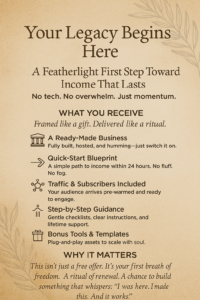
- ✅ Pre-built traffic and lead flows – so you don’t have to wrestle with funnels or Facebook.
- ✅ Clear growth roadmaps – laid out step by step, toward consistent £10K+ months.
- ✅ Checklists that cut the noise – ideal for those who want action, not theory.
- ✅ Direct intros to marketers who’ve walked the path – not social media celebrities, but proven practitioners.
- ✅ Genuine peer accountability – people who listen, share, and support, without ego.
It’s not just a learning space. It’s a launch space.
Communities That Build Trust With Blogging: Why It’s Different, And Who It’s For
 There’s a reason this isn’t splashed all over ads.
This isn’t for everyone.
It’s designed for those who’ve tried on their own, got close, and know they could go further, with the right people in their corner.
If you’re over 50 or 60 and you’ve felt:
- Behind the curve
- Tired of free Facebook groups that never reply
- Invisible in online spaces filled with 20-somethings selling hustle…
This is a space that honours your pace, your values, and your goals.
Because here’s the truth: Profit is great. But legacy matters more.
Legacy is what happens when you create something that whispers:
“I made this. It changed my story. And it works.”
That’s what this community cultivates.
And that’s why I recommend it.
The Quiet Doorway You Might’ve Been Waiting For
No pressure.
Just a quiet invitation.
If this feels aligned—grounded and honest, not flashy or hyped—then perhaps it’s time to explore.
The Affiliate Marketing Underground community isn’t open to everyone. That’s intentional.
But if you’re someone who builds slow and strong, who values clarity over chaos, there’s room for you.
🔗 Click here to request access – and see if this doorway is yours.
#BuildTrustWithBlogging, #IncreaseBlogReaderTrust, #RankBlogUsingEeat, #ExperienceBasedBlogWritingTips, #BecomeTrustedBlogExpert, #EeatBloggingChecklist, #SeoTipsForBloggers, #GoogleTrustSignalsGuide, #RaiseBlogAuthorityNow, #TrustSignalsForBlogs, #HowBloggersBuildTrust, #ContentThatBuildsTrust,
How to Get your First 100 Backlinks – Vitality And Prosperity Health Wealth for 55+