Why Familiar Faces Build Trust Through Consistency
People begin to remember you when your appearances become familiar rather than occasional.
Build Trust Through Consistency Without Posting Everywhere
You do not need to be on every platform; you need to become reliably useful somewhere.
Quiet Reliability Helps You Build Trust Through Consistency
Trust grows when readers repeatedly discover the same useful standards behind your work.
Build Trust Through Consistency: Proven Ways To Get Noticed
People rarely trust someone because of one clever post; they start trusting the person who keeps showing up with something useful.
Your future customer may be watching for much longer than you realize before they ever click, comment, or say hello.
By nine o’clock in the morning, the internet had already declared three marketing methods dead, introduced two replacements, and produced a cheerful young fellow explaining why anyone who had not changed direction before breakfast was being left behind. Somewhere, another artificial intelligence tool was promising to write a month’s content before the toast popped up. Another email announced a closing deadline which, judging by the identical email sent last month, appeared remarkably reluctant to close. This is the atmosphere in which an ordinary beginner is expected to build trust.
Not simply learn a few digital skills, publish something useful and gradually improve, but somehow keep pace with a marketplace that behaves as though standing still for forty-eight hours is a commercial emergency. Then comes the inevitable disappointment. Yesterday’s Facebook post did not set the world alight. The Reel received a handful of views. The article took hours to finish, and nobody has written to say it changed their life. That is the moment when the temptation to start again becomes strongest. New niche. New page. New software. New plan. Yet there is another possibility, far less glamorous and considerably more useful. Perhaps nothing has gone wrong. Perhaps the audience is simply doing what sensible people have always done before trusting a stranger. They are watching.
Most Of Your Audience Will Watch Before They Speak
Marketers love visible numbers because visible numbers make excellent screenshots. Likes can be counted. Views can be celebrated. Comments create the satisfying impression that somebody is listening. But some of the most important people in the audience may not do any of those things at first. They are the silent readers. Monday morning, they notice a post. Tuesday, they see your name again underneath a useful answer. On Thursday, they recognized the photograph next to another article. The following week, they watch half a video, visit your profile, and quietly disappear again. From your side of the screen, absolutely nothing seems to have happened. From theirs, a judgment slowly forms.
Does this person always sell something?
Does the advice make sense?
Will they still be talking about the same subject next Tuesday?
Are they genuinely trying to help, or are we merely being marched towards another checkout button? That is why trying to Build Trust Through Consistency is so different from trying to manufacture attention. Attention can be borrowed with a dramatic headline. Trust has to survive what happens after the headline.
A reader may need to see you five, ten, or twenty times before your name moves from “somebody on Facebook” to “that person who usually explains this stuff clearly.” No notification announces when that change occurs. It simply grows through repeated evidence.
Consistency Does Not Mean Becoming A Content Factory
This is where the word consistency has been badly abused. Tell a beginner to become consistent, and they may imagine they have just been sentenced to Facebook at breakfast, LinkedIn before lunch, YouTube after tea, three emails before bed, and a weekend producing inspirational quotations for platforms they hadn’t heard of until Tuesday. That is not a business plan. It is an excellent way to make retirement feel suspiciously like going back to work. Consistency does not mean being everywhere. It means becoming predictably useful somewhere.
One worthwhile Facebook post. One proper article. A Reel when there is something worth showing. A sensible reply when somebody asks a real question. Then do it again. Not identically, and certainly not mechanically, but often enough for people to recognize the thread joining the work together. Yesterday we talked about learning a new digital skill without trying to swallow the entire internet. This is where that lesson begins earning its keep. Learn how to publish one useful Reel, then publish another when appropriate. Learn how to answer questions in a community without barging in with an affiliate link, then answer another. Discover how to create a simple PDF, then find the person it actually solves a problem for. The skill improves with practice. At the same time, the audience starts seeing evidence that you didn’t disappear after the first burst of enthusiasm.
People Remember The Ones Who Keep Turning Up
The reliable tradesman, shopkeeper, café owner, or local business earns a reputation without needing to announce every morning that they are building a personal brand. People know what to expect. The door opens. The telephone gets answered. The job gets done. Problems are dealt with rather than hidden under clever language. Online business sometimes makes ordinary reliability sound hopelessly old-fashioned, yet human beings have not changed nearly as quickly as the software surrounding them. We still notice who keeps their word. We notice whether somebody answers before or after the sale.
We remember the person who admitted they did not know the answer rather than inventing one. We notice when every recommendation mysteriously pays the person recommending it. And we certainly notice when somebody who was shouting about a wonderful new opportunity three weeks ago has already vanished to promote the next one. A quieter operator has an advantage here. They do not have to win the argument in one post. They can allow familiarity to do some of the work. Each useful appearance becomes another small piece of evidence. Not proof that they are perfect, nor proof that every suggestion will be right, but evidence that they are serious enough to keep showing up. That is a far sturdier foundation than trying to impress a stranger into trusting you before they have had time to decide who you are.
Your Message Becomes Stronger When You Stop Reinventing It
Consistency has another hidden benefit. You become clearer. When you first start explaining what you do, the words tend to wander around looking for somewhere comfortable to sit. One day you describe yourself one way, the next day another. You try a clever phrase somebody recommended, find it doesn’t sound remotely like you, and quietly replace it. That is normal. Repetition sharpens the message. Questions from real people sharpen it further. If the same confusion appears in three comments, explain it more simply next time. A Reel gets a response you didn’t expect, so tomorrow’s article tackles that point properly.
Somebody asks what you mean by “digital value,” giving you a chance to explain it without marketing language. Eventually, the audience begins to recognize not only your name but also your point of view. That is when consistency stops being a publishing schedule and becomes part of your identity online. The important thing is not to keep producing material merely because the calendar says Tuesday. It is to keep the useful conversation alive. Some days may deserve a full article. On the other hand, one thoughtful Facebook answer may do more good. The purpose isn’t volume for volume’s sake. It is to give the person watching quietly from the back enough evidence to think, “They were here yesterday, they’ve helped again today, and I suspect they’ll still be here tomorrow.”
Today’s Facebook Fishing Question
That gives us today’s question, and it’s worth listening to carefully because it turns the whole subject on its head. Instead of asking what marketers think creates trust, ask the people on the receiving end: When you follow somebody online, what eventually makes you trust what they say? Is it seeing them turn up regularly? Watching how they answer ordinary questions? Seeing them admit when something has not worked? It’s the relief of finding somebody who can talk about online business for ten minutes without turning every conversation into a sales pitch.
Those answers are useful because they reveal what people actually notice while we are busy staring at analytics. And that is our job today. Look back over the last few things you have published and forget the numbers for a moment. Ask whether a stranger seeing those pieces together would understand what you are trying to help people with. If they would, resist the urge to reinvent everything. Come back tomorrow and make the message a little clearer. Because trust seldom arrives with a fanfare, Marra. More often it arrives quietly, after somebody has watched you doing useful work for long enough to believe you might actually mean it.
Trust Is Often Growing While The Numbers Look Dead
There is a cruel little trick built into online work: the period when you most need encouragement is often the period when the screen gives you almost none. You publish something useful, and the numbers barely twitch. You answer a question properly, and nobody replies. A carefully made video disappears into Facebook with all the ceremony of a brick dropped into the North Sea. Meanwhile, someone else posts a dancing dog and racks up twelve thousand views before lunch. It is enough to make any sensible person wonder whether they have misunderstood the entire internet.
Yet this is precisely where measuring only the visible response can lead you badly astray. A future reader may have seen three of your posts without clicking anything. Another may have saved a useful idea and forgotten where it came from until your name appears again next week. Somebody else may have visited your website, read half an article, and gone away to think. None of them owes you a public reaction while they are deciding whether you are worth their attention. Build Trust Through Consistency, and let that decision happen at the reader’s pace rather than demanding proof after every post. Quiet days aren’t necessarily empty days. Sometimes they are simply the days when familiarity is accumulating in ways the dashboard cannot see.
The Sale Usually Starts Long Before Anybody Reaches The Button
We often describe an online sale as though it began when somebody clicked a link. In reality, the interesting bit may have started much earlier. Perhaps they first noticed you answering a beginner’s question without trying to sell anything. A few days later, they saw another post and recognized the name. Then came a short video that explained something they had been struggling with. By the time an offer finally appeared, they were no longer meeting a stranger. They had already formed an opinion. That is why a hard sell can sometimes signal that the groundwork hasn’t been done. If every piece of trust must be manufactured on the sales page, the sales page has an enormous job.
But when useful content, honest answers, and repeated appearances have done their work beforehand, the eventual recommendation feels less like an interruption. The reader already understands how you think. They have seen whether you exaggerate. They know whether your explanations help. None of that guarantees a sale, of course, and it should never be treated as if it does. What it does is remove some of the uncertainty. And in a marketplace where people have been promised everything from instant riches to effortless businesses built before breakfast, reducing uncertainty can be far more persuasive than another row of flashing buttons.
Consistency Also Means Staying Consistent With The Truth
Another side has nothing to do with posting frequency. You can publish every morning at precisely eight o’clock and still fail to build trust if the message changes to whatever pays the best commission that week. Consistency is also about standards. If you told readers yesterday there were no shortcuts, you cannot suddenly discover a miraculous shortcut on Thursday just because the affiliate percentage looks attractive. If you encourage beginners to take one manageable step at a time, your recommendations shouldn’t bury them under seven pieces of software they apparently need immediately. People notice those contradictions.
They may not challenge them in the comments, but they notice. The opposite is also true. When somebody hears the same sensible principles appearing in different situations, a pattern forms: help first. Keep the human judgment in charge. Learn the piece you need. Do not pretend every new tool is compulsory. Finish useful work. Come back tomorrow. Those ideas become recognizable because they survive from one post to the next. That is when a collection of articles begins becoming a point of view. And a clear point of view gives the audience something far more useful than endless novelty: they begin to know what you are likely to say before you say it.
Your AI PA Can Help With Consistency Without Manufacturing A Personality
Artificial intelligence can certainly make regular publishing easier, but it also needs boundaries. Ask AI to create thirty random posts, and it will happily oblige, often producing thirty different versions of somebody you hardly recognize. Give it your finished article, your audience and one clear purpose, and it becomes far more useful. You might say: “Take the main lesson from this article and create one Facebook post that sounds calm, practical, and useful to an older beginner. Keep the same message, do not add claims or results I have not supplied, and finish with one genuine question.”
That is not handing your voice to the machine. It is asking the machine to carry the same idea into another format while you supervise the result. The human still decides what matters. The human still removes anything that sounds false, exaggerated, or unlike them. Used that way, AI can reduce the repetitive part of consistency without turning consistency into automated wallpaper. The goal is not to appear every five minutes because software makes it possible. The goal is to make sure that when you do appear, the reader meets roughly the same useful human being they met last time.
The Graft Way Is Almost Embarrassingly Simple
If money is tight, you don’t need to buy anything to practice this. Choose one place where the people you want to help already spend time. Decide on a rhythm you can genuinely maintain. Then become useful there. One post. One thoughtful comment. One answer. One follow-up. Keep a small notebook if necessary and record what you published, what question it addressed, and what response came back. Do not turn the exercise into a spreadsheet worthy of the Treasury. You are simply looking for signs of recognition.
Did somebody ask a second question?
Did an old reader return?
Did somebody mention that they had seen yesterday’s post?
Did a person visit the page after remaining silent for several days?
Those small signals matter because they show that you are beginning to occupy a little patch of somebody else’s memory. And if very little happens at first, resist the temptation to scatter yourself across another six platforms. One of the strongest ideas from this entire seven-day run has been the importance of concentration. One useful job. One useful audience. One useful conversation. Consistency gives each of those enough time to become something rather than abandoning them just as the roots start going down.
The Investment Way Should Make Showing Up Easier
Paid tools earn their place when they remove friction from a process that is already worth repeating. Scheduling software may help if publishing manually is causing good posts to be forgotten. A reliable email service can help you continue a useful conversation away from social media. An AI tool may shorten the repetitive work involved in repurposing one finished lesson into several formats. Those can all be sensible investments. But before opening the wallet, ask a useful test: Will this tool help me keep doing something valuable, or is it giving me an excuse to start doing something completely different?
The distinction is worth money. A tool that saves twenty minutes from a job you perform every day can be valuable. Another dashboard promising an entirely new strategy may interrupt the strategy that had finally begun gaining traction. Technology should strengthen the habit of turning up, not become the latest reason you disappeared for a fortnight while learning another system. The machinery can change. The promise to the reader should remain remarkably ordinary: when you return, there will be something here worth your time.
Now you know how to unlock AI secrets. Are you ready to sell your first product online?
Join Unlock AI Secrets with Michael Cheney’s Top Apprentice now: a marketing journeyman, Alan Skinner, who is now allowed to share 5 FREE Videos that provide step-by-step guidance from a master digital product creator and hands-on Unlock AI Secrets mentorship to unlock our secret, like-minded apprentices’ community!
I can’t believe I’m admitting this, but I’ve been missing out on some incredible online offers lately, and it’s driving me crazy! I don’t want you to miss out on these opportunities and experience the frustration that comes with it.
The other day, I stumbled upon a deal too good to pass up. But guess what? I completely overlooked it, and now I’m kicking myself.
It’s a lesson I don’t want you to learn the hard way. While scrolling through my emails, I half-heartedly glanced at the subject lines, and there it was, a golden opportunity just waiting for me. I thought I had it all under control, but I dropped the ball big time.
Tomorrow’s Small Step Is What Makes Today’s Trust Believable
Consistency has no grand finale, because that would defeat the point. You don’t finish on Tuesday and announce that trust is complete. You give Wednesday something to build upon. That brings us neatly to the final day of this first seven-day experiment. We began by moving forward without pressure. We learned slowly rather than restarting. We gave AI a clearer job. We went looking for people who actually care. We learned the skills required for the work in front of us.
Today we have reached the point where all those things begin to come together: keep turning up long enough for useful work to become familiar. Tomorrow we reduce the whole journey to its simplest principle: Take Simple Steps Daily. Not because small steps make a dramatic sales headline, but because repeated small actions are how a beginner stops being somebody who is always preparing to build and quietly becomes somebody who has built something.
Apprentice Task
Choose one useful thing you can reasonably keep doing for the next seven days. It might be answering one genuine question, publishing one short lesson, making one Reel, improving one existing page, or starting one useful conversation. Keep it small enough that you don’t need motivation, a new piece of software, or perfect conditions to begin. Then decide what “done” looks like and turn up tomorrow to do it again. At the end of the week, do not judge yourself only by likes, views, or sales.
Look for something more important: are you clearer, quicker, and more confident at the job than you were seven days earlier, and has anyone begun to recognize what you are trying to help them with? If so, something is already working. Because the real purpose of Build Trust Through Consistency is not to make more noise, it is to become the useful person who is still there after everybody else has finished shouting.

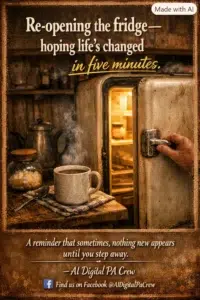 Marketers love visible numbers because visible numbers make excellent screenshots. Likes can be counted. Views can be celebrated. Comments create the satisfying impression that somebody is listening. But some of the most important people in the audience may not do any of those things at first. They are the silent readers. Monday morning, they notice a post. Tuesday, they see your name again underneath a useful answer. On Thursday, they recognized the photograph next to another article. The following week, they watch half a video, visit your profile, and quietly disappear again. From your side of the screen, absolutely nothing seems to have happened. From theirs, a judgment slowly forms.