Build Your Selling Roadmap Before You Build Another Product
A useful product is only one room in the house. Make sure the buyer has a clear route to it.
Map The Buyer Journey Before You Add More Digital Assets
Every post, page, and button should move the reader towards a single, clear next step.
Build The Route Before You Decorate The Workshop
Movement matters more than adding another bonus, graphic, or clever tool.
From Apprentice To Tradesperson Starts With One Visible Route
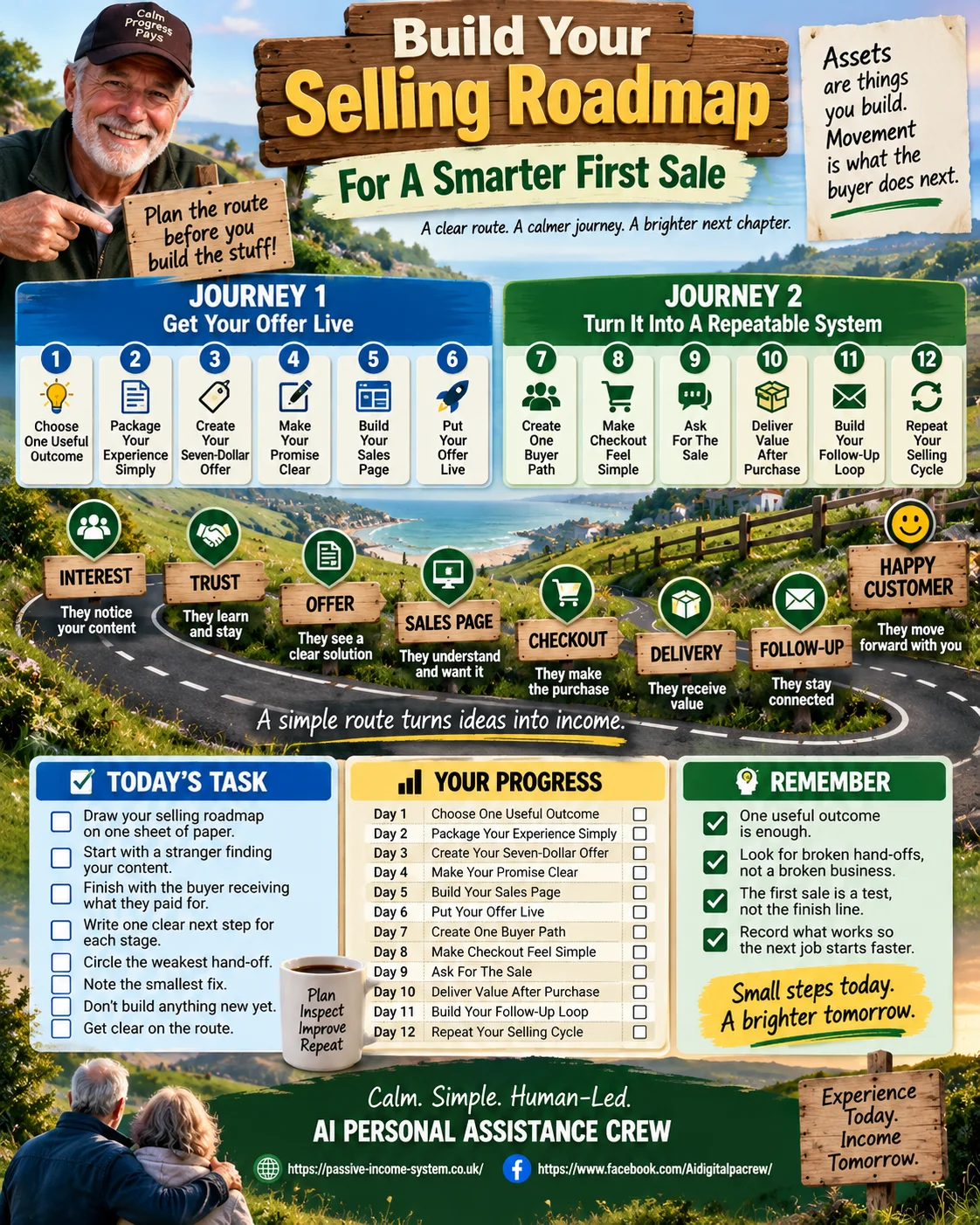
The next twelve working days are not twelve unrelated lessons. They are two connected journeys designed to leave the reader with a real selling system they can inspect, improve, and use again.
There is a distinctly British moment when you discover a project has failed. After days of effort, tea, and sharper language, you notice the door is missing. Digital business repeats this pattern: we build the ebook, design the cover, and create three graphics. You open a Facebook page, write seven emails, and buy another clever AI tool; YouTube says it will change everything. By Friday, the workshop is full of finished parts. Yet a stranger asks how to move from interest to purchase. That is why today’s job is to build your selling roadmap. Before we build another bloody thing. The goal is clarity and momentum, not noise.
One lesson took time to recognise online because I understood it elsewhere. As a heating engineer, you did not install the upstairs radiator first because it looked impressive. You traced the route: boiler, pipework, controls, radiators. Each part had a purpose and passed value to the next.
Build Your Selling Roadmap Around One Paid Destination
Beginners are urged to keep expectations modest at the start. The material stresses a gradual path rather than pursuing grand dreams. The material notes a product ladder, upsells, memberships, webinars, email automation, and affiliate offers, but none of them guarantee success if an ordinary person cannot move from interest to a small paid decision. A staged approach is therefore advised, with a focus on early traction.
The six‑day plan begins with narrowing, not widening. Choose One Useful Outcome, because a product is easier to explain with a single clear job. Then package Your Experience, shaping what the Gaffer knows into a form others can use. After that, create Your Seven-Dollar Offer, turning a free idea into a real paid proposition.
The Second Journey Begins Where Most First-Sale Advice Stops
Our roadmap becomes more interesting than the common advice to create a product and launch it. Getting an offer live ends the “nothing” phase; it lets us inspect something real. A boiler fitter would not stay popular if the flame lasted only three seconds. We test the system by asking questions such as: Does hot water reach the tap? Does the downstairs warm up?
Is there an airlock somewhere? Has someone fitted a valve backward while insisting it looked right at the time?
The last two roles reveal the beginnings of residual-income thinking. We will build your follow-up loop so a buyer who found something useful does not vanish because no one planned what happens next. On the final day of the month, we repeat your selling cycle.
The goal is to create continuity, not a one-time sale, and to document what works for future steps. When you build a selling roadmap, you document a method that can carry the next product, and the one after that, without starting from scratch each Monday.
A trade is not a hobby with expensive stationery; it is a process. A tradesperson keeps the drawing, knows which tools worked, where delays occurred, and which parts can be reused or changed for the next customer.
Build Your Selling Roadmap From Movement, Not More Stuff
That distinction should guide us through September. Assets are what we build to support outcomes. Movement describes what the buyer does next after engagement. An insightful article that leaves readers stuck is an asset lacking movement. A compelling sales page that nobody visits is an asset without movement. A useful product buried three menus deep remains an asset without movement. Over the next twelve days, we must reconnect the steps. We seek a practical outcome to offer. Move from offer to sales page, then to checkout. From checkout, deliver the product and follow up. Each phase should give a willing reader a clear next step. A business thrives when customers see the logical path forward, not when momentum ends in silence.
So today’s Apprentice Task is deliberately different from the days ahead. Do not create anything yet. Take one sheet of paper and Build Your Selling Roadmap as a simple line from left to right. Start with a stranger discovering something useful. Finish with that person receiving something they willingly paid for. Between those two points, write only the steps you believe are genuinely necessary. If you find yourself adding webinars, bonuses, memberships, twelve-email sequences, and three upsells before you have drawn the first buying path, put the pen down and make a cup of tea. Tomorrow we start building the first piece properly. Today we make sure we know where the bloody road is going.
Build Your Selling Roadmap Around The Hand-Offs
At some point in almost every job, parts stop being the problem and the joins become the problem. The boiler works. The pump works. The radiator works. Yet heat can fail to reach its destination between components. Digital selling has similar misdirections. The article may be perfectly decent, and the offer may be useful. If a reader reaches the bottom of a page with no obvious reason to continue, the route has developed a cold spot. The next part of Build Your Selling Roadmap focuses on inspecting hand-offs, not on creating more material.
Does the useful article lead naturally to the offer?
Does the offer continue the promise made in the article?
Will the sales page keep the journey seamless, or does it feel like a new path started without warning? A selling system becomes reliable when every stage knows what it hands to the next.
This is where a quiet page stops being frightening. If nobody buys, beginners assume the product has failed. That is like finding a cold radiator and ordering a boiler before checking the valve. Once the route is visible, silence becomes information. People may read the content but never click to the offer. The weak connection is probably earlier than checkout. People may reach the sales page but disappear before payment. That is a different hand-off and a different job. Buyers pay successfully but then email questions about the download. The problem sits after the sale. Each failure is smaller than “my online business does not work.” You can inspect and fix small failures. That is a real advantage of building your selling roadmap before scaling. You can see where movement stopped.The First Seven-Dollar Sale Is A Test Of The Route
That is why I don’t see the first seven-dollar sale as the finish line. It is more like the first time you switch the system on after installation. You hear the boiler fire. Good. That is encouraging. But nobody sensible packs the tools away yet. Does the water circulate? Do the radiators warm evenly? Does the thermostat actually control anything? The sale tells us a real person moved from interest to payment. That is useful evidence. It means the route can work. But the bigger value is what we can now inspect. Where did that buyer first find us? Which article or post did they see? What made them click? Was the product clear enough without a dozen explanations? Did checkout feel straightforward? Did delivery happen as promised? The seven dollars is the receipt. The real asset is the working route we have just tested.
And even if the first sale does not arrive immediately, the roadmap still earns its keep. Suppose a hundred people see a Facebook post and twenty click to the article. Good, movement exists. Suppose ten reach the offer, but none click the buy button. That gives us a much sharper question than “Why am I not making money?” Perhaps the promise is unclear. The product may not feel different enough from the free content. The page may introduce three different next steps, and the reader chooses the easiest one: leaving. None of those diagnoses requires a new business model. They require an inspection. The trouble with working without a map is that every silence sounds like complete failure. The advantage of Build Your Selling Roadmap is that silence begins pointing to a location.
Build Your Selling Roadmap So Each Fix Stays Small
Online marketing has a dangerous habit that rewards demolition. A post performs poorly, so the headline, niche, offer, website, and brand colours are put to the test. A sales page produces nothing in three days, so someone assumes the audience is wrong. That is exhausting for anyone, but especially for the retiree who came online for a useful project rather than another full-time reinvention.
This also protects the good parts of the job. If Derek has helped build a useful product, we should not throw Derek’s work in the skip because Peter’s sales page has a confusing button. If Freddy has brought the right people to the page, we should not blame traffic because the offer itself has wandered off message. When the Crew is organised around a roadmap, you can judge each lad’s output by the movement it is supposed to create. Build the asset. Sell the asset. Get the asset found. Then inspect the joins. That is a much calmer way of working than asking all three lads to rebuild everything whenever a number looks disappointing.
The Second Six-Day Journey Teaches The Trade
The first six days of this new roadmap get the offer onto the bench and into the world. The second six days are where the apprenticeship begins to look more like a trade. Creating One Buyer Path forces us to connect the content to the offer, rather than hoping the reader will somehow find their own way. Make Checkout Feel Simple teaches us that payment is part of the customer experience, not an inconvenient technical cupboard we lock at the back of the site. Ask For The Sale sounds almost laughably obvious, yet plenty of helpful people will explain a product beautifully, only to become mysteriously shy at the exact moment they need to invite the reader to buy. Deliver Value After Purchase reminds us that the money arriving does not cancel the promise. It activates it.
Then we reach the two jobs I think matter most for the longer game. Build Your Follow-Up Loop means the first buyer does not become a stranger again five minutes after purchasing. Follow-up does not have to mean pestering somebody every morning with another offer. It can mean helping them use what they bought, answering the obvious next question, sharing another relevant resource or simply staying visible enough that the relationship doesn’t evaporate. Finally, Repeat Your Selling Cycle asks the question that separates one-off online activity from a genuine residual-income skill: which part of this job can we reuse? The page structure? The product template? The trust signal? The email? The delivery process? The lesson learned from the failed hand-off? A tradesperson does not throw away the drawing after finishing an installation. The drawing is part of what was earned.
Build Your Selling Roadmap So The Next Job Starts Ahead
That is what the end of September is really working toward. Not a promise that every reader will have earned seven dollars by a particular Tuesday. Markets don’t obey our editorial calendar, and we shouldn’t pretend otherwise. The successful outcome we can control is different. By the end of the journey, the reader can have one useful offer, one visible route to it, one clear buying step, one working delivery process, and one record of what happened. That is already a different person from the one who started by wondering which AI tool to buy. They have moved from collecting information to running a small job. They know what finished looks like. Readers understand the handoff between parts. Readers know where to look when things stop moving.
And the next idea no longer arrives at an empty workshop. It lands on a bench with a drawing beside it. The Gaffer can say, “Right. Last time we built the useful thing this way. We sold it through that route. This part worked. That part caused trouble. Keep the good. Repair the weak bit. Off you go.” That is how repetition becomes capability. It is also how a hobby begins acquiring the bones of a trade. So when you Build Your Selling Roadmap, do not measure its value solely by whether a single buyer reaches the end. Measure whether the roadmap leaves you better prepared to build the next route.
Today’s Apprentice Task: Draw The Route And Circle The Weakest Join
Take the simple roadmap you drew in Section 1 and review every handoff between stages. Useful content to trust. Trust to offer. Offer to sales page. Sales page to checkout. Checkout to delivery. Delivery to follow-up. Beside each join, write one sentence describing exactly what the reader should do next. If you cannot write that sentence clearly, circle the join. That is not failure. That is the job revealing itself. Do not build anything new today to hide it. Do not add another tool. Avoid redesigning the entire website because one connection looks untidy. Build Your Selling Roadmap, find the weakest hand-off, and write down the smallest repair that would make the next movement obvious.
Tomorrow, we stop staring at the drawing and begin the first six-day build. One useful outcome. One real piece of experience. One small paid destination. The road is now visible. The apprentice finally knows where the tools are going.
Open to See This Video, And This Is What’s Already Built, Trained & Waiting For Your First Command.
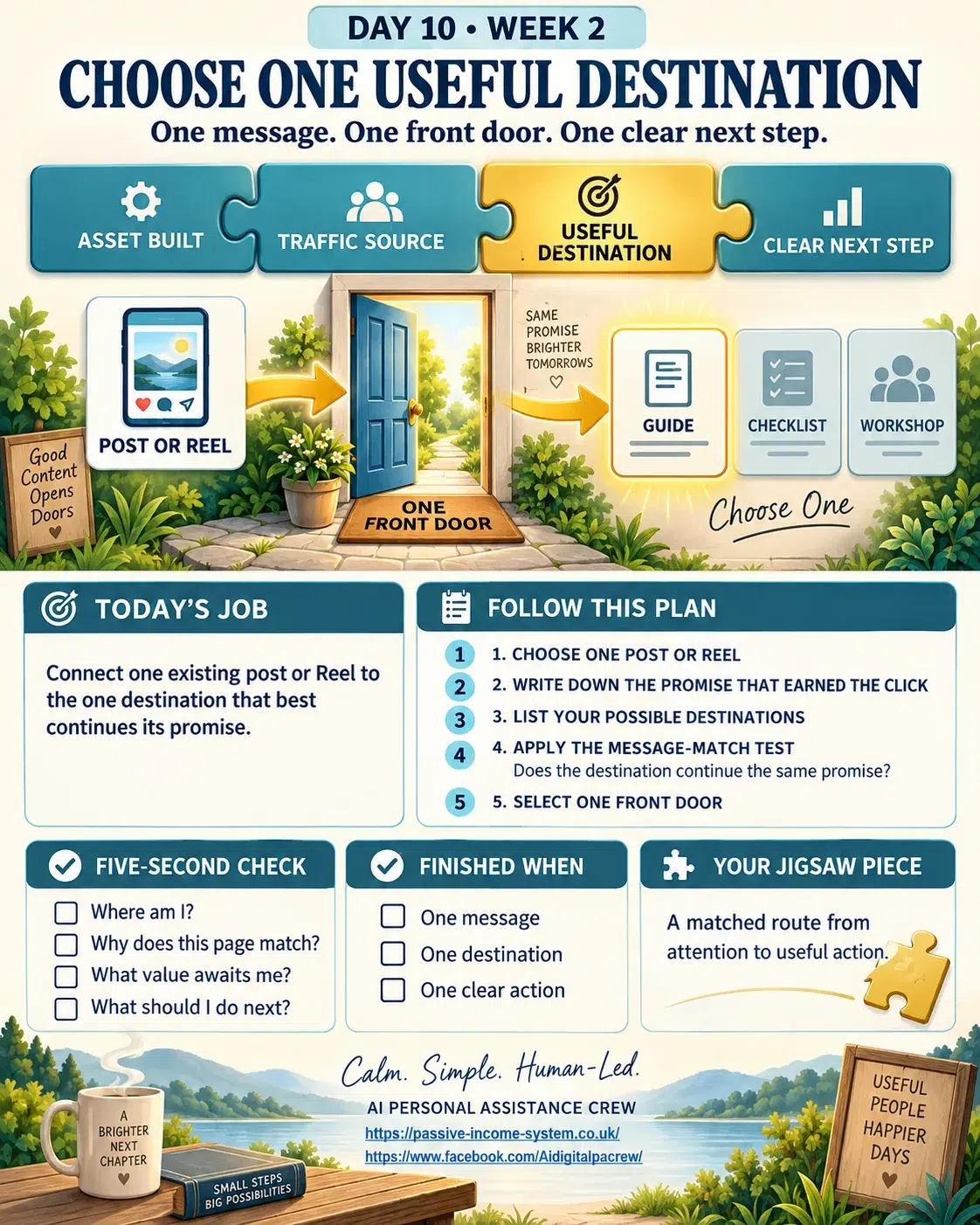
Today’s Apprentice Task: Build One Front Door
Before You Build Another Product, Build Your Selling Roadmap
A useful product is only one room in the house. Before you choose the curtains, make sure there’s a hallway leading someone to the front door.
Before Filling The Workshop With Assets, Map The Buyer’s Journey
The first sale becomes much easier to understand when every page, post, and button has one clear job in moving the reader forward.
Build Your Selling Roadmap For A Smarter First Sale

 Our roadmap becomes more interesting than the common advice to create a product and launch it. Getting an offer live ends the “nothing” phase; it lets us inspect something real. A boiler fitter would not stay popular if the flame lasted only three seconds. We test the system by asking questions such as: Does hot water reach the tap? Does the downstairs warm up?