Choose One Useful Lesson
Small lessons make lifetime experience easier to teach and easier to use.
Why One Useful Lesson Works
Beginners need one clear change, not your whole working history.
Turn Experience Into Action
Choose the lesson that changes what someone notices, decides, avoids, or does next.
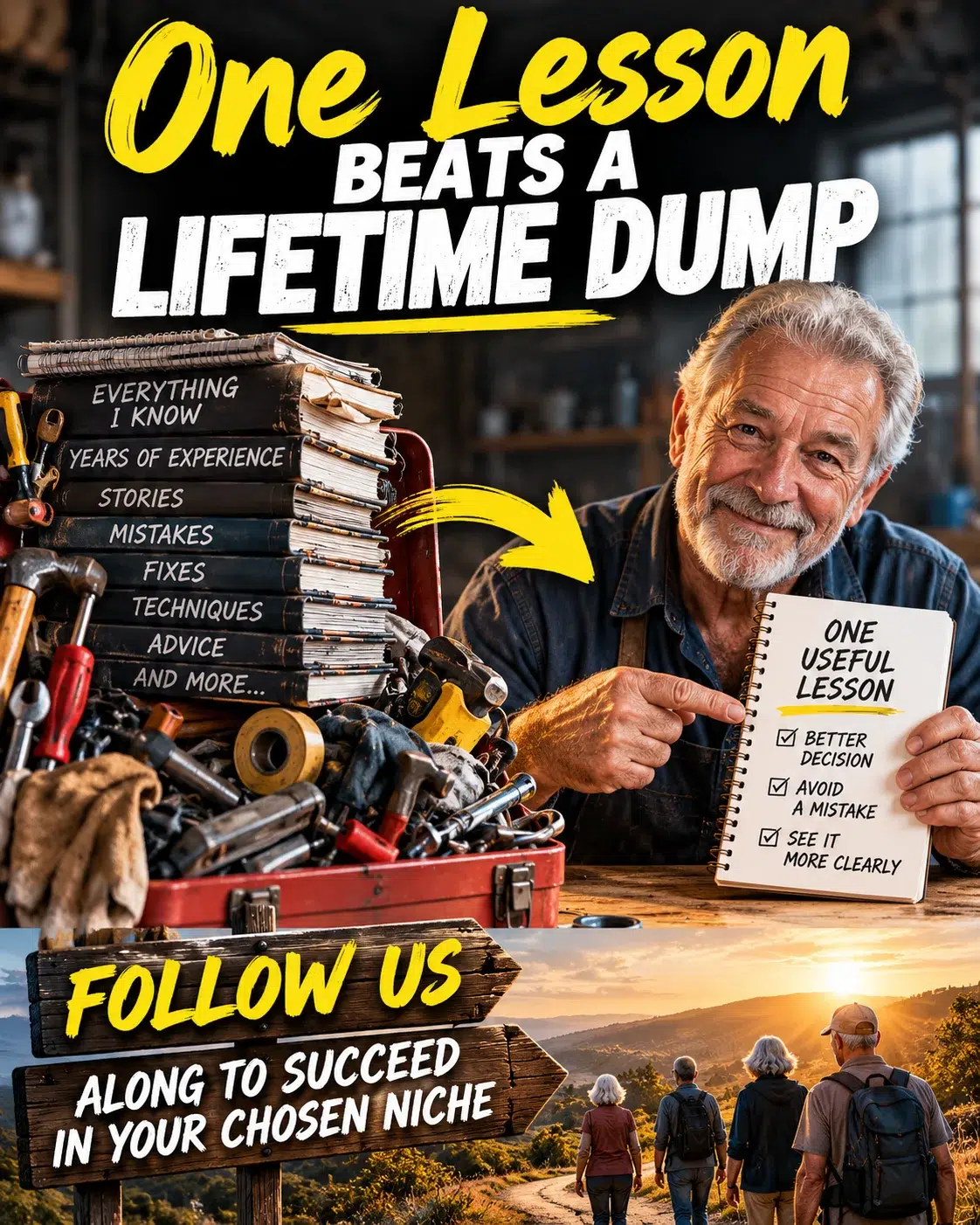
Before asking AI what to create, Choose One Useful Lesson from the experience you already have. That sounds simple until you try it. After thirty or forty years of work, family responsibilities, mistakes, fixes, customers, awkward jobs and hard-earned judgment, almost everything feels connected. One memory leads to another. One warning reminds you of a shortcut. One shortcut reminds you of the mistake that taught it. Before long, you are trying to explain half a lifetime to somebody who only needed help with one small problem. That is where experienced people can accidentally bury their own value. The knowledge isn’t weak. Too much of it arrives at once. A beginner does not need the contents of the whole toolbox emptied onto the floor. They need the right tool for the job in front of them.
This hides an old tradesman’s habit. When an apprentice asked a question, the experienced worker rarely stopped the whole job and delivered a three-hour lecture on the trade. He showed him what mattered now. “Look at that first.” “Don’t touch that yet.” “Ask the customer this before you start.” One sentence might save twenty minutes, a wasted journey or a mistake that had to be put right later. That small lesson carried more practical value than a long explanation because it changed what the apprentice did next. The same principle works when turning lifetime experience into digital value. You do not need to teach everything you know about plumbing, gardening, selling, bookkeeping or running a small business. You need to identify one piece of experience that changes somebody’s next decision.
Use The One-Change Test
 A useful lesson should have a job. That gives us a simple test before we turn anything into an article, checklist, worksheet or video: what will the reader notice, decide, avoid or do differently after learning this? If the answer is vague, the lesson is still too big. “How central heating works” is a subject. “Check whether the problem affects one radiator or the whole house before assuming the boiler is at fault” is a lesson. One could fill a manual. The other immediately changes what the beginner checks first. That is the difference we are looking for. Choose One Useful Lesson that produces one clear change, because clear changes are easier to teach, easier to remember and much easier for the reader to put into practice.
Imagine the retired heating engineer standing in a customer’s hallway. The customer says, “The heating isn’t working properly.” Years ago, the young apprentice might have heard one thing: boiler trouble. The experienced engineer hears a question that hasn’t been answered yet. Is the whole house cold, one room cold, or one radiator cold? That distinction can change where he looks first. He does not need to teach the customer every component inside the system.
The useful lesson is smaller: find out whether the problem is local or system-wide before deciding where the fault probably sits. That is the kind of knowledge experienced people overlook because it becomes automatic. Yet to a beginner, that one distinction can completely change the next step.
The same pattern appears outside the trades. A gardener looking at a struggling patio plant may check how quickly the pot dries in afternoon heat before adding more feed. A former shopkeeper may know that a customer saying “I’m only looking” often needs space before they need more information. An office manager may see the same mistake appearing on several forms and check the instructions before blaming the staff. None of these lessons sounds grand enough to fill a course. That is precisely why they are valuable. Each one changes a specific judgement at a specific moment. Experience is often most useful when it helps somebody see the situation differently before they act. The smaller lesson gives the beginner something they can actually carry into the next real situation.
The Best Lesson Is Not Always The Cleverest
This is where experienced people can fall into another trap. They often choose the lesson that sounds most impressive rather than the one that would help most. Advanced knowledge feels valuable because it took years to learn. But the beginner does not care how difficult the knowledge was to acquire. They care whether it helps them understand what is happening and what to do next. A sophisticated explanation of a heating system may prove that the engineer knows his trade. A simple warning such as “check whether somebody changed anything yesterday before you start dismantling things” may save the beginner far more trouble. Practical usefulness beats complexity when the purpose is teaching.
That gives us another decision rule for Choose One Useful Lesson: pick the lesson with the clearest consequence. What happens if the reader understands it? What mistake might they avoid? What decision becomes easier? What confusion disappears? If you can answer those questions in plain English, you probably have something worth developing. If you need five minutes to explain what the lesson is about, you may still be holding a subject rather than a lesson. The aim is not to make your experience smaller. It is to make one piece of it usable. Once that first piece is clear, the rest of the lifetime does not disappear. It simply waits its turn.
Turn One Lesson Into Something Useful
Once you have chosen the lesson, the next job is not to make it bigger. It is to make it clearer. This is where Choose One Useful Lesson becomes practical. Take the lesson and explain it as if you were speaking to an apprentice standing beside you, not an expert who already knows the background. What do they need to notice first? What would they probably get wrong? What simple question would help them avoid the mistake? What should they do next? Those questions force the lesson out of your head and into a usable shape. The more experienced you are, the more tempting it is to skip steps because they feel obvious. But the obvious step is often what the beginner needs most. Good teaching is not showing everything you know. It is revealing the part the other person cannot yet see.
A simple way to sharpen the lesson is to ask whether it belongs to one of three useful jobs. Does it help someone make a better decision? Does it help them avoid a mistake? Or does it help them understand a confusing situation more clearly? Those three jobs cover a surprising amount of practical experience. The retired tradesman may teach a decision: check whether the fault is local or system-wide. The gardener may teach a mistake to avoid: do not keep adding feed when the real problem is heat and dry soil. The former office manager may teach clarity: repeated errors can point to uncertain instructions, not careless people. When Choose One Useful Lesson has one of those jobs, the lesson becomes easier to explain because the purpose is obvious. The reader can see exactly what the knowledge is for.
Choose One Useful Lesson Before AI Helps
This is also the right point to bring AI into the workshop. Not before. Don’t ask AI to invent the lesson, because the value comes from your experience. Instead, give AI the lesson you have already chosen and ask it to help organise the thinking. It can help turn the idea into a checklist, worksheet, short guide, article outline or video script. It can help simplify the language, group the steps and spot where the explanation jumps too quickly. But you still have to make the judgment. If AI adds a clever-sounding point that you would never teach an apprentice, take it out. If it misses the warning that matters most, put it back in. Choose One Useful Lesson first, then let AI help package what experience has already decided is important.
That keeps the human and machine jobs separate. Your experience decides what matters. AI helps make it easier to use. That distinction protects the lesson from becoming generic. Imagine telling AI, “Write something about plumbing mistakes.” It could produce a tidy list, but much of it would be ordinary information. Now compare that with giving it a real lesson: “A customer says the heating isn’t working. Before assuming boiler trouble, establish whether the whole house, one room or one radiator is affected.” That gives AI something grounded to organise. It can turn the idea into a diagnostic checklist or beginner guide, but the useful judgement was already there. This is exactly why Choose One Useful Lesson works so well. It gives the machine a better starting point because the human has already done the most valuable thinking.
Pick The Smallest Useful Format
The final decision is choosing the simplest format that lets the lesson do its job. A lesson about what to check can become a checklist. A lesson about making a choice can become a decision guide. A lesson about avoiding a mistake can become a warning sheet. A lesson that needs a short explanation may suit an article or video. There is no prize for turning a five-minute lesson into a fifty-page ebook. In fact, making the format too large can bury the value all over again. The format should fit the lesson, not the other way round. If the lesson works on one page, let it work on one page. If a ninety-second video explains it clearly, that may be enough. Choose One Useful Lesson and give it the smallest useful container that helps another person understand and act.
That also makes digital creation far less intimidating for someone starting later in life. You are not sitting down to “become a content creator.” You are taking one thing you already know and giving it a useful shape. Tomorrow, you can do the same with another lesson. One decision becomes a checklist. One warning becomes a short video. One shortcut becomes a worksheet. One mistake becomes an article. Over time, those small pieces begin to form something much larger: a library of experience that other people can actually use. The lifetime is still there, but it is being unpacked in a way the reader can absorb. That is how a career becomes digital value without forcing everything into one giant product before you have even started.
Open to See This Video, And This Is What’s Already Built,
Trained & Waiting For Your First Command.
Your Apprentice Task Today
Pick one activity you have done many times at work, in business, in family life, as a hobby or in everyday problem-solving. Then write three things down: one decision you now make quickly, one mistake you know how to avoid, and one thing you notice that a beginner might miss. Do not explain your whole background. Look at those three possibilities and Choose One Useful Lesson using the One-Change Test: what will somebody notice, decide, avoid or do differently after learning it? Pick the one with the clearest answer. Explain it in simple language as if a beginner were beside you asking, “What should I look for first?” Only after that should AI enter the job. Ask it to help organise your lesson into one useful format, then check that your judgement is still doing the teaching.
The rule to carry forward is simple: one useful lesson should create one useful change. If it does, you have something worth building; if it does not, make the lesson smaller until the change becomes clear.