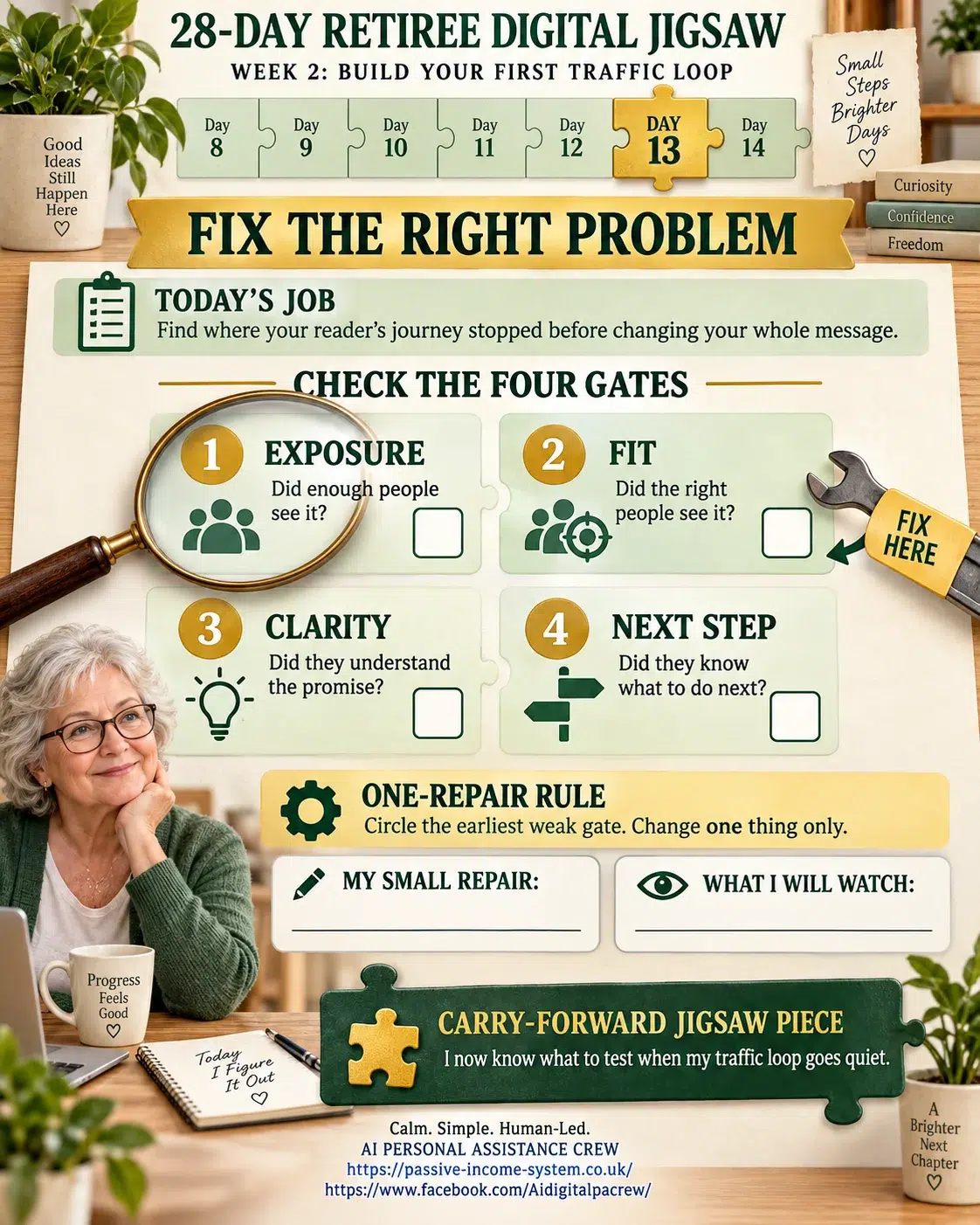
Fix The Right Problem Before Rebuilding Your Message
A disappointing response tells you to investigate the reader’s journey, not demolish everything you created.
Diagnose The Evidence And Fix The Right Problem
A quiet response means something needs investigating, but it doesn’t reveal which part needs replacing.
Use Four Reader Gates To Fix The Right Problem
Exposure, Fit, Clarity and Next Step reveal where useful reader movement may have stopped.
Change One Element To Fix The Right Problem
A measured repair provides clearer evidence than rebuilding the entire traffic path.
The cold radiator was upstairs in the back bedroom, but the worried householder had already sentenced the boiler to death. When the heating engineer arrived, someone opened a brochure and calculated borrowing possible by Christmas. The engineer listened politely, walked upstairs, touched the radiator, checked the valve and released a pocket of trapped air. Within minutes, the radiator began warming. The boiler had never been the problem.
Online beginners can behave like that worried householder. A Facebook post gets no comments, a video attracts only a few views, or nobody clicks through to the promised guide. The immediate conclusion is that the message failed. We rewrite the headline, replace the graphic, question the offer, and the entire idea slides toward the digital scrapyard. Yet the visible symptom tells us only that the reader didn’t complete the journey we expected. It doesn’t identify where the journey stopped.
Yesterday, we learned to Watch Your Reader Response without inventing the reason for a quiet result. Today, the job moves one practical step forward. We will use the available evidence to fix the right problem, preserve what may already be working, and change only what’s most likely blocking the reader.
Four Gates Can Produce The Same Silence
 Imagine a retired office manager sharing a free checklist called Seven Documents Every Household Should Keep Together. She publishes a thoughtful Facebook post explaining how difficult it can be for relatives to find important information during an emergency. The post receives one reaction, no comments and no visible downloads. From the outside, the result appears simple: silence.
However, four entirely different problems could have produced it. The post may have passed through too little Exposure, meaning hardly anyone saw it.
It may have reached people but failed the Fit gate because those people didn’t recognise the situation as relevant to them. The audience may have been suitable, yet the message failed the Clarity gate because the checklist’s value wasn’t immediately obvious. Finally, people may have understood and wanted the checklist but stopped at the Next Step gate because the link, instruction or button was unclear.
Each possibility produces the same visible outcome, but each requires a different repair. More exposure won’t rescue a confusing promise. The platform won’t show the post to the right audience even with a stronger headline. A clearer button cannot solve a page nobody reaches. We determine the first principle of repair is straightforward: others may share the symptom, but the fault differs.
Before changing any words, we should work backwards through the four gates and determine the earliest point at which we cannot confirm reader movement.
Begin With Exposure Before Blaming The Message
Exposure asks whether enough suitable people had a reasonable opportunity to see the content. This isn’t an invitation to chase enormous viewing figures. It is a basic check that prevents us from judging a message before it has received a fair test. If a Facebook Page has forty-nine followers and the post reached twelve people, zero comments tell us very little about the wider audience’s interest. The message may be weak, but the evidence doesn’t prove it yet.
This is where beginners often repair the wrong component. They rewrite the opening paragraph because the response feels disappointing, even though most intended readers never encountered it. A better first repair might be to share the post at a different time, place it in front of a relevant existing audience, mention it in an email, or turn its central point into a short Reel that links to the same destination. The content stays the same, but the opportunity to see it improves.
To fix the right problem, record what the platform can genuinely tell you. How many people were reached? Was the content delivered to followers, strangers or an unknown mixture? Did previous posts normally reach more people? Avoid pretending that a small number gives a complete answer. The purpose of the Exposure check is not to declare success or failure. It is to decide whether the message has been tested fairly enough to examine the next gate.
Audience Fit Is More Specific Than General Interest
Suppose the household-document post reached several hundred people but still produced little useful movement. That sounds like stronger evidence against the message, but reach alone doesn’t confirm that the right people saw it. A general audience might agree that organising documents is sensible without feeling that the checklist applies to them today. They understand the subject, yet no personal reason pulls them towards the next step.
The Fit gate asks whether the message helps the intended reader recognise themselves, their situation or their immediate concern. “Keep your household paperwork organised” is broadly sensible, but it could pass unnoticed because it sounds like advice for everybody. “Could your family find your insurance details, medication list and emergency contacts if you were suddenly taken into hospital?” creates a more recognisable moment for older householders. The checklist hasn’t changed. The audience hasn’t necessarily changed. The connection between the two has become more specific.
Fixing Fit doesn’t mean making the language frightening or dramatic. It means showing clearly who the information is for and when it becomes useful. A retired gardener’s seasonal planner may fit beginners with a small garden but feel irrelevant to experienced allotment holders. A guide to creating a first digital asset may suit retirees with useful experience but fall flat for marketers already selling complex courses.
A message cannot fit everyone equally. The repair is to make the intended person easier to recognise.
Let The Evidence Help You Fix The Right Problem
A creator who suspects both Exposure and Fit may be tempted to change everything at once. They share the post in three new places, rewrite the headline, replace the image and add a stronger call to action. The response improves, but the creator still doesn’t know why. Any one of those changes may have helped. Several may have made no difference. One may even have weakened the journey while another produced enough improvement to hide the damage.
This is why today’s work needs the One-Change Rule. Choose the earliest gate where the evidence suggests movement stopped. Make the smallest reasonable repair at that gate. Leave the other working parts alone, then watch what happens.
If Exposure appears weak, improve distribution without rewriting the promise. When Fit appears weak, sharpen the target audience without changing the destination. If Clarity becomes the likely fault, clarify the promised value without changing the audience. If the Next Step is hidden, strengthen the instruction without rebuilding the article.
The goal is not merely to produce a better number. It is to learn which repair moved the reader.
That knowledge can be used again, while a complete, uncontrolled rewrite leaves you dependent on guesswork the next time silence appears.
Clarity Fails When The Reader Must Translate Your Offer
A message can reach the right people and describe a problem they recognise, yet still lose them because the promised value remains foggy. Creators understand their own work so well that they often fill gaps without noticing. The reader cannot. Phrases such as “unlock your potential,” “discover digital opportunities”, or “take your business to the next level” may sound positive, but they don’t tell a beginner what they will understand, receive or be able to do.
Return to the retired office manager and her household-document checklist. If her post promises “greater peace of mind through better personal organisation,” the intended reader may agree but still struggle to picture the practical result. A clearer promise would explain that the checklist helps someone collect seven important documents in one place so their family can find them during an emergency. The second version gives the reader an object, a number, an action and a reason.
The repair belongs at the Clarity gate. It doesn’t require a new checklist or a different audience. The creator needs to replace the vague promise with a specific explanation that allows the reader to judge whether the resource is useful.
A simple Clarity check asks: Could a suitable reader explain what this helps them do after reading it once? If not, remove broad language, name the practical outcome and show what becomes easier because the resource exists.
Fix The Right Problem At The Next-Step Gate
Sometimes the message has done nearly everything correctly. The right person sees it, recognises the problem and understands the promised value. Then the journey ends because nobody clearly explains what to do next. The creator assumes the action is obvious, while the reader reaches the final sentence and meets “Learn more,” “Check this out”, or a naked website address offering no reason to continue.
The Next Step gate must answer three ordinary questions. What should I do? Where will that take me? What useful thing will happen when I arrive? A call to action such as “Download the free seven-document checklist and complete the first box today” answers all three. The action is download, the destination is the checklist, and the immediate payoff is beginning the task.
This repair should remain proportionate to the interest already earned. Someone reading one Facebook post may be ready to open a related guide but not to join a paid membership. A visitor who has completed several workshop lessons may be prepared for a larger commitment. The next step fails when it is hidden, confusing or too large for the relationship.
Before rebuilding the message, inspect the final instruction. If a willing reader could reasonably ask, “What exactly happens when I click?” the Next Step gate needs attention. Strengthen that instruction first and leave the rest of the message alone.
Test One Repair Under Similar Conditions
Once you’ve identified a likely fault, the repair needs a fair test. This doesn’t require laboratory conditions or complicated tracking software. It requires enough consistency to make the comparison useful. Share the adjusted message with a similar audience, through the same traffic source and in a comparable format. If everything surrounding the repair changes, the new response cannot teach you much.
Suppose yesterday’s post reached forty suitable readers and produced one click. You diagnose an unclear next step and replace “Find out more” with “Open the free checklist and choose the first document you will collect.” When you share the revised version, watch whether more people move toward the checklist. A small improvement doesn’t prove that the wording will always work, but it provides better evidence than changing the headline, image, audience, destination and call to action together.
The aim is to see whether movement improves at the repaired gate. An Exposure repair should increase suitable reach. A Fit repair should attract more responses from the intended type of reader. A Clarity repair should reduce confused questions and increase recognition of the promised value. A Next Step repair should help more interested people continue towards the destination.
To fix the right problem, match the measurement to the repair. Don’t judge a clearer call to action by whether it earns more likes. Judge it by whether more suitable readers take the requested next step.
Movement Matters More Than Applause
Social platforms make applause easy to notice. Likes, reactions and view counts sit in public, while the quieter signs of useful movement may require closer attention. A post with fifty cheerful reactions can feel successful even when nobody visits the guide it was created to support. Another post may collect only five reactions but send three suitable readers into the workshop. The smaller-looking result may be doing the more valuable job.
This doesn’t make likes meaningless. They can show that somebody noticed, enjoyed or agreed with the content. However, they don’t automatically reveal whether the traffic path worked. The right measure depends on the message’s purpose. When a post is meant to start conversations, relevant replies matter; if it was created to introduce a checklist, visits and downloads matter. If it was created to help readers complete a workshop task, progress towards that task matters.
The repair process gets distorted when creators chase whatever number looks biggest. They may turn a useful teaching post into light entertainment because entertainment earns faster reactions. Eventually, the account gets applause from people with little interest in the destination.
Ask one grounding question: What reader movement was this message built to create? That answer tells you which response matters and prevents vanity numbers from disguising a broken traffic path.
Preserve What Works And Fix The Right Problem
Repair partly depends on knowing what not to touch. Readers who regularly stop for the headline may indicate the headline is working. If suitable people comment with relevant experiences, the audience Fit may be sound. If visitors reach the destination but fail to complete the action, the problem may sit on the page rather than inside the social post.
Creators often destroy useful components because they judge the entire journey as one object. A poor final result makes every earlier step look guilty. Yet a reader may have travelled successfully through three gates before meeting the blockage. Replacing those successful parts creates new uncertainty and may introduce faults that did not previously exist.
The heating engineer doesn’t replace the pump because a radiator valve is stuck. Similarly, a creator shouldn’t discard a strong example just because the link was hard to find. Protecting what works saves time, preserves consistency and makes the repair easier to evaluate.
Keep a short record after each test. Note the message, audience, traffic source, destination, response and one change made. You don’t need an elaborate dashboard. A simple dated document is enough to stop yesterday’s evidence disappearing beneath today’s assumptions.
Over several messages, patterns begin to emerge. Those patterns help you fix the right problem faster because you are no longer starting every investigation from an empty notebook.
Today’s Apprentice Task: Make One Measured Repair
Choose one recently published post, email, video or Reel that received a quieter response than you expected. Write down only what you can observe. Include the reach, relevant reactions, questions, clicks or completed actions available to you. Do not write “people weren’t interested” unless they actually told you that.
Now inspect the four gates in order:
- Exposure: Did enough suitable people have a fair opportunity to see it?
- Fit: Could the intended reader recognise that the message concerned them?
- Clarity: Could they explain the promised value after reading or watching once?
- Next Step: Did they know exactly what to do and what would happen afterwards?
Circle the earliest gate where you can’t confirm reader movement. Choose one small repair that belongs only to that gate. Don’t change the audience, headline, example, image, destination and call to action together.
Publish or share the repaired version under similar conditions. Then record the one response that would show whether movement improved at that particular gate.
Your finished jigsaw piece today is a measured repair, not a complete rewrite.
Silence began as a symptom. Yesterday, you investigated it. Today, you repaired the most likely fault without damaging the rest of the system. The next step is to repeat the traffic loop and discover whether the repaired path can keep producing useful movement without constant rebuilding.
Open to See This Video, And This Is What’s Already Built,
Trained & Waiting For Your First Command.
Repair The Broken Gate Instead Of Replacing The Whole Path
Exposure, Fit, Clarity and Next Step are four different problems requiring four different repairs.
Change One Thing And Let The Response Provide Evidence
A small controlled adjustment teaches you more than rewriting the headline, image, offer and call to action together.