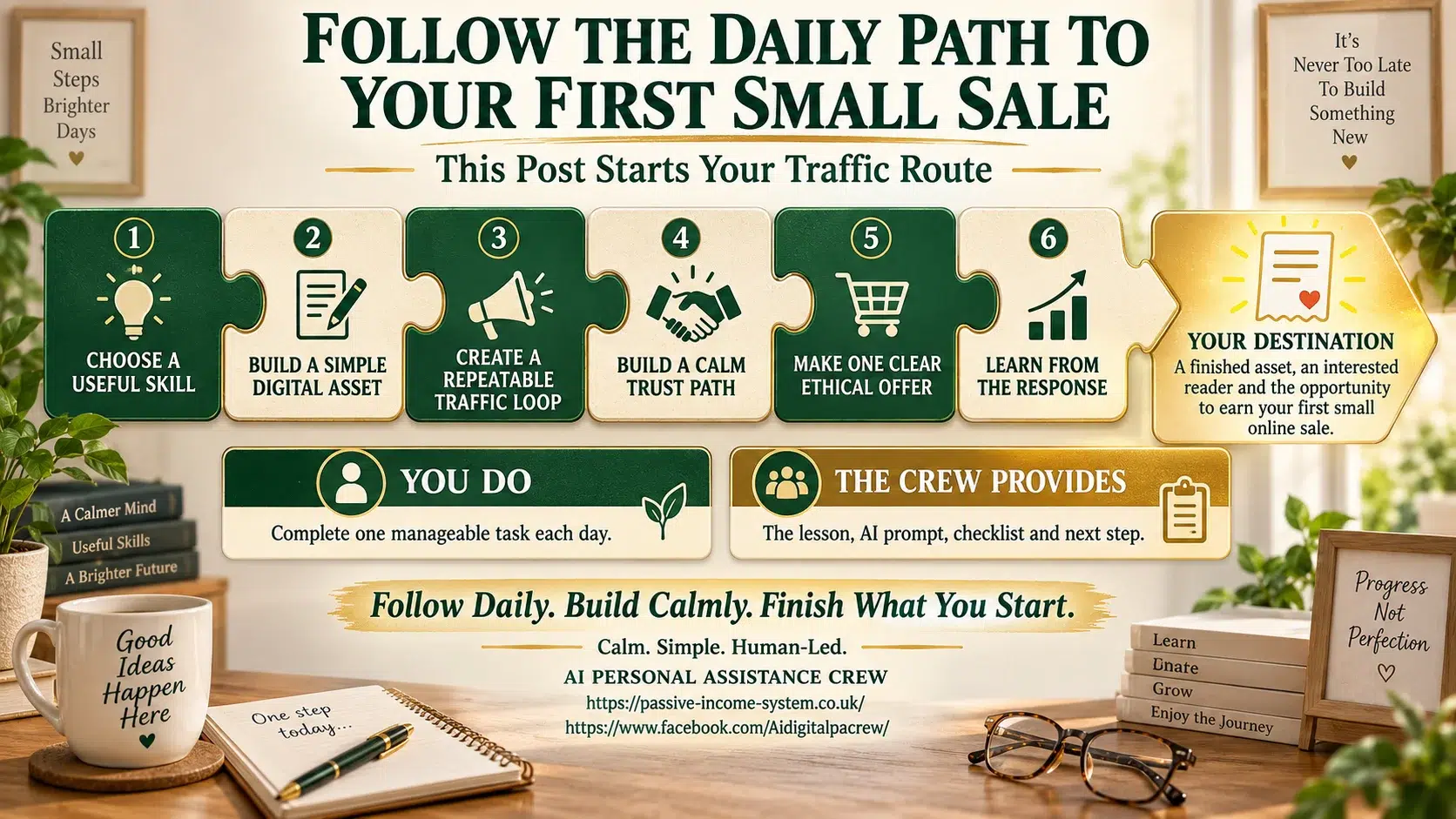
Cold visitors don’t arrive with trust, patience or an understanding of your business. Your first job is to give them a good reason to stay.
Turn A Passing Glance Into One Useful Click
A broad traffic page must quickly answer an unfamiliar visitor’s first question: “Is there anything here for me?”
Build One Daily Route Instead Of Chasing Every Platform
Consistent traffic begins when one useful message, one source and one destination are connected and repeated.
Picture a market trader arriving before the high street has properly shaken the sleep from its eyes. He unlocks the shutters, sets out the goods and places his clearest offer where passing strangers can see it. He doesn’t expect every pedestrian to stop. The trader certainly doesn’t chase them down the pavement waving a price list. His first job is simpler. He gives the right passer-by a reason to pause, look closer and perhaps step inside.
That is the job facing us when we learn how to get traffic from people who have never heard of us. They don’t know our story, recognise our name or understand what lies beyond the link. Some may be interested in earning online. Others may be curious about traffic, blogging, artificial intelligence or why their own website resembles a railway platform after the last train has departed.
They are not yet prospects, subscribers or buyers. They are passing strangers.
Therefore, this page must not behave like a twenty-minute sales presentation delivered before the visitor has removed their coat. It must make one useful promise, explain it plainly and help the reader take one easy step forward. If it does that, the visit has served its purpose.
How To Get Traffic Without Requiring Instant Trust
The old version of this article tried to make traffic sound like the only thing standing between a beginner and success. That certainly created urgency, but it also skipped an important distinction. More visitors don’t automatically create better results. If the page confuses them, sends them toward five different offers, or asks for too much too soon, extra traffic gives more people the chance to leave.
Cold traffic behaves differently from a familiar audience. A Facebook follower may recognise your face and understand why you’re discussing online income. A newsletter reader may already trust your judgement. However, somebody arriving from a traffic rotator has none of that background. The person may give the page only a brief inspection before deciding whether to continue.
That makes clarity more valuable than cleverness.
The headline must tell them what they will gain. The opening must confirm that they’ve arrived in the right place. The article must deliver enough practical help to reward the click. Finally, the next link must feel like the natural continuation of what they are already reading.
We are not asking a stranger to join our entire journey. We are earning permission for one more step.
Turn one daily message into more website clicks without posting everywhere, mastering complicated technology or building another funnel.
The problem may not be your website or offer. You may simply be missing the three-part route that gives strangers a reason to notice, visit and continue.
The Daily Traffic System Needs Only Three Working Parts
Online traffic gets complicated when you throw every platform, format and fashionable tactic into the same bucket. One person begins a blog on Monday, experiments with short videos on Tuesday, joins three new social networks on Wednesday and spends Thursday wondering why nothing appears to work. By Friday, the only thing moving quickly is the mouse between browser tabs.
A useful daily traffic system is far less dramatic. It requires three connected parts:
One traffic source where people can discover the message.
One useful message that gives them a reason to pay attention.
One useful destination that keeps them on the journey.
For example, the source might be a Facebook Business Page. The message might be a short observation about why random posting produces random results. The destination might be an article that explains a simple daily traffic routine. If the article then guides an interested reader towards one related lesson, the route is complete.
That is how to get traffic without building an online octopus whose tentacles require constant feeding. The system isn’t powerful because it contains dozens of moving parts. It becomes useful because the same few parts connect deliberately and repeat often enough to reveal what happens.
Cold Visitors Need A Doorway, Not A Guided Tour
Consider walking into a large shop where an enthusiastic assistant immediately begins explaining every department, membership scheme, special offer and future delivery service. Nothing may be wrong with the information, yet the sheer quantity of options feels like the most desirable option.
Many websites make the same mistake. The visitor arrives to learn about traffic and is immediately confronted by several products, unrelated articles, social buttons, subscription boxes and promises of future success. The owner sees opportunity everywhere. The reader sees a maze.
A broad traffic page needs one doorway.
The visitor should understand the immediate problem: they want more people to see their work, but their efforts are scattered or inconsistent. They should then receive one practical conclusion: choose a repeatable daily route connecting a source, a message and a destination. Once they understand that idea, the page can offer one related link that helps them take the next step.
This doesn’t mean hiding everything else on the website. It means deciding which action matters most on this particular page. Every additional choice competes with that decision, particularly when the visitor hasn’t yet developed a reason to trust us.
How To Get Traffic By Earning The Second Click
The first click may have been accidental, impulsive or purchased through the traffic system we are testing. Consequently, it tells us very little on its own. The second click is more revealing because the visitor has now seen enough of the page to make a choice.
Does the headline match their interest? Was the opening clear and sensible? Did the article provide something useful? Did the next destination feel relevant?
A second click doesn’t prove that somebody will eventually subscribe or buy. However, it does indicate movement. The reader has voluntarily travelled from an unfamiliar entry page towards another part of the site. That is more useful than celebrating a large page-view number while everybody quietly disappears through the same door they entered.
Our broad traffic test must therefore measure more than arrivals. We need to watch whether visitors remain long enough to read, whether they choose the suggested internal link and whether they continue into the workshop. Those behaviours tell us whether we have built a pathway rather than merely rented a crowd.
The important question isn’t only, “How many people visited?”
It is, “Did we give the right ones a reason to continue?”
And that brings us to the daily routine itself: the small, repeatable action that turns a hopeful link into a traffic path we can observe, improve and use again.
Section 2
A Daily Traffic Routine Must Be Small Enough To Repeat
The daily routine begins with a decision that seems nearly disappointingly modest: choose one place to show up. Not Facebook, Instagram, YouTube, email, Threads and three platforms whose passwords you have already forgotten. Choose the source you can use comfortably and consistently for the next few weeks.
If that source is Facebook, the routine might begin with one short post containing a useful observation, story or question. The post doesn’t need to contain the website link. In fact, letting the message do its job before introducing the destination often makes the interaction feel more natural. You can then post the article link in the first comment for readers who want the fuller explanation.
Next, spend a few minutes responding to genuine comments and participating in relevant conversations. This isn’t an invitation to paste your link beneath somebody else’s work or send unsolicited messages. It is simply the ordinary human behaviour that reminds people there is a real person behind the page.
Finally, record what happened. Note the post, destination and visible response. A routine that produces evidence can be improved. A burst of random activity merely leaves you tired and none the wiser.
Use One Useful Message To Earn Attention
People often ask how to get traffic when the more immediate question should be, “What would make somebody curious enough to stop?”
The answer isn’t always a dramatic claim. Cold visitors are surrounded by promises, many of which sound as though the internet has recently discovered a secret tunnel into the Bank of England. A specific, recognisable problem can be far more effective.
“Posting everywhere is not a traffic plan” contains a useful tension.
“One source, one message and one destination” gives the reader a memorable rule.
“If nobody clicks, find where their journey stopped” gives a practical reason to continue reading.
Each message creates curiosity because it helps the reader notice something. It doesn’t demand belief in an extraordinary result. Instead, it offers a small piece of reasoning they can test against their own experience.
The strongest daily messages usually do one of four jobs. They expose a common mistake, clarify a confusing distinction, introduce a useful rule or show a manageable next step. Choose one job for each post. When a message tries to do all four at once, the central idea can disappear under its own luggage.
How To Get Traffic With A Repeatable Message Pattern
A blank posting box can make a perfectly intelligent person feel as though every useful thought has been removed overnight. Therefore, a simple structure is more valuable than waiting for inspiration.
Use this three-part pattern:
Observation: Name something your reader may have experienced.
Useful distinction: Explain what they may have misunderstood.
Next step: Give them one action or invite them to read the fuller lesson.
For example:
You posted your link several times but received no useful response. That doesn’t necessarily mean the offer failed because too few of the right people may have seen it. Before rewriting everything, check where the reader journey stopped.
The observation earns recognition. The distinction introduces a useful idea. The next step opens the door towards the article.
This structure works because it doesn’t require a dramatic personal story every morning. Some days you may have an anecdote worth sharing. On other days, a clear observation will do the job perfectly well. The aim is to communicate like a helpful person, not audition for the role of inspirational speaker before breakfast.
Once the post is live, resist the temptation to rewrite it after ten quiet minutes. Give people time to see it, then observe the response calmly.
Measure Movement Instead Of Admiring Page Views
A traffic rotator may send a noticeable number of visitors, and that makes the page-view graph exciting to watch. However, raw views are the first gate, not the final result.
For this broad traffic test, we ought to follow four levels of movement:
Arrival: How many visits reached the article?
Attention: Did visitors remain long enough to engage with the page?
Continuation: Did they click the recommended internal link?
Action: Did any visitor subscribe, return or enter the workshop journey?
This prevents us from confusing rented exposure with genuine interest. Five hundred people arriving and immediately leaving may teach us less than fifty visitors who read, click and explore another page.
The broad post is deliberately designed to attract general curiosity. Therefore, we shouldn’t expect every visitor to match the retiree audience. Its job is to establish how much traffic arrives and whether the page can earn a second click from strangers.
Later, we will compare that result with the niche retiree post. If the niche page receives fewer visits but produces more continuation, we will have learned something important about audience fit. Neither result needs to be declared a triumph or failure. Together, they give us evidence.
Give Every Visitor One Obvious Way Forward
A useful article shouldn’t end like a country lane at a locked gate. Once the reader understands the daily traffic system, the next destination should help them apply one part of it.
For this page, the most natural continuation is the lesson about choosing one traffic source. The reader has already found the three-part route: one source, one message and one destination. So learning how to choose the source is the appropriate next step.
The link should be introduced in plain language:
Continue with the next practical lesson: Choose One Traffic Source And Stop Scattering Your Best Work.
You don’t need to surround that link with three competing offers. The visitor can stay or leave, but the decision is clear.
This is the quiet difference between collecting traffic and building a traffic loop. Collected traffic produces a number on a screen. A traffic loop gives somebody a route through connected, useful material and gives us evidence about where that journey continues or stops.
How To Get Traffic Without Losing The Human Element Thread
Systems help reduce confusion, but they should never make communication feel mechanical. Behind each page view is a person making a rapid series of decisions: Does this concern me? Can I understand it? Is it worth another minute? What am I supposed to do next?
Our job is to make those decisions easier.
We don’t need to know every visitor’s age, occupation or ambition before helping them. The broad page can meet strangers at the shared problem of wanting more attention for something useful. Those who recognise the problem may continue. Those who don’t can leave without being pushed or pursued.
That is why this traffic test matters. We are not buying a guaranteed audience. We introduce an existing piece of work to unfamiliar people and observe whether the pathway earns their interest.
If it does, we keep what works and carefully improve the route. If it doesn’t, we diagnose the weak gate before changing the whole article. Either way, the traffic gives us information that can make the next version more useful.
Open to See This Video, And This Is What’s Already Built, Trained & Waiting For Your First Command.
Apprentice Task: Build Your Fifteen-Minute Traffic Routine
Choose one traffic source you can use consistently for the next seven days. Then complete this small daily routine:
☐ Write one message containing an observation, useful distinction and next step. ☐ Publish it on your chosen traffic source. ☐ Direct interested readers towards one useful destination. ☐ Respond naturally to sincere engagement. ☐ Record the views, internal clicks and useful actions. ☐ Change nothing until you have enough evidence to identify the weak gate.
Complete the sentence:
My chosen traffic source is: ____________________________
My one useful destination is: ____________________________
The movement I will measure is: ____________________________
Don’t attempt to conquer the internet before lunch. Build one visible route, invite people to follow it and learn from what they actually do.
That is how to get traffic with a system you can repeat tomorrow.

 The old version of this article tried to make traffic sound like the only thing standing between a beginner and success. That certainly created urgency, but it also skipped an important distinction. More visitors don’t automatically create better results. If the page confuses them, sends them toward five different offers, or asks for too much too soon, extra traffic gives more people the chance to leave.