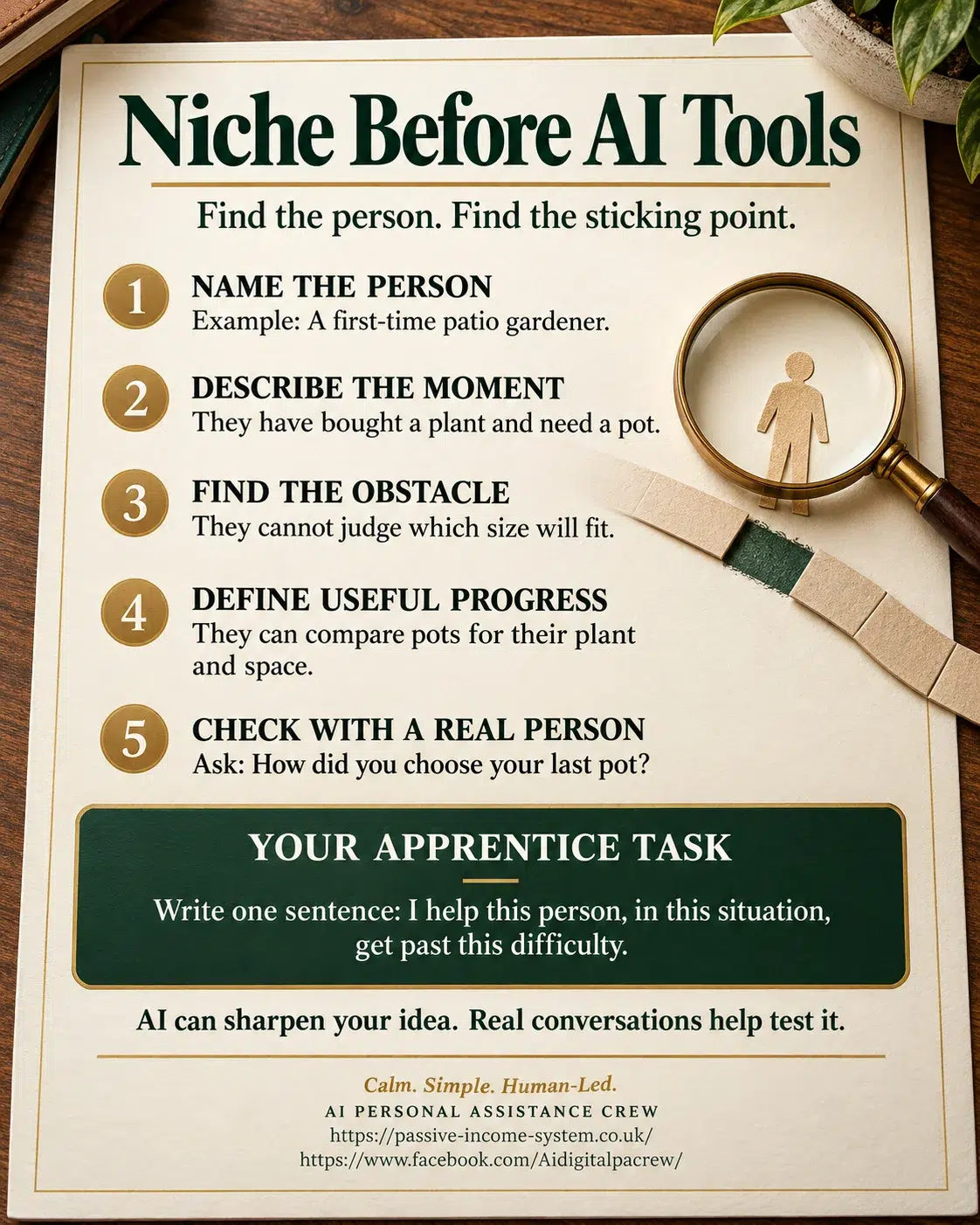
Niche Before AI Tools
Niche Before AI Tools: Find The Person Who Needs Your Help
Turn your experience into a clear starting niche by identifying someone with a specific task they cannot yet complete.
Choose The Person At The Sticking Point
Describe the moment a reader needs help, and your content’s purpose becomes easier to define.
Start With A Person, A Situation, And An Unanswered Question
Find what interrupts progress before deciding how to solve it.
Six tabs are open on the laptop, and every one seems determined to improve your working life. One makes videos, another writes books, and a third promises to organise everything except the biscuit tin. Before comparing another subscription, put Niche Before AI Tools into practice. Decide whose problem you want to help solve and when that person would need you.
For a retiree creating a first digital asset, choosing a niche can sound like an examination nobody mentioned at the start. You have years of experience, plenty of interests, and perhaps a notebook full of ideas. Yet the advice to find your niche can leave you staring at the page, wondering which part of your life deserves a business name.
Start with a familiar scene instead. Picture someone trying to complete a task you understand. Notice where they hesitate, make a guess, or ask for help. That moment gives your knowledge a practical purpose. You can examine what they need before choosing a format, opening another application, or producing pages that have no clear reader in mind.
A Broad Subject Leaves The First Question Unanswered
 Gardening is a subject with room for thousands of lessons. It includes choosing plants, preparing soil, watering containers, and planning large spaces. You could create useful material about any of those activities. However, the word gardening alone gives you little guidance about which question your first guide should answer or who would find it useful today.
First-time patio gardeners choosing containers for a small space give you a clearer starting point. You can picture their circumstances and identify a decision. They may have selected a plant but feel unsure about the container it needs. That description begins to tell you what information belongs in the guide and which related subjects can wait.
This is the value of Niche Before AI Tools. A clearer audience problem helps you define the production job. If you begin by choosing video software, you may start looking for something to film. If you start with a person who needs to compare two options, you can consider which format makes that comparison easiest to understand.
Follow The Reader To The Moment They Pause
Imagine an illustrative beginner standing in a garden centre. They have chosen a plant and measured a corner of their patio. Several containers look attractive, but the labels leave them unsure which features matter. They could pick the nicest one, postpone the purchase, or search for advice on their phone. The question has become immediate because a decision is waiting.
An experienced gardener may recognise this situation straight away. However, the beginner needs the relevant knowledge explained. They may need to record requirements, compare product details, and identify missing information before choosing. Any specific plant-care advice still needs checking against reliable guidance for the plant and conditions involved. Your experience helps you identify the question; accurate teaching helps answer it.
Now you have something more useful than a general interest in gardening. You have a person, a situation, and a difficulty that interrupts progress. Each part affects the help you would provide. Together, they give your first asset a manageable job and help you decide what to investigate before investing time in production.
Niche Before AI Tools Begins With One Clear Sentence
Try describing the audience in a sentence: I help first-time patio gardeners compare containers for their chosen plants when limited space makes the choice confusing. This is a working description, ready to investigate. It identifies relevant experience, names a task, and gives a condition that affects the decision. You can now explain why someone might need the help.
The wording also sets a useful boundary. This first guide does not need to cover lawn care, greenhouse construction, or the design of a large garden. Those subjects may deserve their own treatment. For now, the reader needs support choosing a container. Keeping that decision in view helps you resist adding every gardening lesson you have ever learned.
When you use Niche Before AI Tools as a planning rule, the sentence becomes a reference point. Ask whether a proposed section helps this person make this decision. If it does, examine what it should explain. If it serves another task, save it for later. You are giving each useful idea a place instead of forcing them all into the first guide.
Choose Details That Change The Help
A niche description can become longer without becoming more useful. You might invent an exact age, a favourite newspaper, and a preferred biscuit for your imaginary reader. These details can make a character feel vivid, but they may add little value. The more useful question is whether a detail changes the guidance that person needs.
Limited patio space affects the container decision. Previous gardening experience affects how much explanation is required. Whether someone already owns a plant changes where the guide should begin. Those details earn their place because they shape the teaching. Keep asking what difference each piece of information makes to the instructions, examples, or next action.
Age can matter when it affects a relevant circumstance, but it should not replace experience. A retiree may be an accomplished gardener or a complete beginner. Likewise, someone confident with a computer may know little about plants. Describe the knowledge and conditions connected to the task so your guide starts at the right point.
Use Niche Before AI Tools To Examine Your Own Experience
Your working life may offer several starting points. Think about the questions people brought to you before they could continue with a job. What were they attempting? Which part had they already completed? What did you explain that helped them move forward? These questions can reveal useful teaching opportunities hidden inside work that became routine for you.
A retired administrator might remember helping people organise documents for appointments. A sewing enthusiast might recall beginners who could thread a needle but could not choose a suitable repair method. Each memory suggests a situation worth exploring. The value lies in identifying the point of difficulty and the knowledge that could help, rather than simply naming the former occupation or hobby.
Personal experience gives you a starting hypothesis. It does not prove that people currently want a guide or will pay for one. Keep that distinction visible as you work. First, describe the possible audience and problem clearly. Then you can compare the idea with real questions and conversations instead of treating a convincing description as evidence of demand.
Separate The Complaint From The Sticking Point
Sometimes a person describes a problem in broad terms. They may say they cannot find a container they like. That could concern appearance, size, price, or uncertainty about suitability. Each possibility calls for different help. Before creating the guide, examine what they have tried and which part of the decision remains unresolved.
If the person has found several attractive options but cannot judge their suitability, a comparison method may help. If suitable options exceed the available budget, a guide focused only on container features may miss the immediate difficulty. The broad subject stays the same, but the practical assignment changes. Understanding that difference helps you choose a more relevant starting point.
Apply Niche Before AI Tools by naming the difficulty in terms you can investigate. Avoid assuming the cause merely because it fits the product you hoped to make. A clear niche description should lead to a useful question about the reader’s experience. That question helps you check whether you understand the moment when they need support.
Know What Progress Would Look Like
Once you have described the sticking point, identify a reasonable sign of progress. In the patio example, the reader might complete a comparison, explain a choice, or list the information still needed before buying. Each result shows how the guidance could help. It also keeps the promise close to the decision your asset is designed to support.
You do not need to promise a transformed garden to make a useful contribution. Helping someone approach one choice with better information can give your first asset a clear purpose. The next step is to test the boundaries of that purpose and find out whether real people recognise the situation you have described.
Niche Before AI Tools: Check Whether Someone Recognises The Moment
The beginner in our garden-centre example has a plant in the trolley and two containers under consideration. You have described the hesitation and identified the guidance that might help. Now put Niche Before AI Tools to its next practical test: could someone in that situation recognise their own question in your description?
Try writing the opening of your proposed guide. Address the moment directly: the reader has chosen a plant but is unsure how to compare containers for the available space. Now explain what information they need to gather. If the opening drifts into a broad account of gardening, return to the decision waiting in front of them.
This exercise tests clarity before you start producing. It shows whether your niche description leads to a specific piece of help. You should be able to name the question the first section will answer. If several unrelated questions compete for that position, narrow the situation until you can identify where the reader needs to start.
Know Who Your First Guide Is For
Consider another person shopping in the same garden centre: an experienced grower buying containers for a large display. They may already understand the basic requirements and need help with a different decision. Your beginner checklist could explain too much familiar material while missing their main concern. Sharing an interest in gardening does not make two people the same audience.
Name one nearby reader your first guide will not serve. This helps you set a useful boundary. You can still create something for that person later, but the first asset needs a clear assignment. Otherwise, each extra audience brings more explanations, exceptions, and choices until a simple guide becomes difficult to follow.
Using Niche Before AI Tools lets you start with a manageable task. It does not require choosing every subject you will ever teach. You are choosing a starting point where your experience can help someone make progress. A defined audience makes that first attempt easier to explain, review, and improve.
A Clear Description Still Needs A Reality Check
You can write a convincing audience description without knowing whether people currently face the problem. Treat the description as a working hypothesis. It tells you what to investigate, but it does not establish demand, buying intent, or the value of a finished product. Those questions need evidence beyond the wording.
Begin with the assumption that matters most. In our example, you may assume that beginner patio gardeners struggle to compare containers after choosing a plant. That could be accurate for some people, while others may find the information they need easily. Your next step is to learn what actually happens during that decision.
Keep Niche Before AI Tools focused on the person by asking about their experience. A neutral question could be: When you last chose a container for a plant, how did you decide which one to buy? Their answer may reveal uncertainty, a useful method, or no difficulty at all. Each response helps you refine your understanding.
Ask About What Happened Before Presenting Your Solution
It is tempting to describe your planned checklist and ask whether it sounds useful. Friends may be encouraging, especially when they know you are starting something new. However, a polite response tells you less about the original problem than an account of what someone tried, where they hesitated, and what they did next.
Give the person room to describe the task in their own words. Ask what information they used and whether anything remained unclear. Avoid inserting your preferred explanation into the question. If you assume size caused the difficulty, you may overlook a concern about weight, cost, or understanding the chosen plant’s requirements.
Listen for details that change the help you should provide. Someone who can’t find a product measurement needs different support than someone who has the measurements but doesn’t know how to use them. The distinction may look small on paper. In practice, it changes the instructions your guide needs to include.
Use Niche Before AI Tools To Separate Evidence From Assumptions
Keep brief notes about what you learn. Record the actual question or experience, where it came from, and your interpretation. Make the difference visible. A person saying they compared several pots without buying is an observation. Your belief that they lacked confidence in its suitability is an interpretation until they explain why.
This habit helps when you bring your AI Crew into the work. Give the helper the notes and ask it to distinguish supplied facts from possible explanations. It can organise the material and identify unanswered questions. You still need to check its suggestions against the information available, especially when it adds motives or concerns nobody mentioned.
A fictional example can illustrate a niche, but it cannot confirm one. Label imagined situations clearly and use them to improve your questions. Then look for real accounts that support, challenge, or change the description. A revised niche based on better understanding is useful progress, even if it differs from the idea you liked yesterday.
Keep Details That Change The Guidance
As you collect information, the audience description may grow longer. Before keeping each detail, ask whether it changes the help. Limited space could affect the comparison. Existing knowledge could affect the explanation. A preference for a particular colour might matter to the final choice without requiring its own lesson.
Use the task to judge relevance. For example, carrying a container through a narrow doorway may introduce a practical constraint that the original description missed. That detail could deserve attention because it changes what the reader must check. Decorative facts about an imaginary personality add less value unless they clearly affect the task.
Return to Niche Before AI Tools whenever the description becomes crowded. Can you still explain who needs help, what they’re trying to do, and what interrupts their progress? If those three parts disappear beneath a long biography, simplify the statement. Keep the information that helps you teach the right person at the right moment.
Explore The Sticking Point With A Small Piece Of Help
Once you understand it more clearly, prepare a small sample that answers the question. In the patio example, this could be a short explanation of the comparison process or a draft sheet for recording relevant details. Check any factual advice before sharing it. The sample should let someone try the help without requiring you to build a complete course.
Ask for feedback about the task. Could they use the explanation to approach the comparison? Which part remained unclear? Did the sample answer the question they actually had? These responses are more useful at this stage than opinions about your cover design. They help you inspect whether the proposed guidance fits the problem.
One person’s response is a clue, not a verdict on an entire niche. Look for patterns across relevant examples while keeping differences visible. If people describe several distinct problems, decide which one your first asset can address. You may need to narrow the situation further before adding more material.
Niche Before AI Tools Gives The Software A Defined Job
Now the production task begins to emerge. A reader comparing options may benefit from a clear table. Someone struggling with a physical technique may need a demonstration. A person gathering documents may need a checklist. The audience problem gives you a reason to choose a format, and the format helps define where AI assistance can help.
Start with the tools you can already use when they can perform the job. Ask your AI helper to organise verified notes, draft an explanation, or identify gaps in the instructions. Review the result against the specific task. If a tool cannot produce something essential, you then have a concrete requirement to consider when comparing alternatives.
This keeps the work connected to the reader. Software features become relevant because they help you deliver a useful result. You can explain what the tool is doing and why it is needed. The person at the sticking point remains the reference for the product, the content, and the next production decision.
Choose A Starting Point You Can Explain And Test
A useful niche description names a recognisable person, a specific situation, and a difficulty that interrupts progress. Real conversations help you check whether that description fits. A small sample lets you explore whether your guidance addresses the task. Together, these steps give you a practical basis for deciding what to create next.
You do not need to settle every future business decision today. Choose one situation where your knowledge may help, make the assumptions visible, and investigate the question with care. The aim is a starting point you can explain and test. That gives your experience a clear job before the software begins producing the pages.
Open to See This Video, And This Is What’s Already Built,
Trained & Waiting For Your First Command.
Your Apprentice Task: Put Niche Before AI Tools Today
Choose one skill from your working life, hobby, or everyday experience. Write three short notes: who might need that skill, what they are trying to do, and where they become stuck. Turn those notes into one sentence: I help this kind of person, in this situation, get past this specific difficulty.
Name a nearby problem outside that starting scope, then identify the most important assumption you need to check. Write one neutral question about a real person’s experience with the task. Your finished work today is a clear niche hypothesis and a practical way to investigate it. Before choosing another tool, find out whether someone recognises the moment you have described.