Offer One Safe Step Before Asking For A Bigger Decision
A cautious reader may need useful evidence before they need another reason to keep going.
Offer One Safe Step Without Talking Down To The Reader
Reduce the commitment while respecting the intelligence and lifetime experience of the person making it.
Offer One Safe Step That Leaves Something Useful Behind
The right action preserves control, produces evidence and makes the reader’s next decision easier.
Offer one safe step sounds like uncomplicated advice until you reach the bottom of an ordinary online article and discover six different doors waiting for you. Download the guide. Watch the video. Join the group. Start the trial. View the workshop. Buy the complete system before a clock in the corner reaches zero and civilisation apparently halts.
Our cautious retiree sits at the kitchen table, one finger hovering above the mouse. He has read the article, understood the central idea and may even want to continue. Yet every available button appears to begin a different journey. Nothing tells him which choice fits the question he has just answered.
 The creator believes they have provided freedom. The reader sees a railway departure board during a signal failure.
His hesitation isn’t evidence that he lacks ambition or ability. He may have organised teams, raised a family, repaired machinery or made decisions carrying far greater consequences than downloading a worksheet. The problem is simpler. The commitment being requested is larger than the evidence currently available to support it.
At that moment, another list of benefits won’t necessarily help. The reader needs one action small enough to inspect, useful enough to teach them something and safe enough to leave them in control.
The Decision Became Too Large Before The Trust Was Ready
Online marketing often treats hesitation as a shortage of persuasion. If the reader doesn’t act, strengthen the headline. Add urgency. Increase the bonus stack. Repeat the transformation in brighter colours. Somewhere between the countdown timer and the tenth testimonial, the person quietly closes the page.
The overlooked possibility is that they weren’t rejecting the destination. They were rejecting the size of the next decision.
An experienced retiree wondering whether their knowledge could become a digital asset may be genuinely interested in a 28-day workshop. However, joining the complete programme asks them to judge several unknowns at once. Will they understand the technology? Can they find enough time? Is their experience useful? Will the workshop suit the way they learn? Might they purchase another product that remains untouched on a hard drive?
Those aren’t signs of weakness. They are reasonable questions from somebody protecting time, money and confidence.
A poor response makes the person smaller: “Don’t worry, it’s so simple that absolutely anyone can do it.” The sentence attempts reassurance but quietly places the reader among people assumed to have little judgement.
A better response makes the decision smaller: “Before considering the full workshop, write down three questions people have asked you for help with. Circle the one you could answer most clearly.”
The reader remains a capable adult. The commitment has been reduced to a bounded task that reveals whether their experience contains the beginning of something useful.
That is the distinction worth keeping:
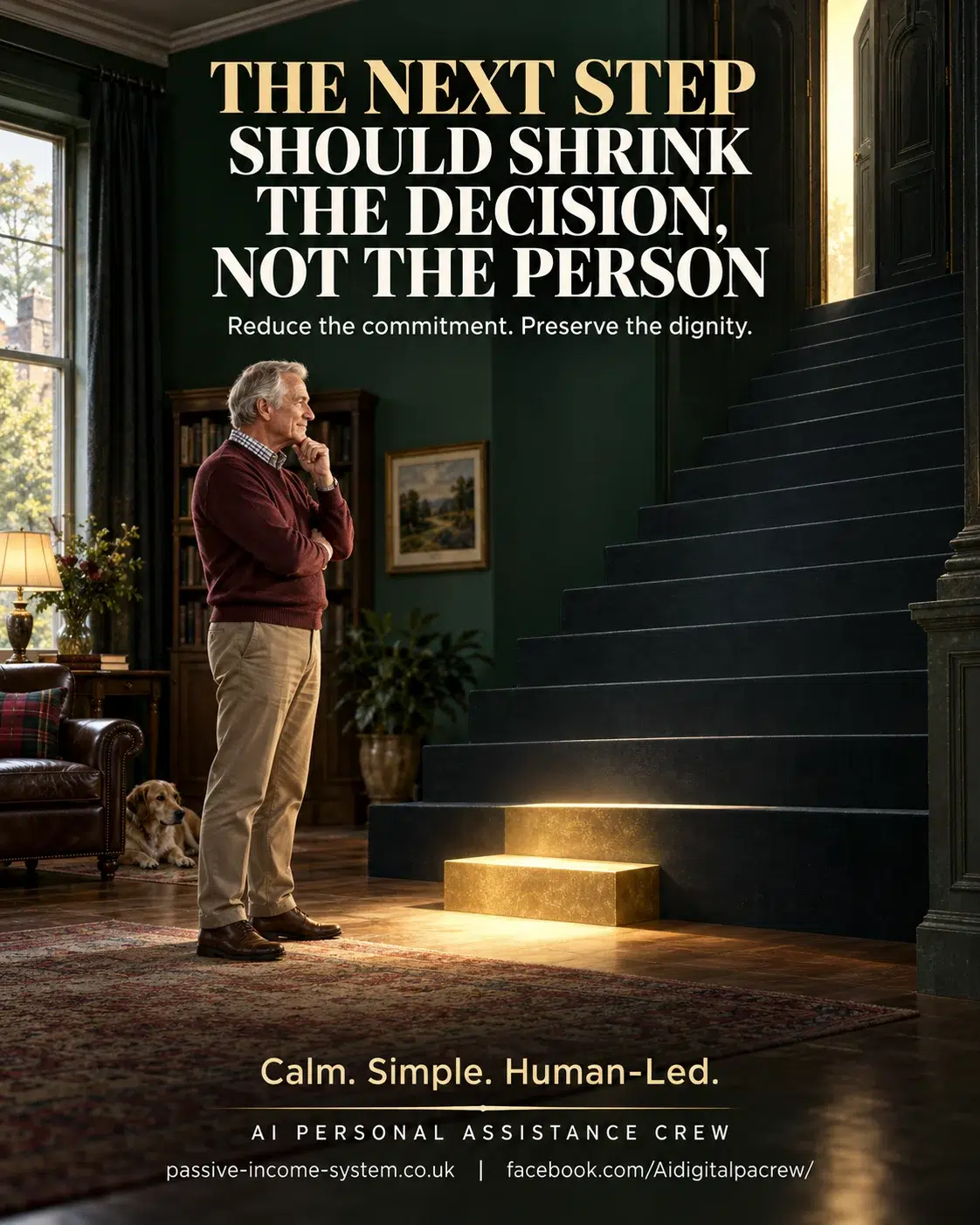
Shrink the decision, not the person.
Offer One Safe Step That Produces Evidence
Small actions are not automatically useful. “Learn more” is small. So is watching another video, opening another tab or joining another mailing list. A person can remain extremely busy while gathering no evidence that makes their decision easier.
A safe step must do more than occupy a few minutes. It should reveal something practical about the problem, the method or the reader’s ability to continue.
Imagine two invitations beneath an article about turning lifetime experience into digital value.
The first says, “Join our complete digital-business programme and learn how to create, market and sell your knowledge online.” It may be a genuine offer, but it asks the reader to accept the complete road before testing the first paving stone.
The second says, “Choose one question you have answered repeatedly and turn your answer into five useful points.”
That task produces evidence. The reader discovers whether they can identify a familiar problem, organise their judgement and create the rough outline of a checklist, guide or short demonstration. They haven’t proved that the idea will sell. They have proved that their experience can be shaped into something another person might use.
The result makes the next decision smaller. Instead of wondering whether they can build an entire online business, they can now ask which simple format best suits the answer they have already organised.
To offer one safe step properly, therefore, ask what the reader will know afterwards that they cannot know now. If the answer is merely “they will know more about my product,” the action probably serves the creator more than the reader.
A Safe Step Leaves The Reader Holding The Steering Wheel
Control is one of the quiet ingredients of trust. Readers become cautious when a small action appears to trigger an uncertain chain of commitments. A free download asks for an email address, which begins a promotion sequence, which introduces an upgrade, which requires another tool. The first click may be reversible, but the route feels as though it has already been chosen for them.
A genuinely safe step has a visible beginning and end. The reader knows what they are doing, what it will require and what they will have when they finish. They can inspect the result before deciding whether to continue.
This doesn’t mean hiding every larger offer. It means placing the offer after enough evidence exists to judge it.
For example, a one-page Experience Finder might ask the reader to record three questions, select one and write the essential answer. The boundary is clear. No website is required. No public post must be created. No software purchase is needed. At the end, the reader has a specific idea to examine.
If the exercise reveals nothing useful, they have lost little and learned something. If it reveals a promising answer, they possess a sensible reason to consider the next stage.
The safe step hasn’t forced confidence. It has allowed confidence to grow from evidence.
One Door Is More Helpful Than A Corridor Of Choices
Creators often add calls to action because each one seems useful on its own. Read the related article. Download the checklist. Watch the demonstration. Join the community. Explore the product. Follow the page. Unfortunately, five sensible options can combine into one unreasonable burden.
The reader must now decide not only whether to continue, but where to continue, which option matters most and what each choice might demand later.
A good next step removes that work. It matches the reader’s current position, not every possible destination in the creator’s business.
If the article has helped somebody recognise that ordinary experience may contain digital value, the next action should help them find one usable example. It shouldn’t suddenly send them towards email marketing, website design or a catalogue of AI tools.
In Section Two, we will apply a simple test to every proposed next step: does it respect the reader’s ability, preserve their control, produce useful evidence and reduce the decision that follows?
Because when trust is still forming, the strongest invitation is rarely “Come all the way.” It is usually: “Here is one useful step. Take a look at what it shows you.”
Offer One Safe Step By Matching The Reader’s Position
The safest next action is not necessarily the smallest action available. It is the smallest action that helps this particular reader make useful progress from where they are now.
A person who has never considered turning experience into a digital asset may need help recognising one useful idea. Somebody who already has a rough checklist may be ready to test whether another person understands it. A reader who has tested an asset may need to choose one place to publish it.
Giving all three people the same call to action ignores the distance each has already travelled.
That is why “Download my free guide” isn’t automatically a good next step. The guide may explain an entire process when the reader needs one decision. It may introduce five new tools when the reader is still testing whether their original idea has value. Free describes the price, not the commitment.
Before deciding what to offer, ask what uncertainty currently prevents movement. If the reader doubts whether they possess useful knowledge, help them find one question they can answer. If they doubt whether somebody else would understand it, help them show the answer to one suitable person. If they doubt whether the process requires expensive technology, demonstrate the first task using tools they already have.
To offer one safe step, begin with the reader’s present uncertainty rather than the creator’s preferred destination.
Four Checks Separate Progress From Polite Busyness
A good next action should pass four practical checks. Miss one, and the step may look harmless while quietly adding uncertainty.
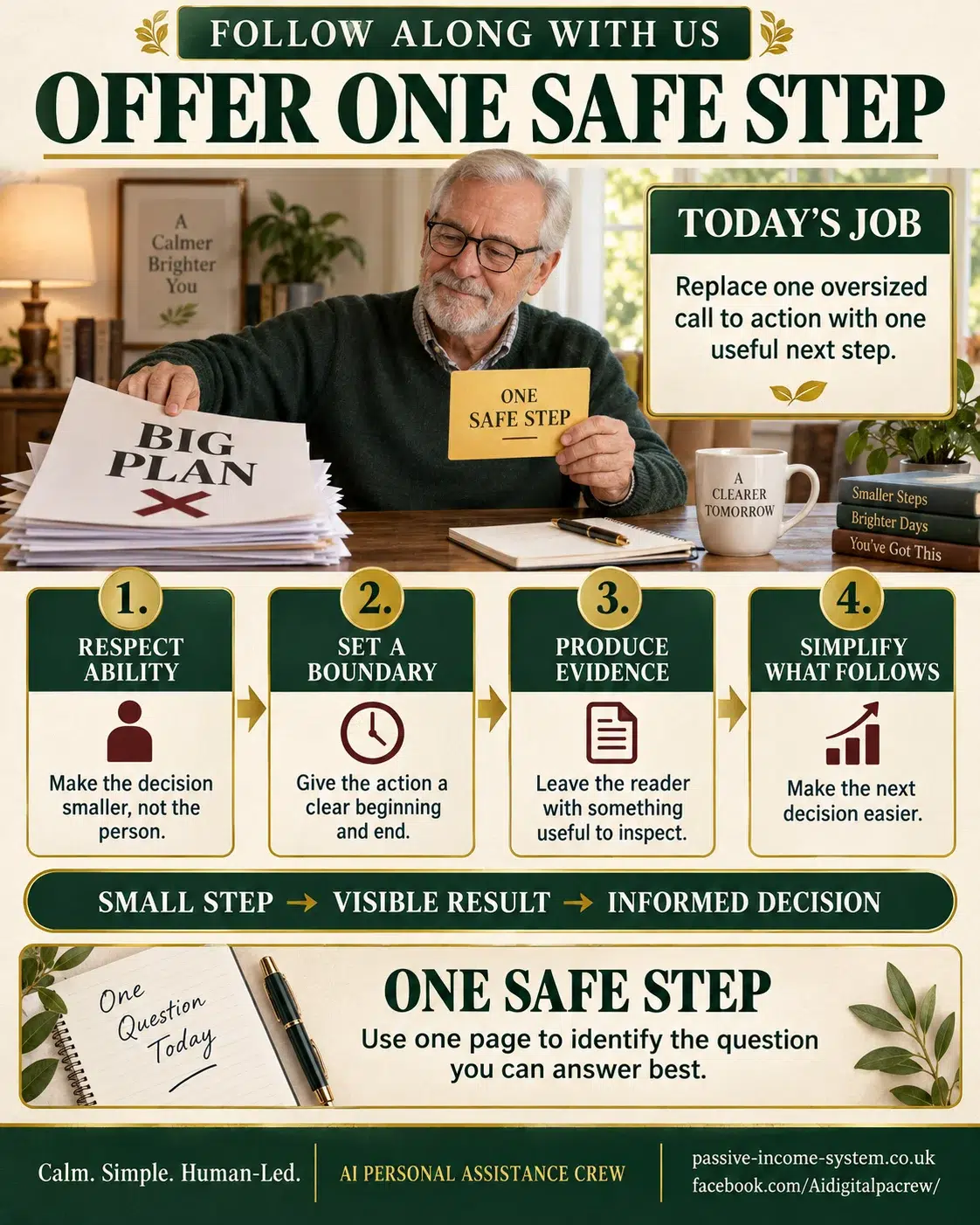
Respect The Reader’s Ability
Clear instructions don’t require childish language. An older beginner may be unfamiliar with a platform while possessing decades of judgement, patience and problem-solving experience. Explain the new task plainly without treating the reader as though they have never made a serious decision.
“Write down one question people ask you repeatedly” is clear. “Don’t worry if this seems scary because computers can be difficult for older people” introduces an insult the reader never requested.
The difference is dignity. One instruction removes confusion. The other reduces the person.
Give The Action A Visible Boundary
A safe step should have a recognisable beginning and end. “Build your online presence” has neither. “Write a five-point answer to one familiar question” has both.
Boundaries help the reader estimate the commitment. They know what must be completed and when they may pause. This is especially important for people who have purchased courses that continually opened into another module, another upgrade and another job.
A bounded action says, “Complete this one useful thing, then inspect it.” It doesn’t smuggle tomorrow’s workload into today’s invitation.
Produce Evidence The Reader Can Inspect
An action earns its place when it makes something clearer after you complete it. The reader might discover which skill is easiest to explain, whether a checklist makes sense or whether the teaching style suits them.
The evidence doesn’t need to be dramatic. A rough one-page outline can answer an important doubt: “Can I organise what I know so another person can follow it?”
That is more useful than another hour spent consuming broad encouragement.
Make The Following Decision Easier
The result should naturally point to one next question. After selecting a useful problem, the reader can decide how to package the answer. After creating a first version, they can ask one person to test it. After receiving feedback, they can repair the earliest point of confusion.
If the completed action produces six unrelated possibilities, the step has widened the decision rather than reduced it.
A Safe Step Can Fail Even When It Looks Generous
Consider a creator offering a free bundle containing an ebook, a prompt collection, three videos, two worksheets and access to a private group. On paper, the value appears impressive. The bundle contains more material than some paid products and has probably taken considerable effort to assemble.
However, our cautious retiree opens the folder and meets nine starting points. Which item comes first? Do you need to watch the videos before using the prompts? Does the worksheet depend upon the ebook? Will joining the group produce further instructions?
The creator has reduced the financial risk to zero while leaving the decision burden fully intact.
A better invitation might extract one worksheet from the bundle and give it one job: help the reader identify the question they are best equipped to answer. The remaining material can become useful later, once the reader has evidence that continuing makes sense.
This isn’t withholding value. It is sequencing value.
Sometimes generosity means giving less material when more would create confusion. The creator’s job is not to empty the entire van onto the customer’s drive. It is to bring forward the tool needed for the job in front of them.
When you offer one safe step, the strongest value may come from removing choices rather than adding resources.
Let The Reader Stop Without Paying A Confidence Penalty
A reversible action feels safer because the reader can inspect the result without becoming trapped inside the process. They can complete the exercise, compare what happened and decide whether to continue.
Reversibility doesn’t mean the action is meaningless. It means stopping carries no hidden punishment.
A free software trial may seem reversible, but it becomes less safe if payment starts automatically and cancellation is hard to find. Joining a community may appear reversible, but it feels less safe if leaving produces guilt or repeated messages. Downloading a worksheet is reversible when the reader can use it independently and ignore the wider offer if it doesn’t suit them.
This matters for retirees who have accumulated old courses, unused tools, and hard-drive folders containing purchases once presented as essential. Their caution may not be resistance to learning. It may reflect lessons learned from experience.
Respecting that caution can strengthen trust. Explain what happens after the click. State whether you need an email address. Identify any cost, follow-up or additional tool. Let the person know where the first task ends.
An honest boundary can make a small action feel genuinely safe.
Offer One Safe Step That Connects To A Real Destination
Safety alone is not enough. The action must still lead somewhere useful.
“Think about what you enjoy” may feel gentle, but it doesn’t necessarily help an experienced retiree identify a viable digital asset. “Write down three questions people have asked you for help with” connects their experience to visible demand. The task remains manageable while the destination becomes clearer.
Our wider route is practical:
- Choose one useful answer from your lifetime experience.
- Turn it into one simple digital asset.
- Create one traffic path towards interested readers.
- Build trust by showing the work and answering genuine doubts.
- Present one honest offer and measure what happens.
The reader doesn’t need to complete the entire route today. Yet today’s step should belong to that route. Otherwise, small actions become a collection of pleasant diversions.
Offering one safe step isn’t removing ambition. It gives ambition a usable first foothold.
Apprentice Task: Replace One Oversized Call To Action
Choose one article, social post, email or sales page you have already created. Find the action you currently ask the reader to take.
Write that action at the top of a page, then test it:
- Does it respect the reader’s existing ability?
- Does it have a clear beginning and end?
- Will it produce something the reader can inspect?
- Will that evidence make the following decision easier?
If any answer is no, reduce the commitment without reducing the person.
Instead of “Join my complete programme,” you might write: “Use this one-page exercise to identify the question you’re best equipped to answer.”
Instead of “Start your online business today,” try: “Turn one familiar answer into five practical points another beginner could follow.”
Instead of “Explore all our resources,” choose the single resource that answers the doubt raised by the current post.
Open to See This Video, And This Is What’s Already Built,
Trained & Waiting For Your First Command.
Your finished safe step should tell the reader exactly what to do, what they will have afterwards and where they may stop to inspect the result.
That is how you offer one safe step without pressure or patronising reassurance. The reader remains capable, the decision becomes manageable, and the next move is supported by evidence rather than borrowed confidence.