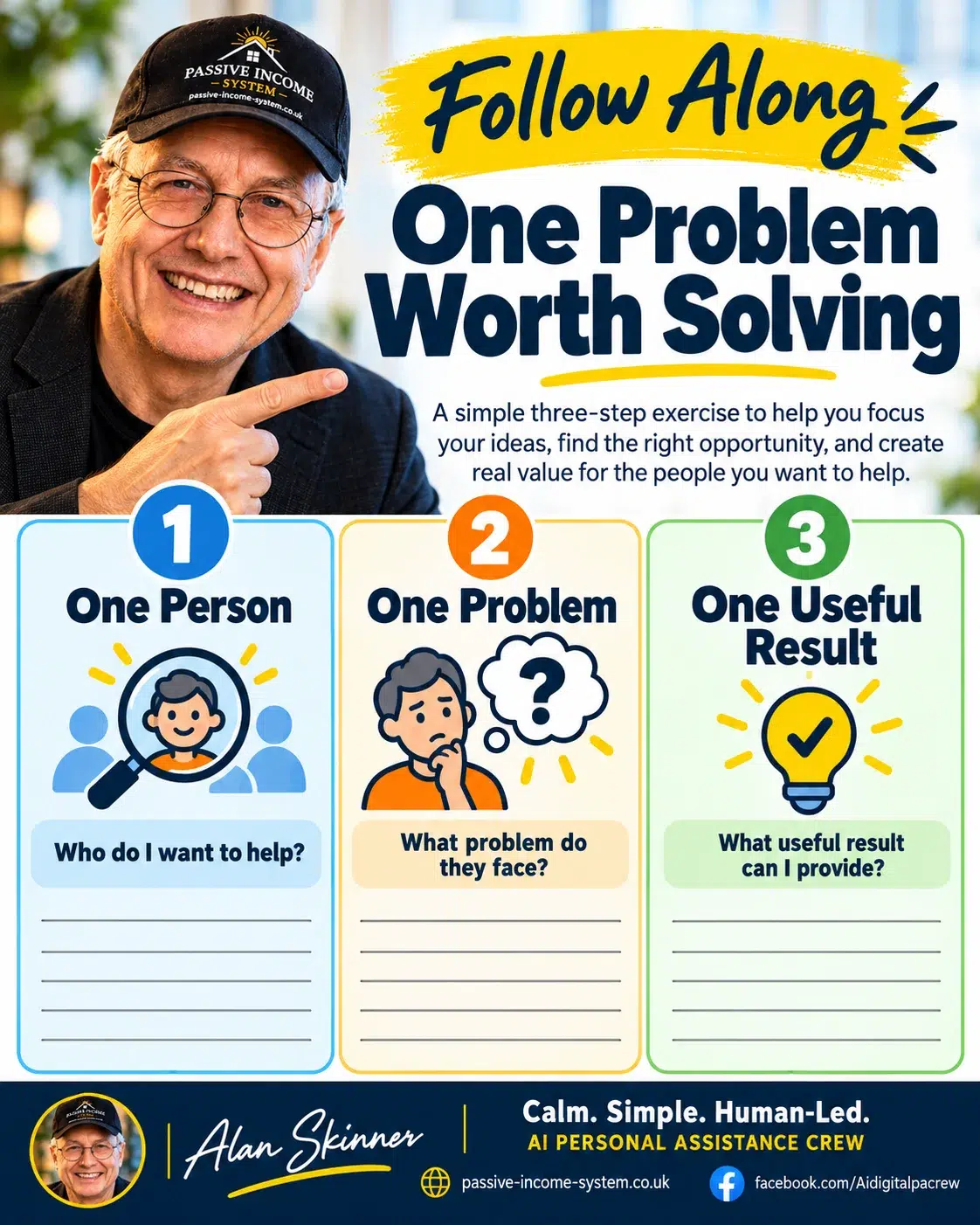
Find One Problem Worth Solving Before Building Anything
What if your first useful digital product begins with a problem you’ve already helped somebody solve?
Your Experience Can Reveal One Problem Worth Solving
Picture someone who needs your help, and imagine the difference a clear explanation could make.
One Problem Worth Solving Can Become Your Starting Point
You don’t need a complete business plan today. You need one reader, one genuine difficulty and one useful result.
Turn Experience Into Income by Finding One Problem Worth Solving
Open the Everyday Expertise Workshop
Let Your Working Life Supply the Raw Material
Phillip arrived at Wilson’s house with a laptop, two mugs of tea and a rather ambitious spreadsheet. He’d created columns for product categories, marketing channels, estimated prices, software subscriptions and potential monthly revenue. Wilson examined the spreadsheet, then asked where they were supposed to write down the problems people had actually asked him about. Phillip admitted that he hadn’t included a column for that. The moment was instructive. He’d built a planning system for selling a product before discovering which problem the product might solve. Wilson pushed the laptop aside and took out an ordinary notebook.
“Let’s start with the questions,” he said.
That’s where today’s practical workshop begins. If you’re a complete beginner, you may think digital-product creation starts with choosing a tool. You may have seen software that promises to produce reports, ebooks, checklists or courses in minutes. Some tools can certainly help you prepare useful material, but none can reliably decide what part of your life experience matters to a real reader without the right information. The technology comes after you decide who you’re helping and what problem needs addressing. Finding One Problem Worth Solving begins with noticing where your own experience could make somebody else’s next step easier.
For now, our aim is deliberately modest. We’re not creating a website or opening an online shop. We’re identifying one useful lesson that may deserve to become a small digital product. The job can be completed using your existing AI assistant and a simple written description of your experience. If you prefer paper, begin with a notebook. If you’re comfortable typing directly into AI, that works just as well. Choose the method requiring the fewest unnecessary transfers, because the thinking matters more than the software.
Step One: Three Questions Reveal One Problem Worth Solving
Start by remembering ordinary conversations from your working life. Don’t begin with qualifications, certificates or job titles. Think about times when someone approached you because they didn’t understand something. Customers may have asked for explanations. Colleagues may have requested help. Apprentices may have struggled with basic decisions. Friends or neighbours may still ask questions years after you’ve retired. These memories are useful because they connect your knowledge to situations where someone actually needed help.
Write down three questions as closely as possible to the way people asked them. A retired gardener might remember, “Why won’t anything grow along this fence?” A former bookkeeper may recall, “Which of these receipts should I keep together?”
A retired heating engineer might remember, “What should I tell the engineer when one radiator isn’t warming properly?” Don’t translate these questions into impressive professional language. The ordinary wording is part of their value. It helps you recognise the problem from the beginner’s point of view. One Problem Worth Solving may be hidden inside a question you’ve answered dozens of times without thinking twice.
Avoid trying to answer the questions immediately. At this stage, you’re collecting evidence from your own memories, not producing finished lessons. If you begin explaining every possible technical detail, you’ll quickly lose sight of the pattern we’re investigating. Keep the questions short and specific. If you cannot remember the exact words, write a reasonable description and mark it as your recollection rather than presenting it as a verbatim quotation. Accuracy matters because the purpose is to examine genuine experience, not manufacture customer demand.
When you’ve written three questions, read them as though you were unfamiliar with your occupation. Can you understand the situation? Does the question suggest a problem someone might recognise? If the answer is unclear, simplify the wording. Wilson began with a question about heating symptoms because the intended homeowner could picture the situation. He didn’t begin with an elaborate explanation of system components. That distinction helps us keep the final product focused on the person who needs it.
Step Two: Identify the Decisions You Make Without Thinking
Now examine the practical judgements you developed through experience. These are often harder to recognise because they’ve become automatic. Consider what you notice before beginning a task, what information you gather before deciding and what makes you choose one sensible action over another. You might recognise warning signs, ask useful questions or notice missing information that a beginner wouldn’t understand. These observations can reveal teaching opportunities that don’t appear on a conventional list of professional skills.
A retired office administrator, for example, might instinctively know that documents need to be separated by purpose before they can be organised reliably. The beginner may place everything in one drawer and hope to find it later. An experienced gardener might examine the conditions in a particular part of the garden before suggesting suitable plants. The beginner may choose flowers based entirely on their appearance. A former shopkeeper might consider what information is needed before preparing an order. Someone with less experience may discover the missing information only after making a mistake.
Write down three of these decisions. The objective isn’t to prove that you’re clever or unusually accomplished. It’s to recognise the practical thinking that has become ordinary to you. Where possible, express each decision as something you check, compare or consider before taking action. That makes it easier to identify whether a beginner could benefit from a short explanation or worksheet. It also reveals the difference between teaching somebody what to think and helping them understand how to make a sensible decision.
Wilson remembers that he never assumed two similar heating symptoms necessarily had the same cause. He learned to gather relevant information and recognise when a qualified professional’s inspection was required. That experience could help a homeowner prepare an accurate description, but it wouldn’t justify creating a remote repair manual for unsafe work. The boundary is important. A useful information product should explain appropriate observations and decisions without encouraging readers to exceed their competence or rely on unsupported technical advice.
Step Three: Find the Mistakes You’ve Repeatedly Helped People Avoid
Next, think about mistakes that appeared regularly during your working life. Some may have involved missing information, unsuitable preparation or misunderstandings that were easily prevented with a clearer explanation. Others may have been complicated failures requiring specialist intervention. We’re primarily interested in the former, because they may support practical, beginner-friendly resources. A small worksheet that prevents avoidable confusion can be more manageable than a detailed manual covering every possible thing that might go wrong.
An experienced seamstress may remember beginners cutting fabric before carefully checking the measurements. A retired bookkeeper might recall clients arriving with documents so poorly organised that essential information was difficult to identify. A gardener may remember people repeatedly choosing plants unsuited to a particular border’s conditions. These examples suggest possible lessons, but they need to be narrowed. The product shouldn’t attempt to prevent every mistake in a trade. It should help the intended reader recognise or avoid one clearly defined difficulty.
Write down three mistakes you’ve encountered, along with the information a beginner would need to understand them. Avoid describing people as foolish or careless. What looks like an obvious error to an experienced person may reflect unfamiliar instructions, missing information or assumptions that nobody has explained. A useful teacher identifies the point where understanding breaks down and offers an appropriate correction. That’s a more constructive starting point than presenting a collection of mistakes merely to demonstrate professional superiority.
You now have up to nine observations: three questions, three decisions and three common mistakes. Some will overlap. That’s acceptable. If the same underlying problem appears in more than one category, it may deserve closer investigation. However, repetition inside your notes doesn’t prove current demand. It simply suggests that the problem appeared regularly during your working life. We still need to decide which possibility offers the clearest reader outcome and which questions require evidence from people today.
Turn One Problem Worth Solving Into A Digital Asset
Step Four: How To Identify One Problem Worth Solving
Phillip looked over Wilson’s notes and immediately wanted to combine several ideas into a comprehensive homeowner’s heating course. Wilson shook his head. One product that addressed every radiator problem, unfamiliar heating noise and possible maintenance issues would require substantial work and careful technical verification. It would also be difficult to explain to a reader looking for one simple answer. Wilson preferred the narrower question about preparing information before contacting an engineer. He could picture the intended reader and understand what that person wanted to achieve.
Use the same approach with your own nine observations. Look for the problem that is easiest to describe to somebody unfamiliar with your background. Ask whether you can identify the intended reader, explain the difficulty and name one realistic result. If the idea requires a complicated course before the beginner can make progress, it may be too broad for a first product. If the result is so trivial that people already solve it immediately using existing resources, it may offer too little value. The aim is a manageable problem that genuinely benefits from a clear explanation.
Consider a former bookkeeper with several options. She could teach complete bookkeeping procedures, explain how different documents are used, or create a worksheet to sort a mixed collection of receipts. The third option may be easiest to turn into a first resource because its practical result is clearly defined. A reader could understand what the worksheet is meant to help organise and what it doesn’t cover. That doesn’t mean somebody will buy it. It means you can explain and test the idea without first building an enormous product. Before creating a complete digital product, check whether One Problem Worth Solving genuinely matters to the people you hope to help.
Choose one observation and complete a simple statement in ordinary language: “Somebody who struggles with this problem could use my experience to help them achieve this result.” If the sentence feels confusing, narrow the problem. Promising more than your information can reasonably deliver requires reducing the claim. If the reader would need specialist advice rather than a general resource, acknowledge that limitation. This statement becomes the working foundation of your digital product idea.
Step Five: Give Your AI Assistant One Useful Job
Now we can introduce AI without allowing the software to take over the decision. Its job is to examine your description of your working experience and organise the possibilities into a practical Everyday Expertise Audit. You don’t need to create a separate digital product, write a full report or answer a long questionnaire before beginning. You already have enough information to start a useful conversation. The key is to share genuine experience and tell the assistant not to invent proof of demand or professional qualifications.
Use the complete reader-facing AI prompt supplied in Part 3. Replace its example with a short description of your own experience, including a few questions, decisions or mistakes you remember. The assistant should identify possible problems, examine which reader might benefit and suggest one focused resource worth investigating. It should distinguish what you’ve actually told it from reasonable inferences. That distinction matters because AI can suggest plausible situations that sound convincing without knowing whether they occurred in your working life.
The best result won’t necessarily be a particularly clever product name. It will be a clearer understanding of one potential reader problem. Suppose AI suggests that Wilson could create a homeowner’s preparation checklist. Wilson can examine the proposed contents and decide whether they reflect his genuine expertise. He can remove unsupported technical claims, adjust the language and identify information that needs current verification. The machine helps organise the material, while the human remains responsible for deciding what is accurate and appropriate.
If the assistant produces nine exciting product titles, three complicated sales plans and a promise of recurring monthly revenue, it has wandered off task. Bring the focus back to one recognisable problem and a modest, useful result. You don’t need more possibilities merely because software can generate them. Our working rule is to reduce unnecessary choices, not multiply them. The right outcome is a product concept that can be explained, checked and tested without demanding another week of planning.
Step Six: Check Whether the Problem Still Exists
Experience identifies possibilities. Current evidence helps determine whether those possibilities deserve attention. Wilson remembers homeowners asking particular questions years ago, but heating equipment and information resources have changed. A retired administrator may remember paperwork problems that newer software now handles differently. A gardener may find that suitable free guidance already exists. None of these discoveries makes the original experience worthless. They affect whether a particular paid product would still offer value today.
Begin with a simple investigation. Look for recent questions from people in the intended audience. Notice whether several individuals describe similar frustrations, what explanations they’ve already tried and what remains unclear. Examine existing resources and consider whether your proposed product would help in a way those resources don’t. If you’re dealing with technical, financial, health-related or regulated subjects, check applicable current authoritative guidance and define appropriate limitations. Don’t rely solely on practices you remember when mistakes could have serious consequences.
You can also ask a few relevant people what they would expect from the proposed resource. Show them a short description, not a complete unfinished book. Ask what problem they think it addresses, what information they hope to receive, and whether existing explanations already meet their needs. Their answers may reveal missing details or show that your idea needs adjusting. Feedback can establish relevance, but only an appropriate purchase test can provide stronger evidence of willingness to pay. A useful answer isn’t automatically a commercial opportunity. The purpose of choosing One Problem Worth Solving is to help one identifiable reader achieve something practical, rather than attempting to please everybody.
This stage deserves care because Turn Experience Into Income isn’t meant to encourage retirees to spend their money and time pursuing every attractive idea. It’s meant to identify opportunities with a reasonable basis for further testing. Sometimes the sensible decision is to share the information for free. The product may require a narrower audience. Sometimes another question from your working life will offer a stronger starting point. A practical apprenticeship teaches you how to make these decisions rather than promising every attempt will succeed.
Keep the First Digital Product Manageable
Step Seven: Choose a Format That Fits the Job
Once you’ve identified one possible reader problem, consider which simple format could support the promised result. A printable checklist may suit someone who needs to remember a sequence of observations or questions. A worksheet can help them organise information and make a decision. A short PDF report may be more appropriate when the reader needs an explanation, examples and practical guidance. The format should follow the job. Don’t begin by choosing a forty-page ebook merely because a particular piece of software can produce one.
For Wilson, a homeowner’s preparation checklist is more appropriate than a comprehensive heating manual. The reader needs a way to record what they’ve noticed, organise relevant information and prepare for a qualified professional’s visit. A simple PDF could include plain-English instructions, a section for recording symptoms, and space for useful questions. It should make clear that it doesn’t diagnose faults or authorise repairs. That boundary protects the reader and helps keep the product consistent with its promise.
A retired gardener might need a different approach. A worksheet for investigating a shaded border could include spaces to record sunlight conditions, soil observations and existing plant difficulties. It might explain how those observations can inform further research before selecting replacements. A retired administrator could produce an organising template with labelled categories and a worked example. In each case, the creator selects only the information the beginner needs to complete the task, rather than assembling everything connected to the broader occupation. Your achievement today is identifying One Problem Worth Solving and understanding why somebody might welcome your help.
Choose the smallest format that can responsibly deliver your intended result. Then write down what absolutely must be included. If a section doesn’t help the reader understand the problem, make the intended decision or complete the promised task, ask whether it belongs. A first product doesn’t become more valuable simply because it contains more pages. The most useful information may be what makes an unfamiliar job feel manageable.
What You’ve Built and What Happens Next.
Today’s Apprentice Task: Build One Front Door
Open to See This Video, And This Is What’s Already Built, Trained & Waiting For Your First Command.
Phillip began the workshop with a spreadsheet full of software subscriptions and imagined earnings. Wilson began with a notebook and a handful of familiar questions. By examining those questions, the decisions behind them and the mistakes beginners often make, Wilson identified one useful product possibility. He didn’t create an entire business. He discovered a problem worth investigating, considered the appropriate reader and chose a sensible format for a possible resource.
You’ve now followed the same method. Your Everyday Expertise Audit should contain genuine observations from your working life, a recognisable reader problem and one practical result your knowledge might help provide. You should also understand why current verification and honest feedback matter before committing substantial time to production. That is meaningful progress because the vague ambition to create an online income opportunity has become a specific idea that can be examined.
Part 3 takes that idea to the finishing bench. You’ll use one complete AI prompt, compare the result with a worked example and check whether your proposed resource is clear, realistic and worth investigating further. The finished job isn’t a guaranteed sale. It’s a practical product brief that guides creation and helps you get useful reader feedback without wandering through unnecessary tools.
Test One Problem Worth Solving Before Building More

 Start by remembering ordinary conversations from your working life. Don’t begin with qualifications, certificates or job titles. Think about times when someone approached you because they didn’t understand something. Customers may have asked for explanations. Colleagues may have requested help. Apprentices may have struggled with basic decisions. Friends or neighbours may still ask questions years after you’ve retired. These memories are useful because they connect your knowledge to situations where someone actually needed help.