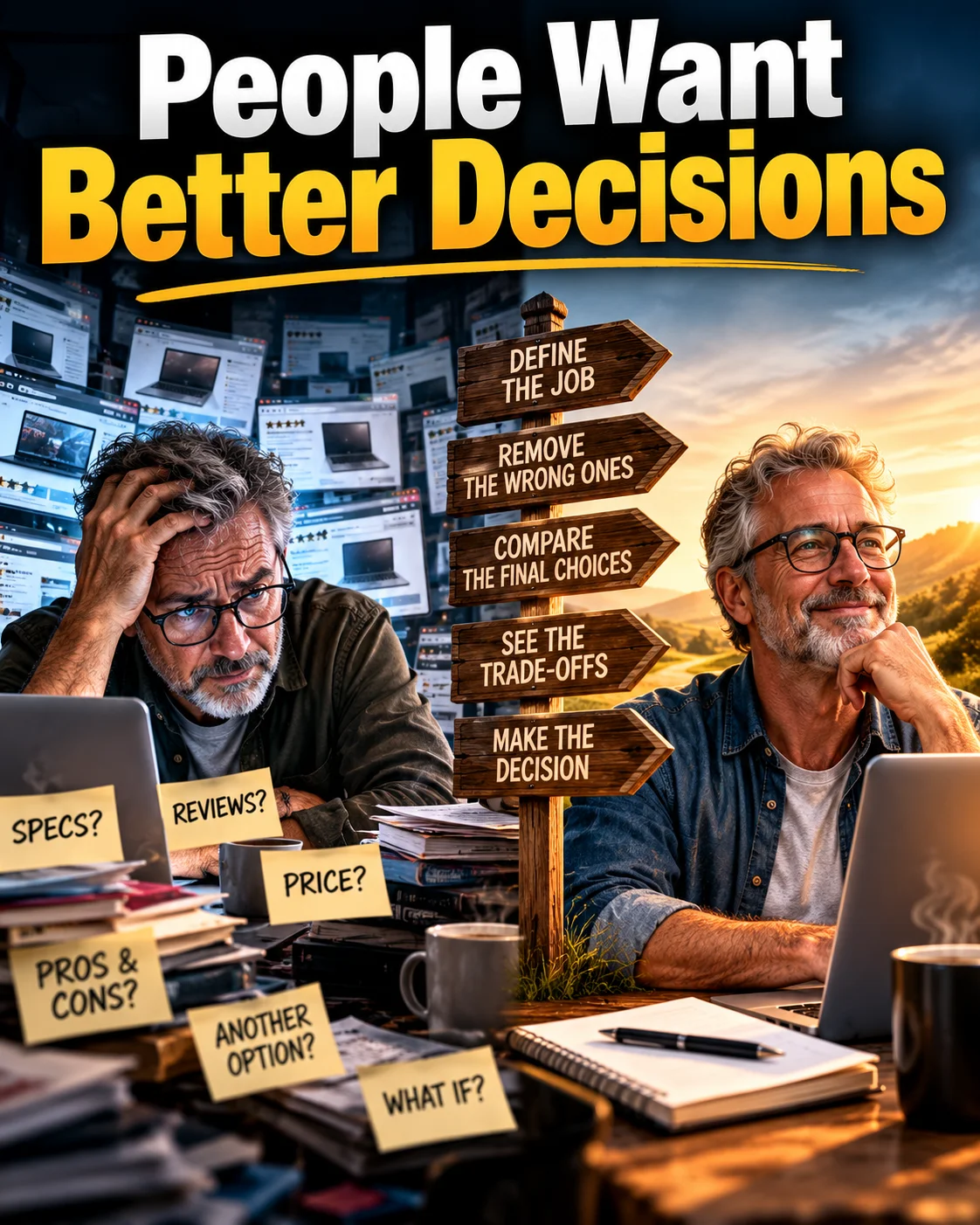
People Want Better Decisions, Not More Information. Why?
More facts can increase confusion when the real problem is unresolved uncertainty.
People Want Better Decisions When Too Many Choices Create Doubt
Narrowing the field makes it easier to compare what actually matters.
People Want Better Decisions When The Tradeoffs Become Clear
A useful choice becomes easier when the gains, drawbacks and next step are visible.
Why People Want Better Decisions Instead Of More Information
More information can help, but real relief often comes when someone finally feels confident enough to stop searching and choose.
People Want Better Decisions When Too Many Choices Create Doubt
The internet can answer almost any buying question, yet too many answers can leave the buyer less certain than when they started.
People Want Better Decisions Because Information Alone Does Not Finish the Job. A useful digital assistant should help narrow the field, highlight the key trade-offs, and guide the person toward a decision they can understand and act on.
A familiar scene plays out in homes every evening. Somebody sits down after tea intending to spend ten minutes choosing a new laptop, booking a weekend away, comparing broadband or finding a decent local tradesman. An hour later, the tea has gone cold, twelve browser tabs are open, three YouTube reviewers disagree, and the person who started with a simple question now knows far more than they ever wanted to. They have processor numbers, star ratings, contract lengths, prices, special offers and opinions coming out of their ears. What they still lack is a decision. That’s where the modern internet reveals one of its strangest weaknesses. It is exceptionally good at providing information. It isn’t automatically good at helping a person know when they have enough.
That matters because People Want Better Decisions, not an endless supply of additional facts. A search engine can return another hundred pages. A retailer can offer another twenty alternatives. A review site can display another comparison chart. None of those things guarantees that the buyer feels any closer to choosing. In fact, the opposite can happen. A new option can bring another regret. Every extra feature raises another question. Every recommendation makes the buyer wonder whether the recommender noticed something the previous reviewer missed. The search keeps moving because the buyer assumes the unfinished feeling means they have not researched enough. Yet very often the research is already sufficient. What remains unfinished is the uncertainty. Once you see that distinction, the job changes completely.
A man looking for a laptop for ordinary home use does not need to become a part-time computer engineer. Suppose he wants email, online banking, Facebook, Zoom, photographs and some writing. His budget is around £700, and he prefers a larger screen because it is easier on his eyes. Those are useful facts. Yet after half an hour online, he may compare graphics processors, refresh rates, storage technologies and specifications designed for games he will never play. The industry has given him more information, but much of it is about jobs he doesn’t need the machine to do. The real breakthrough comes when somebody asks a much simpler question: What does this laptop actually need to do for you? That one question can remove half the market before another review is opened.
This is where a useful AI assistant earns its keep, not by producing a longer list, but by narrowing it. When the buyer expects the computer to sit mostly on a desk, extreme portability matters less. When gaming is irrelevant, move the expensive graphics power down the list. If photographs matter, storage matters more. If a larger display reduces eye strain and makes everyday use easier, screen size becomes more valuable than shaving a few hundred grams off the weight. Notice what has happened. No magical new information appeared. The assistant connected the facts that mattered to the human being making the decision. That is the difference between information retrieval and decision support.
Riley’s Wisdom Drop #14: More Information Is Not Always More Progress When the buyer already understands the main options, another page of facts may add noise instead of confidence. Progress begins when the information is connected to the job the person actually needs done.
The easiest way to spot the problem is to watch the questions change. At the beginning of a search, somebody asks useful factual questions. What is the price? How large is the screen? How long is the contract? Does the hotel have parking? Does the tradesman cover my area? Those questions close genuine information gaps. Later, the questions often become more anxious. Could there be something better? If I regret it? What if I am paying too much? What if I have missed a review? That shift is important. The buyer has moved from gathering facts to trying to eliminate uncertainty. Unfortunately, no amount of searching can promise that another option will not appear tomorrow. A decision has to be made before perfect certainty exists.
That is why People Want Better Decisions should become more than a catchy phrase for us. It describes the job underneath a whole category of useful AI assistance. The customer does not necessarily want AI to know everything about laptops, holidays, broadband, local services or music. They want AI to help make sense of what matters in their particular situation. A useful assistant asks what the job is, removes choices that obviously don’t fit, highlights the differences among the survivors, and explains the recommendation in ordinary language. It turns “Here are twenty possibilities” into “These three fit what you told me, and this is the one I would choose first.” That is a very different experience.
The trade-off is where many buyers finally become unstuck. Most worthwhile choices aren’t about finding an option with every advantage and no drawbacks. They are about deciding which drawback matters least. A laptop might cost £100 less but have a smaller screen. Another might have more storage but be heavier. A broadband deal might be cheaper for six months but lock the customer into a longer contract. A hotel might be closer to the town centre but lack easy parking. A local tradesman might not be the cheapest but may be available sooner and communicate more clearly. Once those trade-offs are visible, the buyer has something real to judge. Until then, they can remain trapped in a vague search for “the best”, as though one universally perfect answer is hiding somewhere on page twelve of Google.
And that word, people want better decisions, causes more trouble than it appears to. Who benefits most? Which job fits best? But at what price is it best? Ideal for someone who travels every week, or for someone whose laptop never leaves the dining room? Best for a couple who want a quiet weekend or a family travelling with grandchildren? Best for a technically confident buyer, or someone who wants it to work without needing a manual? Search results often rank products as though everyone is asking the same question. Real people are not. Their circumstances change the answer. The strongest recommendation is rarely “This is the best product.” It is more often, “Given what you told me matters, this is the strongest fit.”
That gives us a practical rule to carry into every decision: don’t compare everything against everything else. Compare the strongest remaining choices against the job that needs doing. That one change can turn an exhausting search into a manageable decision. Rather than asking if Laptop A is better in every category, consider whether either machine performs the buyer’s work comfortably. Instead of reading every review of ten hotels, identify which three meet the required location, budget and accessibility needs. Instead of chasing every local tradesman, remove anyone who cannot handle the job, doesn’t cover the area, or cannot work within the required timeframe. Elimination is not a shortcut around good research. It is how good research becomes usable.
This is especially valuable for older buyers who didn’t grow up believing they had to become experts in every product category before spending money. The modern web has quietly pushed that burden onto ordinary people. Want a television? Learn screen technology. Want broadband? Learn fibre terminology. Want a phone? Learn cameras, processors, storage and operating systems. Want an AI tool? Compare models, plans, limits and features. It is easy to mistake all that available information for empowerment. Sometimes it is. Sometimes it simply means the customer has been handed the catalogue and told to sort it out. A Digital PA can perform a much more human job: “Tell me what matters to you and I will help reduce this to something manageable.”
Riley’s Wisdom Drop #15: The Best Choice Is Usually The Best Fit Stop searching for the option that wins every comparison. Find the one that does your job well without making you pay for advantages you don’t need.
That is also why the final recommendation matters. Too many AI answers finish by retreating into safety. They produce a neat list of pros and cons, then end with, “Ultimately the choice depends on your individual requirements.” Of course it does. The buyer already knew that before asking. A genuinely useful assistant can remain honest without becoming useless. It can say, “Based on the information you supplied, I would choose Option B because you said screen size and simplicity matter more than portability. Option A is cheaper, but it compromises the feature you are most likely to notice every day. Option C is more powerful, but you have not described a use that requires that extra performance.” The assistant isn’t deciding for the person. It is making its reasoning visible enough for the person to agree, disagree or adjust.
That is the moment the decision begins to feel finished. The reason is not that every possible fact has been collected. Not because risk has disappeared. Not because an AI has declared an answer from on high. It feels finished because the buyer can explain why one option fits better than the others. The reasons line up with their own priorities. The biggest trade-off is visible. No obvious decision-changing fact is missing. Another hour of searching is unlikely to alter the result. You can finally close the browser tabs.
So when somebody says, “I need to do a bit more research,” there is one question worth asking before sending them back into the search results:
What information are you still missing that could realistically change your decision?
If they can name it, go and find it.
If they cannot, they may not need more information at all.
They may need help finishing the decision.
Section 2 can now take that into the practical mechanism: Gaffer: narrowing the field, exposing the trade-offs, the Decision-Finished Test, and today’s Apprentice Task.
People Want Better Decisions When The Search Needs A Finish Line
Once the buyer understands that the real problem may be unresolved uncertainty rather than missing information, the next job becomes practical. How do you know when you have enough? How do you stop a sensible search turning into an evening of comparison tables, reviews and second-guessing? The answer is not to stop researching too early. It is to give the decision a finish line before the search begins. Without that finish line, every new option can feel relevant, every reviewer can reopen the case, and every small difference can look more important than it really is. A useful decision process therefore needs a sequence. Define the job first. Remove what obviously does not fit. Compare the strongest remaining choices. Expose the trade-offs. Then ask whether any missing fact could still realistically change the result. That sequence turns browsing into a decision.
The first step is defining the job. This sounds almost too simple, yet it removes an extraordinary amount of unnecessary comparison. Someone choosing broadband might say, “I want the fastest package.” That sounds clear until you ask what the connection actually needs to support. Two people browsing, streaming TV, making occasional video calls and doing normal home use may not need the same package as a household with several heavy users, gaming consoles and constant large downloads. The useful question is not, “Which package has the biggest number?” It is, “What job does the connection need to perform comfortably?” Once that is clear, People Want Better Decisions becomes a practical rule rather than an interesting observation. The choice can be judged against the job instead of against the entire market.
Then comes elimination. This is where AI can save the buyer a lot of wasted effort without pretending to replace judgment. Ask the assistant to remove anything that fails a non-negotiable requirement. A hotel outside the required area goes. A laptop above the maximum comfortable budget goes. A tradesman who cannot take the job within the required timeframe goes. A software tool that lacks the one feature needed for the work goes. Notice the language here. We are not asking AI to find the winner yet. We are asking it to remove the obvious losers. That is easier to reason about and easier to check. When twenty options become four, the buyer has not lost choice. They have removed noise.
This is one of the strongest lessons hidden inside People Want Better Decisions. The fastest route to a good choice is often subtraction, not addition. Buyers naturally think more options lead to better decisions. Quite often, better decisions come from knowing which options no longer deserve attention. A supermarket shelf with forty nearly identical products feels like freedom until somebody has to choose one. The same thing happens online, but on a much larger scale. Search gives us abundance. Decision-making requires reduction. Once the unsuitable options are removed, the buyer can finally inspect the differences that matter instead of spending energy on choices they were never realistically going to make.
Riley’s Wisdom Drop #16: A Shortlist Is Progress When twenty choices become three sensible ones, you have not lost opportunity. You have removed twenty-seven reasons to hesitate.
The shortlist should then be compared against personal criteria, not generic rankings. This is where the buyer moves from “Which one is best?” to “Which one fits me best?” Suppose someone is choosing a holiday cottage. Their five criteria might be easy parking, ground-floor access, a quiet location, dog-friendly rules and a total price under £700. Another buyer could look at the same three cottages and rank them completely differently because nightlife, public transport and proximity to restaurants matter more. Neither person is wrong. The ranking changes because the job changes. A useful AI assistant can make those priorities visible, then explain how each option performs against them. That makes the recommendation easier to understand and much easier to challenge if something feels wrong.
This is also where trade-offs stop being an irritation and become useful evidence. Every remaining option will probably give something and take something away. That is normal. One holiday cottage may have the best location but weaker parking. Another may cost slightly more but offer easier access. Another may be cheaper yet require a longer walk into town. If the buyer keeps searching because no option wins every category, the search may never end. The stronger question is, “Which disadvantage bothers me least?” That question often reveals the winner faster than asking which option has the most advantages. A decision becomes easier when the buyer stops expecting perfection and starts judging acceptable compromise.
There is another useful distinction here. Some differences are decision-changing. Others are merely interesting. If one laptop has twice the storage and the buyer keeps thousands of photographs locally, that difference may matter. If another has a marginally faster processor that the buyer will never notice in normal use, that difference may not matter at all. The buyer needs a way to separate the two. Ask of every new fact: Would this realistically change which option I choose? If the answer is no, the fact may be worth knowing, but it no longer deserves to control the decision. That single question can stop a lot of unnecessary research.
The Decision-Finished Test
This is where the process earns its finish line. Before searching again, run the decision through four checks.
First: Do I understand the main options? If not, more research may be justified.
Second: Do I know what matters most to me? If not, the problem is not lack of product information. The priorities need clarifying.
Third: Can I explain the main trade-off between the final choices? If not, compare the survivors more carefully.
Fourth: Is there any missing fact that could realistically change my choice? If not, the research phase is probably over.
That final question is the brake pedal. It stops curiosity disguising itself as necessity. There is always another article to read, another review to watch, another product to discover or another opinion to collect. The internet has no natural finishing point. The buyer has to create one.
Imagine a retiree choosing between three laptops after narrowing the market. It costs £579 for Laptop A and offers the largest screen plus adequate performance. Laptop B costs £649, has more storage and slightly better battery life. Laptop C costs £749 and is considerably more powerful. The buyer mainly works at home, prefers a larger screen, stores photographs but also uses cloud backup, and does not play games. At this stage, another review of processor benchmarks probably will not change the decision. The real choice is between saving money, paying more for storage and battery life, or buying performance that may never be used. Once framed that way, the decision becomes understandable.
A useful AI assistant might say: “I would choose Laptop A. It performs the work you described, gives you the larger screen you value, and avoids paying for power you are unlikely to use. Laptop B is worth considering if local photo storage matters more than the extra £70. Laptop C appears unnecessary for the job you described.” That is a much stronger answer than a generic ranking because it connects the recommendation directly to the buyer’s priorities. If the buyer suddenly says, “Actually, I am starting video editing next month,” the recommendation can change. That new fact genuinely changes the job. Good decision support remains flexible when the circumstances change.
This is exactly where AI should be useful without pretending to be infallible. The assistant can organise information, expose trade-offs, narrow the field and explain its reasoning. The human still decides whether the priorities are correct and whether the recommendation feels right. That division of labour matters. People Want Better Decisions, but they do not need to hand over responsibility for their choices. AI’s useful role is to reduce unnecessary complexity and make the reasoning easier to inspect. Humans still know what matters in their own lives.
There is another advantage. Once the buyer can explain why they chose something, the decision becomes less fragile. Without clear reasoning, a new advert tomorrow can reopen the whole process. A competitor drops the price. A reviewer praises another model. A friend says they bought something different. Suddenly the buyer starts doubting again. But if the decision was built around clear priorities and visible trade-offs, the new information has to pass a higher test. Will it change the job? Does it change one of the important criteria? Does it expose a serious drawback we missed? If not, you can keep the decision closed.
Riley’s Wisdom Drop #17: A Finished Decision Has Reasons If you can explain why the choice fits your job, another shiny option has to bring genuinely new evidence before it deserves to reopen the case.
This principle reaches far beyond buying products. It works when choosing a traffic source, deciding which AI tool should join a digital crew, selecting a blog topic, planning a holiday, comparing a local service or deciding whether an online offer is worth pursuing. The pattern is the same. Define the job. Remove what clearly does not fit. Compare the survivors against personal criteria. Make the trade-offs visible. Check for one decision-changing missing fact. Then choose. The subject changes. The thinking process survives.
That is why today’s four-word phrase has more weight than it first appears. People Want Better Decisions because information has become cheap and abundant. The scarce part is judgment. People can open another tab. Anyone can ask for another list. Anyone can collect more specifications, recommendations or opinions. The useful person, tool or Digital PA is the one that helps turn those facts into a clear next move.
Today’s Apprentice Task: Build One Front Door
Open to See This Video, And This Is What’s Already Built, Trained & Waiting For Your First Command.
Today’s Apprentice Task: Finish One Real Decision
Choose one decision you are currently delaying. It could be something you want to buy, a piece of software you are considering, a service you need, a holiday choice, a traffic platform, or even a small business decision.
Do not begin by searching again.
Write down the job the choice needs to perform. Remove anything that clearly fails that job. Reduce the remaining options to the strongest three.
Choose up to five things that genuinely matter to you.
Look at the main trade-off between the finalists. Then ask one final question: What information am I still missing that could realistically change my decision? If you can name something important, find that fact.
If you cannot, stop searching. Make the decision. Because the internet will always offer you another option. A better decision begins when you know you no longer need one.
People Want Better Decisions Make Choices With Confidence

 That matters because People Want Better Decisions, not an endless supply of additional facts. A search engine can return another hundred pages. A retailer can offer another twenty alternatives. A review site can display another comparison chart. None of those things guarantees that the buyer feels any closer to choosing. In fact, the opposite can happen. A new option can bring another regret. Every extra feature raises another question. Every recommendation makes the buyer wonder whether the recommender noticed something the previous reviewer missed. The search keeps moving because the buyer assumes the unfinished feeling means they have not researched enough. Yet very often the research is already sufficient. What remains unfinished is the uncertainty. Once you see that distinction, the job changes completely.