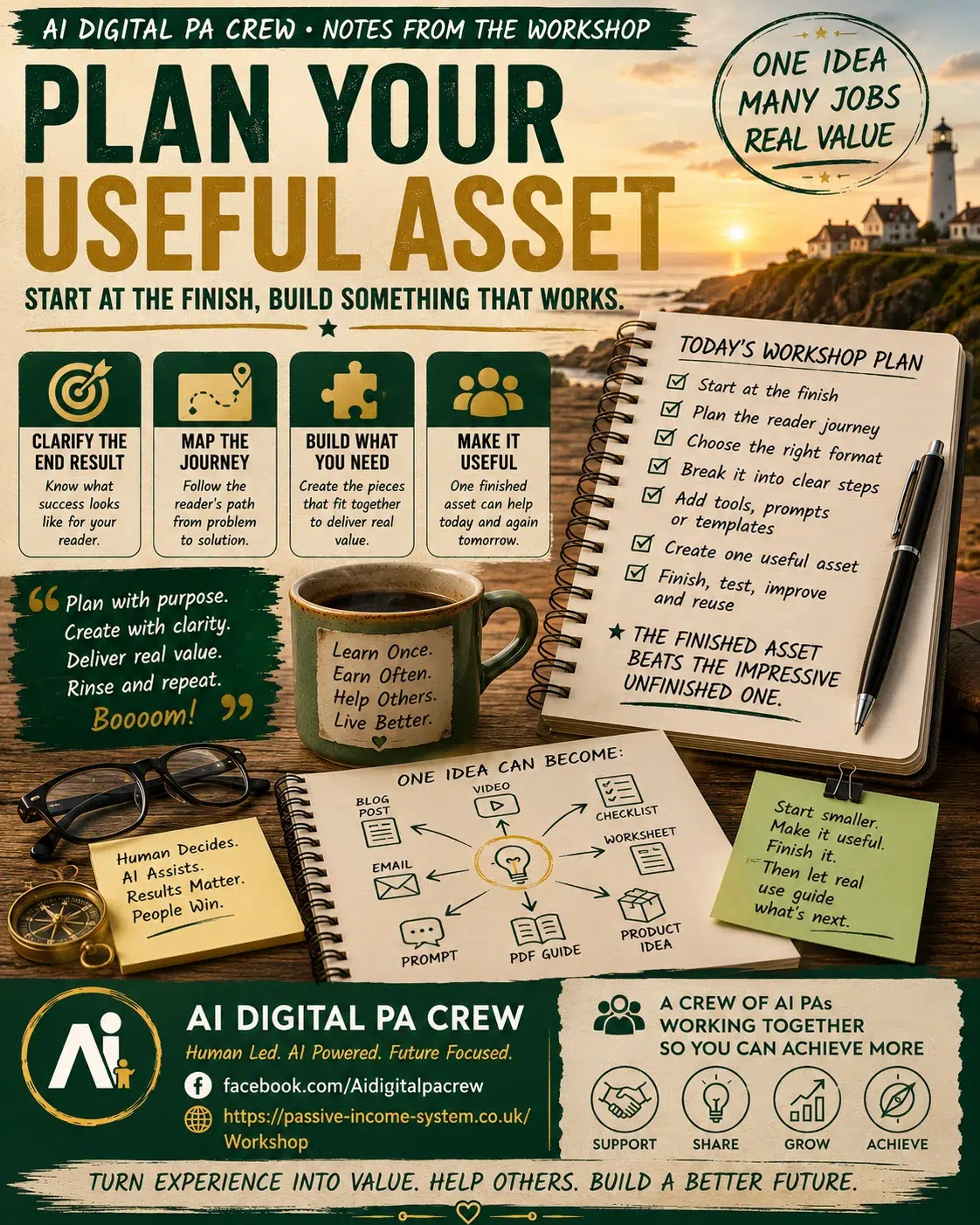
Plan Your Useful Asset And Build With Confidence
Plan Your Useful Asset by deciding what your reader should understand, decide or do when they reach the finish.
Use The Reader’s Journey To Plan Your Useful Asset
A clear finish line helps you decide what belongs in Version One and what can safely wait.
Give Every Part Of The Asset A Job
Useful sections move the reader towards one clear improvement instead of simply displaying everything you know.
Build Around The Reader’s Journey
Arrange the help in the order a beginner needs it, from their starting problem to the better position they want to reach.
Start At The Finish Before Opening The Toolbox. The easiest way to make a small digital asset enormous is to begin with a blank page and ask, “What shall I put in this?” It sounds sensible. Unfortunately, the moment an experienced person asks that question, forty years of knowledge start queuing at the door. One useful point reminds you of another. Then comes the story that explains it beautifully. Then the warning you cannot possibly leave out. Before the kettle has boiled, yesterday’s one-page checklist has developed chapters, bonus material and ideas above its station. Today we are going to Plan Your Useful Asset from the opposite direction. Before deciding what goes in, we decide exactly where the reader needs to come out.
Decide What Better Looks Like For The Reader
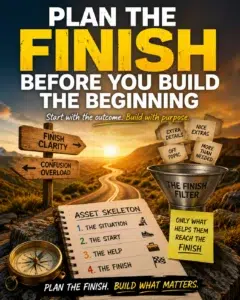 That gives us one question that can do a surprising amount of work: “After somebody has used this, what should they be better able to understand, decide or do?” Notice that we are not asking what they should know about the whole subject. We are asking what should be different afterwards. They could ask a better question. Compare three choices. Avoid one common mistake. Organise something that was confusing them. Use an AI assistant for one simple job. That finish line matters because once you can see it clearly, every idea you are tempted to add has to prove that it helps the reader get there.
Your Experience Can Be Bigger Than The Asset
This is particularly important for retirees creating from a lifetime of experience. The problem is rarely that there is nothing useful upstairs. Quite the opposite. The cupboards are full. You have lessons, shortcuts, mistakes, stories, warnings and little bits of judgement that became second nature years ago. When you start creating, they all feel connected because, in your experience, they are. But the beginner on the other side of the asset does not need your entire filing cabinet emptied onto the table. They need the right piece at the right moment. Your experience can remain enormous while the first useful asset stays wonderfully small.
The Finish Line Starts Editing Before You Write
Bring back our retired heating engineer. He has already identified his person and his useful job. A homeowner has received a boiler replacement quotation and does not know what questions to ask before agreeing to the work. Our engineer could sit down and list everything he knows about domestic heating. Boiler types, controls, radiators, warranties, pipework, water pressure, servicing and enough airing-cupboard stories to keep a public bar entertained until closing time. But none of that tells him what belongs in Version One. So instead, he writes the finish first: “After using this asset, the homeowner should be better able to ask sensible questions before deciding whether to accept the quotation.”
Look what that one sentence immediately does. Does the homeowner need a history of central heating? No. Do they need to understand every boiler on the market? Not for this job. Do they need a lecture on radiator sizing? Probably not. Do they need to know which questions could reveal something important about the quotation and why those answers matter? Absolutely. We have not written the asset yet, but we have already rejected half a dozen tempting detours. That is the hidden value of planning the finish first. The intended improvement becomes an editor before the writing even begins.
Give The Asset A Simple Skeleton
Now we can Plan Your Useful Asset around four simple points. First comes the situation: where is this person right now? Second comes the start: what do they need to understand before anything else will make sense? Third comes the help: what minimum useful guidance do they need to move forward? Fourth comes the finish: what should they be better able to do afterwards? That is our Asset Skeleton. It is not a business plan, a twenty-seven-box flowchart or an excuse to buy another piece of software. It is simply enough structure to stop the asset from wandering off while we build it.
For the homeowner, the situation is uncertainty about an unfamiliar quotation. The start might be a brief reassurance that they don’t need to become a heating engineer before asking sensible questions. The help could be five carefully chosen questions with one plain-English explanation beneath each. The finish is a clearer conversation before you decide. Situation. Start. Help. Finish. We can see the whole job on one sheet of paper. More importantly, we can spot anything that doesn’t belong there before wasting time creating it.
Plan Around Their Journey Rather Than Your Knowledge
This exposes another mistake experienced people can make without noticing. Experts tend to organise information by subject. Beginners organise it around the problem in front of them. Our heating engineer naturally sees boilers, controls, installation, warranties and servicing as separate areas because years in the trade have organised the knowledge that way. The homeowner does not arrive thinking, “Today I would like Module Three: Boiler Controls.” They arrive thinking, “I have this quote in my hand, and I don’t know whether I’m about to make an expensive mistake.” A useful beginner asset should follow that journey, not the creator’s internal filing system.
The same principle works with something completely different. Imagine a retired office administrator helping another retiree organise important household paperwork. She could create sections about filing systems, document management, naming conventions, retention and office organisation. All perfectly respectable. But what does her reader actually want? They may be sitting at the dining table surrounded by pension letters, insurance documents, utility paperwork and bank information, wondering where to begin. If the intended finish is, “I know what my important accounts are, who provides them and where the information is kept,” the first asset may simply need a worksheet with a handful of carefully chosen boxes.
Every Section Must Earn Its Seat At The Table
A simple diagnostic keeps that worksheet, checklist or guide under control. Take every proposed section and finish this sentence: “This section exists because the user needs to…” If the answer comes easily, the section probably has a job. “This box exists because the reader needs somewhere to record the renewal date.” Good. “This explanation exists because the homeowner needs to understand why the warranty question matters.” Good. But if the sentence becomes, “This section exists because I know quite a lot about this,” stop. Interesting knowledge is not automatically necessary help.
That does not mean throwing the idea away. Put it onto the Later List. That little list is one of the most useful tools an experienced creator can keep beside the desk because good ideas are often more dangerous to Version One than bad ideas. Bad ideas are easy to bin. Good ideas whisper, “Go on, just add another page.” Then another. The Later List lets you keep the idea without allowing it to hijack today’s job. Nothing valuable is lost. It simply waits until there is a genuine reason to give it an asset of its own.
Plan Your Useful Asset Until The Whole Job Is Visible
Before we create anything, run one final test for this half of today’s job. Try to sketch Version One on a single planning page. Not the finished worksheet, guide, prompt or checklist. Just its bones. You should be able to see the person’s situation, what they need first, the minimum help that belongs in the middle and the finish they are heading towards. If you cannot see those pieces without covering the page in arrows, extra sections and tiny handwriting, the problem may not be the page. The idea may still be trying to perform too many jobs.
That is where we stop Section One, with the asset still deliberately sitting on the planning bench. We know the person. We know the job. We can see the finish. And now we have a skeleton capable of telling us what belongs inside and what can wait outside. We have not created the finished digital asset yet, and that is precisely the point. A few minutes spent deciding what deserves to be built can save hours spent creating something the reader never needed in the first place.
Work Backwards When You Plan Your Useful Asset
And today our Workbench experiment is live too: keep working normally and notice which tabs actually get touched during this morning’s complete production run. We don’t count a tab merely because it’s open. It has to earn its place by doing a job. 🧩🔥
Use The Finish Line To Cut Away The Clutter
Once the asset skeleton is visible, the next job is not adding more. It is removing anything that does not help the reader reach the finish. This is where experienced people need discipline, because useful knowledge can be very persuasive. A point may be accurate, interesting and worth teaching somewhere, yet still have no business inside Version One. The finish line permits you to say no. If the reader can reach the intended improvement without that section, example or explanation, move it to the Later List and keep the first asset clean.
That is an important distinction. You are not reducing quality. You are reducing friction. The reader does not benefit because you included everything you know. They benefit because you included what they needed, when they needed it. A clear five-point checklist can outperform a long guide if the job is to help somebody make one decision quickly. A worksheet can be better than a video if the person needs to think through their own answers. Planning helps you see that difference before you spend time creating the wrong thing.
Make Every Piece Move The Reader Forward
A useful way to test the structure is to look at each section and ask what changes for the reader after they use it. Does it remove uncertainty? Does it help them compare options? Does it tell them what to notice? Does it help them record something important? Does it move them one step closer to the finish? If the answer is vague, the section may be decorative rather than necessary. That does not automatically make it bad. It simply means it has not yet earned its place in this asset.
Suppose our retired office administrator is building that household paperwork worksheet. One box asks for the provider name. Easy. Another asks for the account or reference number. Useful. A third asks for the renewal date. That may help prevent missed decisions later. Then she considers adding a full page explaining different filing systems. The information is sensible, but does it help the reader complete today’s job? Not really. The worksheet needs to organise the information first. Filing systems can wait. The finish line has been decided for her.
Plan Your Useful Asset In The Order A Beginner Needs It
Order matters as much as content. Experienced people often start where the subject interests them. Beginners need you to start where confusion begins. That is why a useful asset should follow the user’s journey rather than the creator’s preferred teaching order. If somebody is nervous about using AI, the first thing they need may not be a detailed explanation of models, prompts or settings. They may need to know where to type one useful instruction and what a reasonable first attempt looks like.
That small change in order can make an asset feel much easier to use. Start with the immediate situation. Then give the smallest piece of information needed to move forward. Then the next. Keep the steps close enough together that the reader does not have to carry too much in their head. By the time they reach the finish, they should feel as though the asset led them there naturally rather than dropping a pile of information in front of them and asking them to organise it themselves.
The One-Page Test Reveals Hidden Bloat
Now take your skeleton and try to fit the plan onto one ordinary page. This is not a design challenge. You are not squeezing the final product into tiny boxes. You are testing whether the idea is clear enough to see all at once. Can you write the starting situation at the top? Can you list the essential pieces in the middle? Can you write the finish at the bottom? If yes, the scope is probably under control. If the page turns into a spider’s web of arrows and extra sections, something is still too broad.
When that happens, do not solve the problem by making the planning page bigger. Diagnose the idea instead. Perhaps two different audiences are hiding inside it. Perhaps the asset is trying to solve three problems. One section has quietly become a second product. This is why planning on one page is so useful. It makes complexity visible before complexity becomes work. You can fix a crowded plan in ten minutes. Fixing a crowded twenty-page guide after it has been written is a different story entirely.
Build Backwards From The Better Decision
Another way to check the plan is to work backwards. Start at the finish and work backwards one step at a time. If the reader should be better able to compare three options, what must they know immediately before they can compare them? They may need three criteria. What must they understand before those criteria make sense? A short explanation of what each criterion means. What is their starting situation? Perhaps they have three choices but no way to judge them. That backward route tells you exactly what the asset needs and often exposes material that was never required.
This can be especially useful with AI-assisted assets because AI can generate far more material than Version One needs. Ask for ten ideas, and you may receive twenty. Ask for an outline, and suddenly you have twelve sections. The danger is accepting quantity as usefulness. Plan Your Useful Asset first, then use AI against the plan. Ask it to help with the sections that already have a job. That keeps the human decision in charge and stops the tool from deciding the scope simply because it can produce more.
Keep The Human Decision At The Centre
AI can help organise, simplify, suggest wording and test whether the structure makes sense. But the creator still decides what the reader genuinely needs. Your experience tells you which warning matters. Your judgement tells you what to leave out. Your understanding of the person tells you whether the asset should feel reassuring, practical, quick or detailed. The tool can help with the work, but it shouldn’t turn a simple job into a warehouse of content just because generating extra material is easy.
That is why the finish line matters even more when AI is involved. It gives the tool a boundary. Instead of saying, “Create a guide about household organisation,” you can say, “Help me create a one-page worksheet that leaves a retiree knowing which important accounts they have, who provides them and where the documents are kept.” One instruction is broad. The other has a finish. The clearer finish gives both the human and the AI a better chance of building the right thing.
Today’s Apprentice Task: Build The Asset Skeleton
Bring forward the smallest useful asset you chose yesterday. Write one sentence beginning: “After using this asset, the person should be better able to…” Make that finish specific. Then work backwards and write the four parts of your Asset Skeleton: the situation they are in now, what they need to understand first, the minimum useful help they need in the middle, and the better position they should reach at the finish. Keep the whole plan on one page if you can.
Now inspect every section you are thinking of adding and complete the sentence: “This section exists because the user needs to…” If you cannot finish that sentence clearly, move the idea to your Later List. Then arrange the remaining pieces in the order a beginner would naturally need them. Your aim today is not to create the finished asset. You aim to make the plan so clear that tomorrow you can begin creating without wondering what belongs inside.
Your Apprentice Task gives you today’s job. The printable Jigsaw Worksheet below helps you actually complete it. Fill in today’s piece, keep your answers, and bring them forward because tomorrow’s lesson will build directly on what you write today.
Open to See This Video, And This Is What’s Already Built,
Trained & Waiting For Your First Command.
Tomorrow’s Piece: Create The First Useful Version
Once the finish is clear and the skeleton fits on one page, the uncertainty begins to disappear. Tomorrow the job changes from deciding to making. You will already know who the asset is for, what job it performs, what belongs inside it and what has been deliberately left out. That means creation can begin with boundaries instead of guesswork.
For today, keep one rule beside you: Plan the finish, build backwards, and give every piece a job. If a section cannot explain how it helps the reader reach the finish, it can wait.
Plan Your Useful Asset Before The Good Ideas Take Over
Plan Your Useful Asset by deciding what somebody should be able to understand, decide or do when they reach the finish.