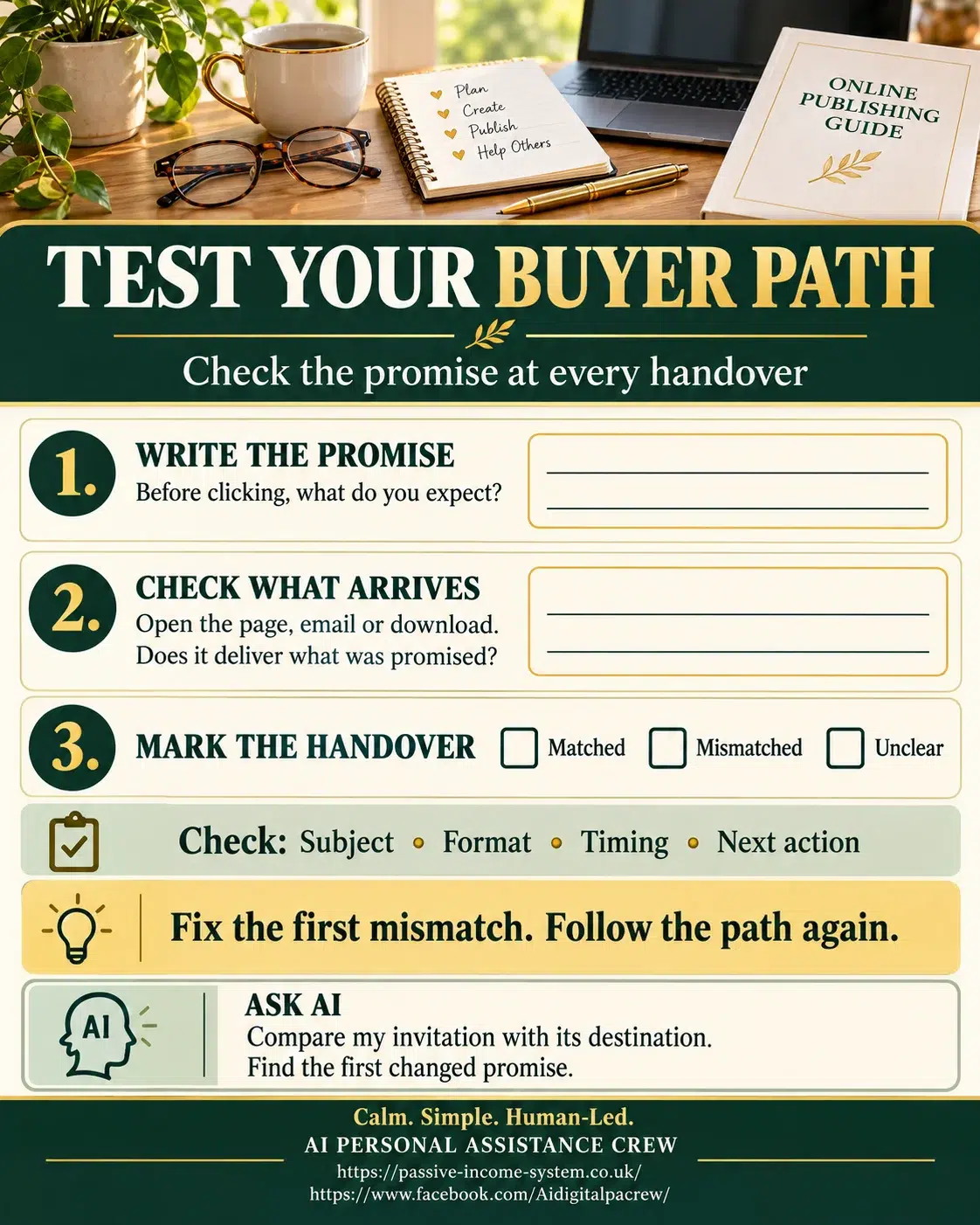
Test Your Buyer Path Before Readers Take A Wrong Turn
Every destination should deliver what the previous step promised.
A Working Link Can Still Break The Promise
A page can open correctly and give the reader the wrong thing.
Follow The Expectation Through Every Handover
Compare what someone expects with what actually arrives.
Test Your Buyer Path begins with a small moment of satisfaction. The button works. The form accepts a name and email address. The thank-you page appears, and the PDF downloads without a peep. The kettle goes on. After an afternoon wrestling with technology, the apprentice has earned a biscuit.
Then someone opens the file. They were promised a blogging checklist, but the document introduces affiliate marketing. It may be a perfectly useful guide. However, the reader arrived with a particular question, and the answer has quietly changed between the sign-up box and the download.
Nothing has broken in the machinery. Yet something has broken in the journey. The creator checked whether the link opened. The reader is checking whether it brought them what they came for. Those are two different tests, and a useful buyer path needs to pass both.
Test Your Buyer Path For Meaning As Well As Movement
 Anyone who has fitted a heating system will recognise the difference between getting water through a pipe and getting it to the right place. A sound connection counts, but so does the destination. Online, it is possible to connect several working parts while overlooking what the person travelling through them expects.
A button sends someone to a form.
The form sends them to a thank-you page. That page provides a download. Each part may behave properly on its own. Nevertheless, the words introducing those parts must describe a consistent journey.
▶ Watch Today’s Video
▶ Watch Today’s Video
The comparison is not exact, of course, but it gives us a useful way to think. Human movement also has preparation. Sometimes that preparation appears economical and almost invisible. Other times, it recruits half the body before the main job has started. The sensible response isn’t to tell the body to stop doing it immediately. The sensible response is to notice it. Here is the rule worth keeping beside your desk: a link passes its technical test when it opens; it passes its reader test when it delivers what the reader expected.
That gives a beginner something specific to examine. Instead of wondering whether the whole website is good enough, you can look at one handover. Read the invitation, write down what it promises, then open the destination and see whether it delivers.
The Creator Knows More Than The Visitor
Imagine a retired community organiser building her first online offer. She has written an article about turning years of experience into a useful guide. Beside it sits a form giving a free blogging checklist. Meanwhile, an existing affiliate marketing PDF is already connected to the thank-you page.
From her side of the desk, these things belong to the same wider project. Blogging, useful content and affiliate marketing can all play a part in an online business. Consequently, the old download seems close enough to use while she gets the new article published.
But the visitor sees a narrower job. They want help starting a blog. The word “checklist” suggests something they can work through, perhaps choosing a subject, outlining a first post and deciding what to publish. An introduction to affiliate marketing may help later, but it does not automatically do the job they expected today.
The creator can explain the connection because she knows the plan. The visitor has only the words on the page. If those words promise something different, you need to repair the connection before more people follow it.
Test Your Buyer Path Before Rebuilding The Website
Fortunately, this kind of mismatch does not always call for a new system. You have two practical options: deliver the blogging checklist you promised, or change the invitation so it accurately describes the affiliate marketing guide you already have.
Neither choice is automatically better. If the article attracts people who need a blogging checklist, creating that resource may give them the most useful next step. Alternatively, if the existing affiliate guide assists the intended reader, clear wording can introduce it honestly.
For example, the form could say “Free Guide: Affiliate Marketing From Scratch.” Its description could explain that the download introduces the basics of affiliate marketing. The thank-you page can then repeat the same title beside the download link, helping the subscriber recognise what has arrived.
Some readers may decide that guide is not what they need. That is a useful decision too. Accurate wording lets people choose an appropriate next step instead of discovering the difference after subscribing.
The Promise Includes More Than The Subject
Once the topic matches, check other details. “Watch a short demonstration” suggests a video. “Download your checklist” suggests a file available to open. “We will email your guide” tells the reader to look in their inbox. These invitations describe different experiences.
Therefore, a destination can cover the correct subject and yet surprise someone in an unhelpful way. A reader expecting an immediate download may find instructions to wait for an email. Someone expecting a short video may reach a long written article. Either arrangement can work, as long as the invitation explains it clearly.
As you Test Your Buyer Path, compare four things where they apply: the subject, the format, the timing and the next action. Does the reader receive the promised help, in the form they expected, when they expected it, with a clear way to begin?
A small sentence beside a button can settle much of this. The aim is to give people enough information to recognise the next step when they reach it. Once that is clear, you can follow the rest of the path and check whether the same promise survives each handover.
“`html
Test Your Buyer Path One Handover At A Time
Our retired community organiser now has a useful way to check her work. She starts with the words beside the form, then follows the route a subscriber would take. This time, though, she writes down the promise before opening the destination. That stops her own knowledge of the project from filling in gaps the visitor cannot see.
She compares the sign-up box with the thank-you page, then the download link with the PDF itself. If an email also delivers the guide, she checks its wording and destination too. Each neighbouring pair has a job: carry the same expectation forward.
For every handover, she asks two questions: “What did this step lead me to expect?” and “What did the next step actually provide?” Plain answers are enough. If one says “a blogging checklist” and the other says “an introduction to affiliate marketing,” the repair becomes easier to identify.
“What I Really Meant” Is A Useful Warning
A familiar temptation arises when you spot a mismatch in your own work. You explain it away. “What I really meant functioned as a guide to earning online,” you tell yourself. Unfortunately, the visitor cannot hear that explanation. They can only read the invitation you published.
That private defence is worth noticing. It often shows where you have asked the reader to supply a connection that belongs on the page. Instead of defending the wording, compare it with the resource and make the invitation accurate.
Suppose a social post says, “See how I turned one article into a video.” Its link opens a page listing AI tools. One of those tools helped produce the video, so the creator understands the connection. Nevertheless, the promised demonstration is missing.
The creator could lead with the demonstration and explain the tool afterwards. Alternatively, the social post could introduce the tool offer directly. The best fix depends on the post’s purpose, but either option makes the handover clearer than letting visitors guess.
Test Your Buyer Path When You Reuse Old Material
Reusing a working form or an existing guide can save an apprentice a good deal of effort. Yet the surrounding article may have changed since you first built that form. A familiar button can still carry the name of last month’s resource while the thank-you page delivers something else.
Consequently, a component that worked yesterday deserves another look when you place it in a new context. Check the words around it as well as the settings inside it. The same form can make a different promise when it appears beneath a different headline or beside a new description.
This is particularly relevant to a crew producing daily posts. The article changes, the image changes and the offer may change, while parts of the delivery system remain familiar. As you Test Your Buyer Path, look for yesterday’s wording hiding in today’s journey.
Matching Names Help, But Open The Actual File
A clear title makes a resource easier to recognise. If the form promises “Affiliate Marketing From Scratch,” repeating that title on the thank-you page and in the delivery email helps the subscriber know they have reached the right guide.
However, matching labels do not prove the resource does the promised job. A file called “Your First Blogging Checklist” should contain a usable checklist for that task. Open it, read it and ask what the subscriber can actually do with it.
For a beginner, that might mean choosing a subject, outlining one post or checking a first draft. If the invitation promises those actions, the resource needs to support them. Renaming a different guide will not make the missing instructions appear.
Equally, avoid making the invitation more ambitious than the resource. A short introduction can be useful when you describe it as a short introduction. Calling it a complete system creates an expectation it may not meet.
Use Three Clear Decisions To Test Your Buyer Path
You do not need complicated software to record this check. A notebook or a simple document will do. For each handover, write the promise, describe what arrives and choose one of three decisions: matched, mismatched or unclear.
“Matched” means the destination provides what the previous step described. “Mismatched” means something materially different arrives. “Unclear” means the invitation or destination leaves you unable to establish what the reader should expect.
Treat an unclear result as something to improve. A button labelled “Discover More” may avoid naming the resource, but it also gives the reader little information about where the click leads. A specific label can make both the invitation and the test more useful.
Once you repair a mismatch, repeat the handover. Then continue through the remaining steps. Changing the form heading won’t fix the whole journey if the confirmation email still promises the old download. Every place that describes the resource should agree with what is delivered.
Keep The Check Smaller Than The Whole Business
This test answers a practical question: does someone who follows the invitation receive what your words led them to expect? It cannot tell you whether every visitor will want the guide, enjoy the video or buy the offer. Those decisions require their own evidence.
However, you can check the promise before you have a large audience. That makes the task manageable for a retiree building a first buyer path. You can identify a mismatch, repair it and repeat the check without waiting for more traffic to reveal the confusion.
Your first job is to make the journey consistent. Each invitation should describe its destination accurately. Each destination should clearly explain how to use what arrived. When those parts agree, you have a firmer basis for inviting people through.
Open to See This Video, And This Is What’s Already Built,
Trained & Waiting For Your First Command.
Test Your Buyer Path: Today’s Apprentice Task
Choose one live route, beginning with the post, form or button a visitor would encounter first. Before each click, write down what you expect to receive. Then open the destination and compare it with that promise, including the subject, format, schedule and subsequent action where relevant.
Mark each handover as matched, mismatched or unclear. Repair the first mismatch or unclear invitation, then follow the route again. Finish when each step delivers what the previous one described and the reader can see how to continue.