Join our newsletter

Insights and updates delivered straight to your inbox.

Useful Content Needs Distribution After You Press Publish
Creating the asset finishes one job, but helping the right people find it starts the next.

When Useful Content Needs Distribution, One Asset Can Travel Further

Give strong content more than one road instead of replacing it with something new too quickly.

Better Distribution Shows Why Useful Content Needs Distribution

The right road helps useful content meet people who already have a reason to care.

Useful Content Needs Distribution After The Publish Button

Creating something useful finishes the production job. Helping the right people discover it begins the marketing job.
There is a surprisingly satisfying moment when the WordPress screen finally stops fighting back. The headline analyser is green. The focus phrase is sitting where it belongs. The featured image looks respectable. Grammarly has stopped waving its little red flag at every second sentence. You take one last look down the page, press Publish, and there it is. Another useful article sitting proudly on the internet. For a few seconds, it feels like the day’s work is finished. Kettle on. Feet up. Job done. Except the uncomfortable truth is that nobody outside the workshop knows the thing exists yet. Publishing has made the asset available. It has not created an audience for it. That is why Useful Content Needs Distribution. The Publish button closes one job and opens another.
The distinction sounds small, but it changes the way we think about daily content. If you treat publishing as the finish line, tomorrow morning begins with another blank page. A further article. Another image. Another SEO score. Before long, the website contains dozens or hundreds of perfectly respectable assets that received one Facebook share, perhaps one email mention, then disappeared underneath everything created afterwards. The problem is not necessarily poor content. The problem may be that production kept moving while distribution was left standing still. A carpenter would not keep making tables if the finished ones were stacked floor to ceiling at the back of the workshop with no route to a customer. Online, we can do exactly that without noticing because digital stock does not take up physical space.

Riley’s Wisdom Drop #5: Publishing Opens The Door
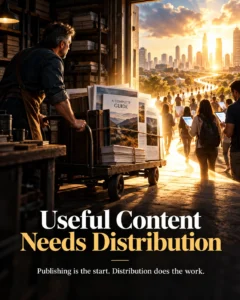
Useful Content Needs Distribution For Your Better ResultsPublishing puts the stall in the market. Distribution opens the doors and lets people walk past it.

That old market-hall picture keeps earning its place because it strips away the technical language. Imagine spending all morning arranging a beautiful stall. The stock is clean. Prices are visible. Everything has been placed carefully. Then, instead of opening the shutters, you sit behind the counter, waiting for customers who don’t know the market is open. That would look ridiculous in the real world. Online, it can look perfectly normal. We publish an article and quietly hope that search, social media, good fortune or an algorithm will eventually discover it for us. Sometimes that happens. Often, it doesn’t happen quickly enough to teach us anything useful. Useful Content Needs Distribution because a finished asset still needs roads connecting it with people who may care.

TODAY’S QUICK WATCH
Watch Today’s Video
See today’s problem-solving lesson in action.


▶ Watch Video

This is where those old Article Marketing videos from the hard drive became unexpectedly useful. The machinery belonged to another internet. Article directories, resource boxes and some of the old backlink tactics have aged. But beneath them sat a job that hasn’t disappeared. Create something relevant. Put it somewhere people interested can find it. Give those people a sensible route towards the fuller asset. The old system used the roads available at the time. We now have Facebook, YouTube, email, short video, internal links, communities, digital stalls and whatever useful platform comes next. The road changes. The distribution job remains.

One Asset Can Have A Home And Several Roads

The article stays in one place, while different introductions help the right readers discover it elsewhere.
Consider a post written for a recently retired heating engineer called “How To Turn Forty Years Of Plumbing Experience Into A Simple Digital Guide.” The full article belongs on the website. That is its home. But the idea inside doesn’t need to stay trapped there. A Facebook post could ask, “What did your working life teach you that somebody younger would gladly avoid learning the hard way?” A short video could tell one memorable story from the trade and point towards the article. An email could introduce the lesson to subscribers who already know the writer. A newer article about earning a little retirement income could link naturally to it. The article has not been rewritten four times. One useful asset has been given several roads.
That distinction matters because people often confuse distribution with creating more content. They are not the same job. Creating another article adds another asset. Distribution gives an existing asset another opportunity to meet the right person. Once that clicks, the daily workload looks different. The question is no longer automatically, “What shall we create next?” Sometimes the better question is, “What have we already created that still deserves another journey?” This is one reason Useful Content Needs Distribution fits so neatly into our current Crew system. AI can help us turn one strong lesson into a Facebook introduction, a video script, an email angle or a short clip without losing the original lesson.

Riley’s Wisdom Drop #6: Don’t Confuse More With Further

Another piece of content gives you more. Better distribution helps what you already have travel further.
Enthusiastic creators can fall into a trap here: making something new feels productive. You can see the article appear. Please save the image. You can count another post on the site. Distribution is less dramatic. Sharing an older article through a better angle or adding a relevant internal link does not produce another item in the library. Yet it may be the move that finally gives the existing asset a fair chance to work. The internet encourages visible production because it’s easy to count. Ten posts look more impressive than five. Fifty videos look busier than twenty. But numbers don’t tell us whether those assets ever reached the people they were designed to help.
The key is not to throw the same link blindly across every platform. That is activity, not a distribution plan. Different roads attract people in different situations. The person scrolling Facebook may need a question strong enough to interrupt their feed. Someone on YouTube may respond to a short explanation or demonstration. An email subscriber already knows who you are, so that you can be more direct. Somebody reading a related article on your own website may need only one sentence and a relevant internal link. The destination can remain the same while the doorway changes. That is much more useful than copying “New post, click here” everywhere and calling the job complete.
Useful Content Needs Distribution That Matches The Reader
The best road is not the busiest road. It is the road carrying people who have a reason to care.
Yesterday we looked closely at human intent, and that lesson becomes even more valuable here. Distribution only works properly when the road and the reader’s job make sense together. If somebody is trying to learn, an explanatory article or helpful video may be a good doorway. When readers compare, a concise comparison post may steer them to a more comprehensive guide. If they already trust you through email, one useful observation may be enough to bring them back to the website. Traffic isn’t just a number travelling to a page. People arrive with reasons, expectations and different stages of understanding.
This means the distribution plan should begin before the Publish button is pressed. As we decide what the article is supposed to do, we can also ask where that lesson might naturally travel. Who is it for? Where might those people already encounter this subject? What small piece of the article could make them curious enough to follow the road home? That does not require a twenty-platform marketing operation. For most of our daily posts, one home and two or three sensible roads are more than enough to start. The discipline is simply refusing to let a useful asset die quietly on the day it was born.

Riley’s Wisdom Drop #7: Give Every Asset A Travel Plan

Before you publish, know where the asset lives, where it will travel, and why somebody on that road should care.
Those three questions give us a simple distribution framework.
Where does it live?
That is the permanent asset. Usually the website, guide, video page, workshop page or another place we control.
Where will it travel?
Choose one or two suitable roads instead of spraying the link everywhere. Facebook, YouTube, email, another relevant post, a digital stall or another place where the intended reader may already be paying attention.
Why will somebody care?
This is the piece most easily forgotten. The distribution message needs a reason to travel. Pull out a question, mistake, distinction, story, practical result or useful observation from the main asset. Give somebody a reason to stop before asking them to click.
That is exactly what we have just done with the five old Article Marketing videos. They weren’t worthless because they sat on an old hard drive. They were finished assets with no roads. We gave them a modern introduction, a modern ending, clearer titles and a route through Opus to the social platforms. The lessons did not need rebuilding from scratch. They needed bringing back into circulation. Their original distribution system belonged to another era, but the underlying principle still works perfectly.
And that gives us a useful test for our own library.
Before creating tomorrow’s new asset, look backwards for a moment.
Could an article still answer a useful question?
Could there be a video that still teaches something relevant?
Is there a checklist that deserves another mention?
Is there a strong post that was published once, shared once and then forgotten?
If the answer is yes, we may not have a content shortage.
We may have a distribution shortage.
That is an entirely different problem, and thankfully, it is often much easier to fix.
Wisdom Drops are officially back in the daily template, Partner. Three per full post when the material naturally supports them, rather than bolting them on just to hit a number.
Aye Marra. Section 2 takes us from getting the asset moving into distribution debt, evidence, and knowing whether the road actually worked. I’ll keep the three Wisdom Drops already used in Section 1 for today’s full post, so we don’t overdo them.

Useful Content Needs Distribution Before More Content Is Added

When finished assets pile up unseen, the problem may be circulation rather than creation.
At some point, producing more becomes the wrong answer. It usually arrives quietly. The website already has dozens of articles. The video folder contains useful material. There are graphics, guides, old emails, checklists and perhaps several posts that were strong enough to deserve more attention than they received. Yet the daily routine still begins with a blank page because creating something new has become the habit. That is where Useful Content Needs Distribution turns into a diagnostic rather than just a publishing principle. If useful assets are accumulating faster than they are being introduced to suitable readers, the system has developed what we might call distribution debt. The work is done, but part of the job remains unpaid. More production increases the debt because every new asset joins the queue waiting for a road.
Distribution debt is easy to miss because nothing appears broken. The website still grows. The archive gets larger. The publishing calendar looks healthy. From the outside, the operation seems busy. But look at individual assets and another picture may appear. An article was published once, shared once, then never mentioned again. A video received an initial upload but was never clipped, emailed or connected to a related post. A useful worksheet exists, but newer readers have no obvious route to discover it. None of those assets necessarily needs rewriting. They may need another introduction. When Useful Content Needs Distribution, an older asset can be more valuable than a new draft because the expensive creation work is already done.
A simple way to spot distribution debt is to examine your last ten useful assets and ask one question of each: how many genuine roads did this asset receive? A genuine road means more than repeating the same bare link on several platforms. It means giving the asset another relevant opportunity to meet someone who may care. One article may have travelled through Facebook, an email, an internal link and a short video. Another may still be sitting exactly where it was published. The second asset does not automatically need four channels. It does, however, deserve a deliberate decision. Either it is still useful enough to travel, or it has done its job and can stay in the archive.

Distribution Should Teach Us Something

The purpose is not merely to create exposure. It is to discover whether the message, road and reader belong together.
Once an asset starts travelling, another job begins. We watch what happens. Not because every post must produce spectacular numbers, but because distribution gives us evidence. A Facebook introduction may attract clicks while another angle is ignored. A short video may hold attention better than expected. An email may produce replies. A related internal link may quietly move readers deeper into the site. None of these signals proves that one channel will always work, but each can teach us something about the fit between the asset, the message and the people encountering it.
This shift matters because creators can easily judge distribution by raw exposure alone. What about views? How many impressions? How many people saw the post? Those figures can be useful, but they are incomplete. A smaller response that produces a meaningful next action may teach us more than a larger number of passive views. If somebody watches a video, visits the related article and then downloads a useful worksheet, that journey tells us something. The distribution road made sense. If thousands of people see a post but almost nobody follows it anywhere, we may need to examine the hook, the audience, the destination or the reader job.
That is why Useful Content Needs Distribution and distribution needs observation. The asset travels out, and information travels back. That feedback can improve the next introduction without changing the underlying asset. Perhaps the Facebook question was too broad. Perhaps the video opening was clearer. The email audience may already have understood the problem and needed a more direct next step. We are not guessing forever. We let each distribution attempt teach us a little more about how the asset is being received.
Imagine the old plumbing-experience article again. The first Facebook post says, “Read my new article about turning plumbing knowledge into a digital guide.” It receives little response. That does not automatically mean the article is poor. The introduction may have given people no reason to stop. A second post asks, “What mistake did you learn to prevent after twenty years in your trade?” That question connects directly to the experience inside the article. If more people engage with that angle, we have learned something useful. The asset remained the same. The doorway improved.
The same logic applies to video. We have just taken those five Article Marketing lessons from an old hard drive and given them modern titles, intros and outros. Now they are scheduled to appear one at a time through Opus. The next job is not to assume distribution succeeded just because scheduling worked. We can watch which subjects attract interest, which clips hold attention and which messages send people towards another useful asset. That evidence can shape the next batch. Useful Content Needs Distribution, but distribution becomes much more powerful when it feeds information back into the workshop.

Give Strong Assets More Than One Working Life

An asset doesn’t become old simply because yesterday’s publishing date has passed.
Online, there’s a strange habit of treating content as though it has an expiry date printed on the bottom. Yesterday’s post feels old because today’s post exists. Last month’s video disappears beneath newer uploads. An article from last year can feel ancient even if the lesson inside it has not changed. This is another place where a workshop mindset helps. A useful spanner does not become worthless because it was bought twelve months ago. If it still fits the job, it stays in the toolbox.
Content should be judged the same way.
Will the article still answer a useful question?
Can the video still explain something clearly?
Does the guide still help somebody take a sensible step?
If yes, it may deserve a new path.
This does not mean endlessly reposting the same material. The new distribution should make sense. A newer post can create a natural internal link. An older article may include a section that could become a short video. Perhaps a question raised by a reader gives you a better Facebook hook. Perhaps a seasonal moment makes the lesson relevant again. Useful Content Needs Distribution when the underlying job remains useful, not merely because the calendar says it is time to repost something.
This also gives us a better way to think about repurposing. Repurposing isn’t changing the words to fill another channel. It is carrying the same useful lesson into a format that suits another doorway. The full article remains the detailed explanation. The short video becomes the introduction. The email becomes the personal nudge. The social graphic becomes the curiosity trigger. The internal link becomes the signpost. One lesson, several forms, one connected journey.
That structure also protects us from content exhaustion. A retiree building a small online system shouldn’t have to invent seven unrelated ideas every week to stay visible. One strong article can provide several sensible distribution pieces if the lesson has enough substance. That is where AI can help without taking over the thinking. AI can extract a question, identify a short video angle, draft an email introduction or suggest a social hook. The human decides whether those pieces still represent the original lesson accurately.
The goal is not maximum output.
The goal is useful circulation.

Useful Content Needs Distribution That Leads Somewhere

Every road should have a destination and every destination should offer a sensible next step.
One final danger in distribution remains. Attention can scatter just as easily as it can gather. A Facebook post points somewhere else. A YouTube description points somewhere unrelated. An email sends the reader elsewhere. The website offers three different calls to action. The asset is moving, but the journey has become confusing.
This is why every distribution road should have a clear destination.
When a social post introduces a lesson from the article, direct readers to the article.
When the video expands that same lesson, connect it to the related page.
Should the email continue the reader’s interest, provide one obvious next step.
If the article belongs inside a wider workshop journey, make that connection visible.
Distribution works best when the parts feel connected. The reader should not need to understand the whole business model. They only need to recognise the next useful step.
This matters particularly for our own system because we now have several moving parts. Daily posts. Facebook. YouTube. Opus. HeyGen. Digital stalls. The workshop. AWeber. Each one can be a useful road, but only if we know where it’s supposed to lead. Otherwise, we risk building a motorway network with no town at the end.
That brings us back to the original point.
Pressing Publish is not the finish line.
It is the moment the asset becomes ready to travel.
Before creating the next piece, ask:
A home has been found for today’s asset?
Have one or two suitable roads been identified?
Has each road given someone a reason to care?
Does the road lead to a clear next step?
What did the response teach us?
Those questions turn distribution from random promotion into a working system.

Open to See This Video, And This Is What’s Already Built,
Trained & Waiting For Your First Command.

Today’s Apprentice Task: Build One Front Door

Apprentice Task

Choose one useful asset you have already published.
Do not create anything new yet.
Write down:
The asset’s home is where it resides.
The roads are two suitable places where the intended reader may already spend time.
The reason to travel is a question, mistake, story, distinction, or useful result that introduces the asset on each road.
Its next step: what should happen when somebody follows the road home?
Then check whether the asset has distribution debt.
If it was published once, shared once, and forgotten, give it one new road before creating another asset.
Because Useful Content Needs Distribution long after the Publish button has been pressed.
The workshop does not need more finished stock hidden in the back room.
It needs more of the useful stock already made finding its way to the people it was built to help.
Useful Content Needs Distribution For Your Better Results

Leave a Comment

Your email address will not be published. Required fields are marked *


Scroll to Top