Your Best Digital Asset May Be Hiding In An Ordinary Story
Your Best Digital Asset Could Be Sitting In An Old Toolbox
The experience you regard as ordinary may be extremely useful to somebody who hasn’t lived it.
Look Again At The Stories You Nearly Dismissed
Years of practical knowledge can become invisible to the person carrying it.
A Lifetime Of Experience Contains More Than Memories
It contains decisions, warnings, shortcuts and solutions that somebody else still needs.
The box had probably been opened a hundred times, although not recently. Inside were the usual suspects: an old notebook, several yellowing photographs, a folding ruler, two instruction leaflets and a collection of odds and ends that had somehow escaped every clear-out since 1987.
Nothing appeared particularly valuable.
No rare coins hid beneath the paperwork. No forgotten insurance policy worth a small fortune. Not even a watch that might cause an excited expert on daytime television to adjust his spectacles and whisper, “Well, this is interesting.”
Nevertheless, the box contained something valuable.
It held evidence of problems solved, lessons learned, mistakes avoided and practical decisions made during a lifetime of work. The objects themselves were worth very little. However, the knowledge attached to them could still help somebody.
That difference matters because your best digital asset may not begin as a clever business idea. It may begin as an ordinary story you have told so often that you no longer notice the useful lesson inside it.
Familiar Knowledge Rarely Feels Valuable
 A retired heating engineer might remember the morning he walked into a freezing house and discovered that the expensive-looking fault was caused by something surprisingly simple.
A former office manager may remember the checklist she used to prevent important paperwork from disappearing into the wrong tray.
A grandmother who managed a tight household budget may know how to feed a family without turning every shopping trip into a financial emergency.
Ask any of them what valuable specialist knowledge they possess, though, and they may shrug.
“I was only doing my job.”
“It was just common sense.”
“Everybody knows that.”
Usually, everybody does not know that.
The beginner standing outside the experience cannot see what the experienced person sees. They do not recognise the early warning sign, the shortcut that saves an hour or the small decision that prevents a larger problem. What feels obvious after thirty years may be completely invisible during someone’s first thirty days.
This is the Familiarity Trap.
The longer you have known something, the easier it becomes to underestimate it. Repetition makes useful judgement feel ordinary. Eventually, you stop seeing it as knowledge and begin treating it as part of the furniture.
Yet your best digital asset may be hidden inside that very familiarity.
The Story Is Not The Product Yet
This does not mean every old workplace tale should immediately become a 97-page ebook.
Some stories are entertaining but have no practical destination. Others contain a useful lesson, but it remains buried beneath names, dates and details that matter only to the storyteller. The job is not to publish every memory. It is to locate the piece of experience that could help another person do something better.
Imagine a retired plumber describing a customer who repeatedly lost boiler pressure. The complete story might involve the weather, the customer’s dog, a badly parked van and a memorable disagreement with a kitchen cupboard.
Good material for a pint, perhaps.
However, the useful value may be much smaller and sharper: the three checks a homeowner can safely make before calling an engineer.
That practical knowledge could become:
- a one-page checklist;
- a short explanatory video;
- a simple illustrated guide;
- a list of questions to ask before booking a repair;
- or a homeowner’s record sheet for tracking when the pressure drops.
The story attracts attention because it is human. The lesson creates value because somebody can use it.
That is how your best digital asset begins to emerge. You are not selling nostalgia. You are extracting a useful result from lived experience.
Look For Evidence Instead Of Trying To Feel Expert
Many retirees struggle at this point because the word “expert” sounds too grand. It belongs to professors, television presenters and people who charge alarming amounts of money to speak beside a hotel swimming pool.
Fortunately, you do not need to crown yourself an expert.
Look for evidence instead.
When did somebody ask for your help?
What problem did people regularly bring to you?
Which mistake could you spot before others noticed it?
What did you show a new worker, neighbour, customer or family member how to do?
Which task became easier because you developed your own method?
The answers reveal where your experience has already proved useful. You are not inventing authority. You are noticing the times when someone else benefited from what you knew.
A retired care worker might remember teaching new colleagues how to speak calmly with a confused resident. A former delivery driver might know how to plan a route that avoids wasting half the morning. Someone who maintained a large garden for forty years may understand which jobs matter in early spring and which can safely wait.
None of these people needs to claim they know everything.
They only need to identify one useful thing they know well enough to explain.
Your Best Digital Asset Starts With One Result
A lifetime is too large to package.
“Everything I learned during forty years in business” may sound impressive, but it leaves both the creator and reader wondering where to begin. A first digital asset needs a smaller job.
One person.
One problem.
One result.
This rule protects a useful idea from becoming an unfinished monster.
Instead of creating “The Complete Guide To Plumbing,” the retired heating engineer could create “Five Safe Checks Before Calling A Heating Engineer.”
Instead of writing “Everything I Know About Office Administration,” the former office manager could produce “The Friday Checklist That Prevents Monday-Morning Confusion.”
Rather than attempting “My Lifetime Of Gardening Knowledge,” the experienced gardener might create “Seven Jobs That Prepare A Small Garden For Spring.”
The smaller promise does not reduce the value. It makes the value visible.
A reader can quickly recognise whether the asset is meant for them. The creator can finish Version One without disappearing into six months of research. Most importantly, the finished item performs a clear job.
That is the point of the Lifetime Experience To Digital Value Formula. It does not ask a retiree to squeeze an entire working life into one enormous product. It helps them separate one useful piece, shape it clearly and place it where the right person can benefit.
Stop Asking Whether Anyone Will Pay For Your Past
This is where the money question often arrives too early.
“Who would pay to hear about my old job?”
Possibly nobody.
But that is not the real question.
People are not being asked to pay for your past. They may pay for a clearer decision, an avoided mistake, saved time or a useful result your experience helps them achieve today.
The former business owner’s difficult years are not automatically a product. However, the method he developed for dealing with late-paying customers might become a useful invoice follow-up template.
The parent’s experience of raising three children is not automatically a course. Yet the weekly meal-planning sheet she refined over many busy years could help another family reduce waste and simplify shopping.
The enthusiastic golfer’s collection of memories is not automatically valuable to a stranger. However, his checklist for preparing for a first club competition could remove uncertainty for a nervous beginner.
The past supplies the raw material. Present usefulness creates the digital value.
This distinction removes much unnecessary pressure. You do not have to persuade people that your life was unusually important. You have to help one person handle one recognisable situation.
The Quiet Skill Hidden Inside A Finished Job
Practical experience contains more than instructions.
It also contains judgement.
A beginner can often find the individual steps online. What they struggle to find is the quiet knowledge surrounding those steps:
- what to check first;
- what can safely wait;
- which warning sign matters;
- when to stop;
- what usually confuses;
- which shortcut is sensible;
- and which shortcut will create twice as much work later.
This is the difference between information and experience.
A manual can explain how a task should work. An experienced person can often explain why it goes wrong in an ordinary house, office, garden, workshop or family.
That judgement could become the strongest part of your best digital asset because it shortens the road for the person following behind you.
Consider the retired tradesman who has watched apprentices make the same mistake for years. The obvious temptation is to teach the entire trade. Yet a more useful first asset might be a short guide called “Seven Checks To Make Before Starting The Job.”
It would not replace proper training. It would not pretend to make somebody qualified overnight. Its purpose would be narrower and more honest: help a beginner arrive prepared, notice common problems and ask better questions.
That is useful digital value without inflated promises.
One Ordinary Story Can Open The Door
The internet has trained people to believe that digital products must begin with market graphs, expensive software and a sudden flash of entrepreneurial genius.
Sometimes they begin with a notebook found in an old box.
A memory leads to a lesson. The lesson reveals a problem. The problem points to someone who still needs help. Then you shape the experience into something that person can understand and use.
Story to lesson.
Problem lesson.
Problem to useful result.
Useful result to digital asset.
This is not about pretending every memory contains a fortune. Most do not. It is about recognising that useful knowledge is often overlooked precisely because it has become ordinary to the person who owns it.
The first job, therefore, is not to create a course, design a sales page or worry about payment buttons.
The first job is to look again.
Somewhere among the jobs you completed, the questions you answered, the people you helped and the mistakes you learned to avoid, there may be one small piece of knowledge ready to do a new job.
And that may be where your best digital asset has been hiding all along.
Turn One Useful Story Into A Working Digital Asset
The old notebook has been opened. The story has been remembered. A useful lesson has started to show itself.
Now comes the part where many promising ideas are quietly returned to the box.
The owner looks at the handwritten notes, remembers another twenty related stories and decides the subject is far more complicated than expected. Before long, the proposed checklist becomes an ebook, the ebook grows into a course, and the course apparently requires a website, membership area, video studio and customer-support department.
Nothing has been created, but the imaginary business already needs three staff members and a Christmas party.
This is where your best digital asset needs a clearly defined job.
It does not have to contain everything you know. It only has to help one recognisable person move from a particular problem towards one useful result.
Choose The Person Before Choosing The Format
A digital asset becomes easier to shape when you can picture the person using it.
The phrase ‘everybody over fifty’ is not accurate.
Not “anyone interested in earning online.”
Not “people who need help.”
Picture one person in one recognisable situation.
Perhaps it is a recently retired electrician who wants to turn some of his knowledge into a simple guide but does not consider himself a writer. It could be a former administrator with dozens of useful templates stored in a cupboard who can’t see why anyone else would want them. It might be a pensioner watching household costs rise and wondering whether a small home-based income is still possible.
Each person needs a different first step.
If you create the asset before identifying the person, you may fill it with everything you want to say. But when you start with the reader, you can focus on what they need to understand or do next.
The question changes from:
“What can I create from my experience?”
to:
“Which part of my experience could help this person today?”
That small change gives your best digital asset a practical destination.
Find The Problem Hiding Inside The Story
Useful stories often contain a moment of friction.
Something went wrong. Someone became confused. A job took longer than it should. Money was wasted. An important step was missed. A beginner did not know what the experienced person considered obvious.
That moment is worth examining because it may reveal the problem your asset should solve.
Suppose a retired heating engineer remembers arriving at jobs where the customer could not explain what had happened. They didn’t know when the fault began, whether the pressure had changed, or which noises were unusual. The engineer spent the first part of the visit reconstructing the previous three weeks.
The useful product may not be a technical repair manual.
It might be a simple Heating Problem Record Sheet that helps a homeowner record symptoms before the engineer arrives.
The story revealed the friction. The friction revealed the missing tool. The missing tool suggested the asset.
This is a much stronger starting point than deciding to “write something about heating.”
Extract The Decision That Experience Made Easier
A beginner often does not need more information. They need help making a decision.
Should I continue or stop?
Which job should come first?
Is this normal or a warning sign?
What information should I collect?
Which option suits my situation?
What should I ask before paying?
Experienced people answer these questions almost automatically because they have seen the consequences of different choices. That ability may be the valuable knowledge hiding inside an ordinary story.
A former shopkeeper may know whether a product deserves more shelf space. A retired supervisor may know when a struggling worker needs instruction rather than criticism. An experienced home cook may know which meals can be prepared cheaply without producing three days of unwanted leftovers.
These are not merely lists of facts. They are decision rules.
A useful digital asset can capture one of those rules in a form that another person can follow. It might become a comparison sheet, diagnostic checklist, flowchart, question guide or short workbook.
Therefore, when reviewing an old story, ask:
What useful decision became easier because of what I had learned?
The answer may point directly towards your best digital asset.
Build The Smallest Version That Can Do The Job
The phrase “digital product” can make an ordinary person imagine something grand, glossy and technically difficult.
A digital asset is simply something useful that you can create once, store electronically and use again. It could be a single page.
The important question isn’t whether it looks big enough to impress strangers. The question is whether it does its job.
A one-page checklist that prevents a costly mistake may be more valuable than a long ebook nobody finishes. A five-minute video showing one awkward step may be more useful than a twelve-part course. A clearly labelled template may help somebody take action while a hundred pages of theory remain unread.
This gives us a practical Version One rule:
Include what the reader needs to achieve the promised result. Leave out everything that belongs to another result.
If the asset promises to help a beginner prepare for a first customer interview, it does not need to teach the entire business. If it helps somebody choose the right topic for a first guide, it does not need to explain advanced email marketing.
A smaller asset is not unfinished merely because more could be added.
It is finished when it performs its agreed job.
Let AI Help With The Shape, Not Invent The Experience
This is where an AI personal assistant can become a useful member of the workshop.
The retiree remains the Ideas Generator. The experience, judgement and final decisions remain human. AI helps examine the raw material, notice possible lessons and organise them into a clearer working shape.
You might describe a former job, a problem you regularly solved and a story that still stands out. AI can then help identify:
- the person who might benefit;
- the problem contained within the story;
- the judgement you may be taking for granted;
- several possible asset formats;
- and the smallest useful Version One.
However, AI should not be allowed to decorate the story with invented achievements, qualifications or results. Its job is to help you see and organise what is already present.
Think of it as an apprentice standing beside the workbench.
The apprentice can sort the tools, prepare the materials and suggest a sensible order. The experienced tradesman still decides what is safe, accurate and fit to leave the workshop.
Used this way, AI doesn’t replace your experience. It helps make the experience easier for somebody else to use.
Try This With AI
Use the AI you are already using: ChatGPT, Claude, Gemini, Grok, Meta AI, Copilot or another general-purpose AI assistant. Replace the example information in brackets with your own, then copy and paste the complete prompt into your AI.
AI Prompt
Act as a practical digital-value adviser for a retiree. Help uncover useful knowledge from a lifetime of work and life experience. Study this information: Example: I worked as a plumber and heating engineer, ran a small business, trained apprentices; I handled council contracts, renovated an old house, managed difficult customers, priced jobs, and solved heating problems. Identify five specific experiences that could help someone solve a problem, avoid a mistake, make a decision, or complete a useful task. For each one, explain who would benefit, the precise problem it could solve, the valuable judgement or shortcut the person may be taking for granted, and one small digital asset it could become, such as a checklist, worksheet, guide, template, or short video lesson.
Test Your Best Digital Asset Idea Before You Spend Weeks Building It
A promising idea still needs to survive contact with another human being.
This does not require a complicated launch. You can explain the idea to someone who resembles the intended reader and listen carefully to their response.
Do they immediately recognise the problem?
Can they understand what the asset would help them do?
Do they ask to see it?
Which part interests them?
What do they find unclear?
A polite “That sounds nice” tells you very little. A specific response such as, “I could use that before calling an engineer,” provides stronger evidence.
You can also test the idea through a short social post, email or conversation. Describe the problem and one useful lesson from your experience. Notice whether people respond with questions, share similar difficulties or ask what they should do next.
You are not asking people to buy an unfinished product. You are looking for evidence that the problem is real and the proposed result makes sense.
This feedback may reveal that your best digital asset needs a smaller promise, a clearer title or a different format.
That is not failure. It is workshop information.
Don’t Polish The Wrong Your Best Digital Asset
Retirees entering the digital world are often encouraged to begin with appearances.
Choose a brand name. Design a logo. Select colours. Build a website. Open six social accounts. Spend two days deciding whether a button should be green or slightly greener.
Those things may have their place later. But none can rescue an asset that doesn’t do a useful job.
The priority is usefulness.
Can the intended person understand it?
Can they use it?
Does it help them take an action or make a decision?
Is anything essential missing?
Is the next step clear?
Once you can answer all of these with yes, you can make the asset more attractive. Until then, polishing it is rather like painting a boiler before checking whether it produces hot water.
Build the working version first.
A First Small Sale Provides Your Best Digital Asset Evidence
The first sale doesn’t have to transform anybody’s retirement finances.
Its greater value is proof.
It shows that experience can leave one person’s head, become a usable digital asset and provide enough value for another person to exchange money for it.
That small transaction teaches lessons no collection of unfinished courses can provide. It reveals what attracted attention, what the buyer expected, what was useful and what could be improved.
Even if the first response isn’t a sale, you gain evidence.
Perhaps the problem was too vague. The title may have described the subject but not the result. The asset might have targeted the wrong person, or the right person may not have seen it yet.
Each response helps separate a practical business decision from hopeful guessing.
That is why our goal is not an overnight fortune. It is the first useful asset, the first interested reader and the first small commission or sale.
Then we learn, adjust and repeat.
Your Best Digital Asset Experience Can Continue Working After Retirement
Retirement may end a job, but it does not erase the knowledge built while doing it.
A digital asset gives one useful piece of that knowledge a new working life. It can explain something while you are having breakfast, provide a checklist while you are in the garden or help a beginner living hundreds of miles away.
It becomes a small digital apprentice.
You teach it the lesson once. It then performs that limited job repeatedly, as long as the information stays accurate and useful.
This is the deeper meaning behind “Learn Once. Earn Often.”
Income matters, especially for someone watching a pension pot grow less comfortable. Yet the asset also preserves useful knowledge, gives the retiree a fresh sense of purpose and helps another person shorten their learning road.
Good for you.
Useful to others.
Productive for the economy.
That is how the Lifetime Experience To Digital Value Formula earns its name.
Your Best Digital Asset Apprentice Task
Don’t try to map your entire life today.
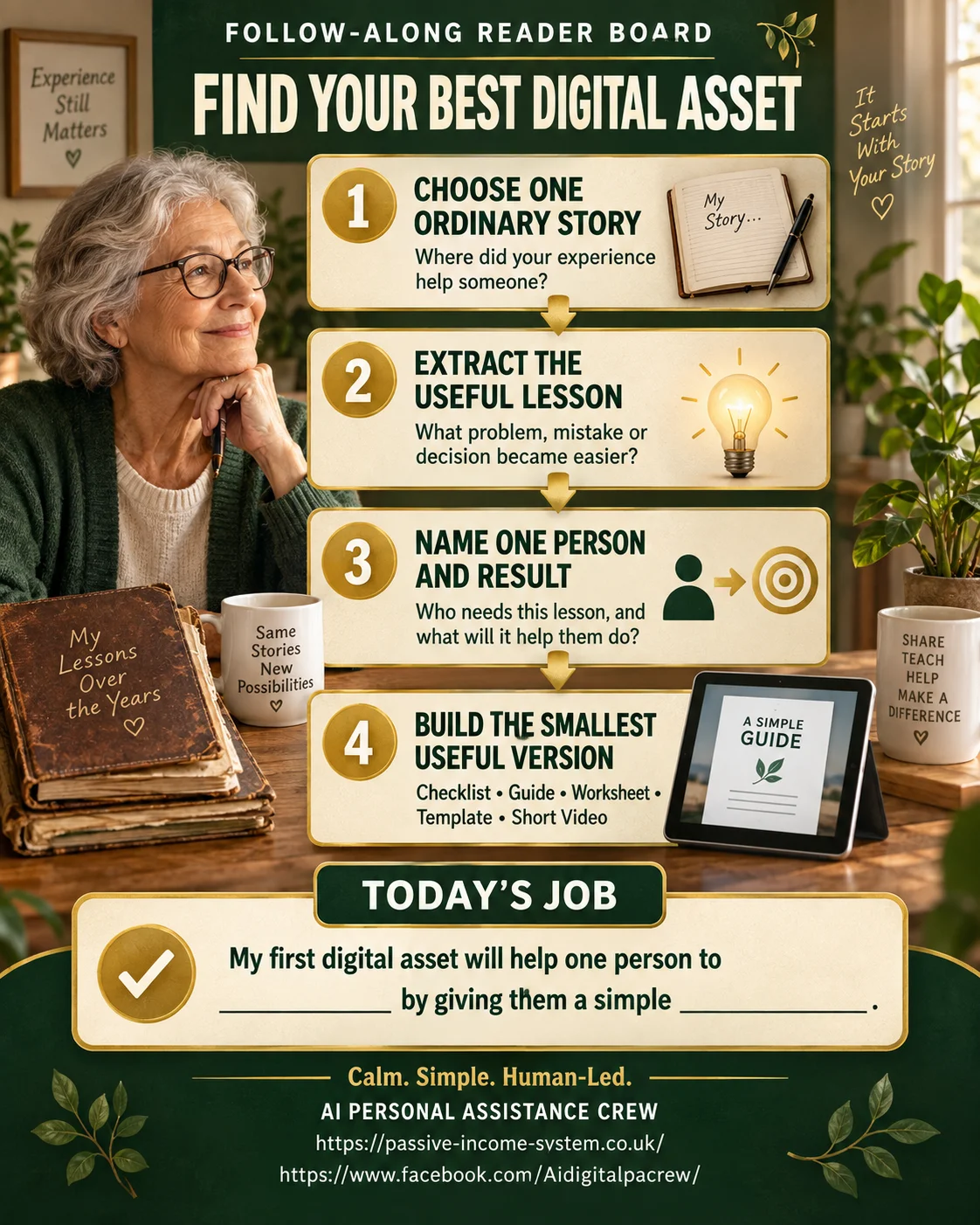
Choose one ordinary story in which your experience helped solve a problem, prevent a mistake or make a decision easier.
Write down four things:
- The person: Who could benefit from this lesson now?
- The problem: What specific difficulty are they facing?
- The result: What could your experience help them do?
- The asset: What is the smallest useful format that could deliver that result?
Then complete this sentence:
My first digital asset will help one __________ to __________ by giving them a simple __________.
Keep it small enough to finish and useful enough to matter.
Open to See This Video, And This Is What’s Already Built,
Trained & Waiting For Your First Command.
The Value Is Your Best Digital Asset
You don’t need to invent a more impressive past before you begin. You don’t need to package every year of experience into one giant product.
Start with one story. Extract one useful lesson. Match it to one person with one recognisable problem. Then build the smallest asset that can produce one worthwhile result.
That is how an ordinary memory becomes practical knowledge. It is how practical knowledge becomes a digital asset. And it is how your best digital asset can begin working long after the original job has ended.