Why Artificial Intelligence Digital Stalls Need The Right Foot Traffic
The right visitors matter more than large numbers of people who have no reason to stop.
How Artificial Intelligence Digital Stalls Turn Websites Into Working Positions
A website becomes useful when its audience, content and offer all point towards the same clear purpose.
The Four-Part Test Keeps Artificial Intelligence Digital Stalls Aligned
Domain, audience, content and offer should feel like four parts of the same conversation.
The smartest digital property in the world earns nothing if no one sees it.
Picture an old market hall at nine o’clock on a Saturday morning. The lights are on, the shutters are up, and one stall holder has spent an hour arranging everything just so. The sign is freshly painted. The stock is neatly displayed. The prices are clear. He has even polished the counter. There is only one problem. His stall is tucked down a passage where hardly anybody walks. Fifty yards away, another stall looks less impressive, yet people stop, talk, pick things up and reach for their wallets. The difference isn’t that one stallholder worked harder. The difference is foot traffic. That same distinction explains why some websites quietly gather dust while others become useful working assets. A website can be beautifully built, but until the right people pass it, it is still only digital property waiting for a job.
That is where Artificial Intelligence Digital Stalls begin to make sense.
The idea is not to build websites simply because domains are cheap, AI is clever or owning twelve sites sounds impressive. A website becomes a working digital stall when it has a clear subject, a recognisable audience, useful material on display and an offer that makes sense to the people arriving there. AI can help us create the words, pictures, videos, research and advertising around that stall, but it cannot change the oldest rule in the market hall. The wrong crowd is still the wrong crowd. If you sell fishing tackle, a thousand people looking for wedding dresses aren’t suddenly valuable just because someone calls them traffic. Online marketing has made a very ordinary idea sound complicated. In the old market hall, the stall holder asked, “Are these my sort of customers?”
Before Traffic Arrives, Artificial Intelligence Digital Stalls Need A Job
 Owning a website and running a useful digital position are two completely different jobs.
This is where many online beginners get caught. They build the website first and only later begin wondering who it is actually for. The domain is registered. WordPress is installed. A logo appears. Colours are changed several times. Pages are written. Plugins multiply like tools scattered across a workshop bench. Then the owner checks the visitor numbers and begins asking how to “get traffic.” That question sounds sensible, but it often comes too late. Before looking for more visitors, we need to know what sort of visitor would make the website useful in the first place.
Think of one of our own possible stalls aimed at retirees who want to use their lifetime experience online. The visitor may have spent forty years solving problems, managing people, repairing things, teaching, selling, caring, organising or simply learning what works through ordinary life. They are not necessarily searching for “artificial intelligence business systems.” They may simply be wondering whether what they know is still useful and whether there is a calm way to do something productive online. If our stall speaks naturally to that person, the domain, subject, and content are already starting to align. If we suddenly fill the same page with an advert for racing bicycle components because the commission looks attractive, we have broken the market logic before the visitor has even had time to understand the stall.
That gives us a simple rule we can use again and again:
Traffic is not valuable because it exists. Traffic becomes valuable when it fits the stall.
Four Parts Help Artificial Intelligence Digital Stalls Stay Aligned
Domain, audience, content and offer should feel as though they belong in the same conversation.
This is the test I want us to carry forward as we build the Internet Market Hall.
First comes the domain. It is the sign hanging above the stall. A good domain doesn’t need to explain the entire business, but it should set a sensible expectation about where the visitor has arrived.
Next comes the audience. These are our digital passers-by. What brought them into this part of the market? What problem, interest or curiosity are they already carrying?
Then comes the content. That is the display. It helps the visitor understand what the stall knows, why it may be useful and whether it is worth stopping for another minute.
Finally comes the offer. That is the next sensible action. It might be a guide, workshop, product, recommendation, service or advertising destination. Whatever it is, it should feel like the next shelf along, not something thrown through the window from another shop.
That is our Four-Part Stall Test:
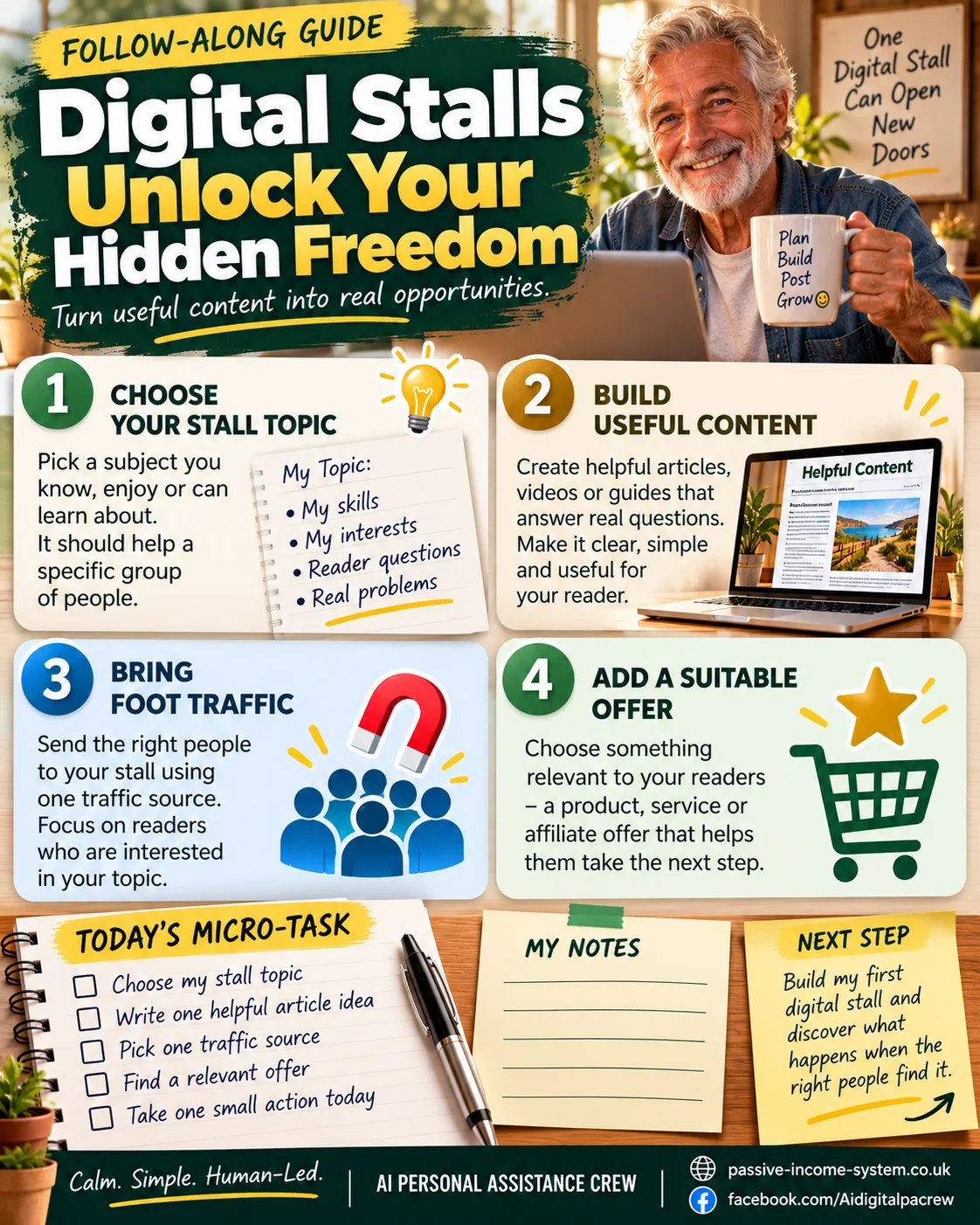
Domain. Audience. Content. Offer. Artificial Intelligence Digital Stalls work best when each website has a clear job, a matching audience and a useful reason for people to stop.
If those four pieces line up, the stall becomes easy to understand. If one breaks away from the others, more traffic may only create more confusion.
Take a simple example. Imagine a website about beginner blogging after retirement. Its audience is largely older people trying to learn digital skills without feeling like they need another university degree. An article explains how somebody can turn one useful lesson from their working life into a blog post. At the end, a small offer for a beginner workshop shows them how to turn experience into digital assets.
That makes sense.
Now put the same workshop advert on a website entirely devoted to restoring vintage motorcycles. Some readers may be retirees. A few could even be interested. But the journey is weaker because the visitor arrived thinking about carburettors, not creating a digital asset. The website is not bad. The product is not bad. The traffic is not bad.
The relationship is bad.
That distinction stops us from wasting months blaming the wrong part of the system.
Stop Decorating The Empty Stall
AI becomes far more useful when it helps us create roads towards the right audience instead of endlessly producing more stock.
There is a dangerous comfort in building. Building feels productive because something changes every time you press a button. A new article appears. Another graphic gets created. Another page is polished. AI makes that easier than ever, so you can now decorate an empty website at extraordinary speed.
That is not automatically progress.
At some point we have to leave the workshop, open the door and find the people.
This is where the AI Crew earns its tea break. One AI can help us identify the questions our intended audience is asking. Another can help turn one of those questions into a strong authority article. Another can produce the graphic. Another can help create the talking-head video. The same central idea can then travel through Facebook, YouTube, Pinterest, email and other suitable roads back towards the stall.
Suddenly, AI is not simply helping us manufacture more content.
It is helping us create foot traffic with a reason to arrive.
And that gives us the question every future digital stall must answer before we build the next one:
Who should be walking past this stall, and why would they stop?
Section 1 sets the market-hall scene, introduces the Four-Part Stall Test, and gets us right to the point where Section 2 can move into evidence, the first stall earning the second, and our 12-website Internet Market Hall mission.
The First Stall Should Earn The Second
An Internet Market Hall grows stronger when each new digital stall is added because the previous one taught you something useful.
This is where enthusiasm can become expensive.
Once the idea of an Internet Market Hall clicks, it is tempting to think in numbers. Twelve websites. Twelve domains. Twelve different subjects. Twelve advertising positions. Then twenty. Then fifty. Then one hundred.
That sounds exciting because scale is easy to imagine.
But scale is not the first job.
The first job is evidence.
If one Artificial Intelligence Digital Stall cannot show us anything useful about the people arriving, the offer they respond to, the content they notice or the path they follow, then building eleven more may multiply confusion.
That is why I like a simple rule:
The first stall should earn the right to suggest the second.
Not necessarily with a huge sale.
Not necessarily with hundreds of visitors.
But with something useful.
A click.
An enquiry.
A question.
A page that gets more attention than another.
A video that sends people back to the website.
A reader who joins the email list.
A small commission.
A subject that clearly gets more responses.
Those clues matter because they turn expansion into a decision rather than a guess.
Imagine we begin with one retirement-focused website.
We publish useful material about turning lifetime experience into digital value. We create one carefully matched advertising page. We distribute that material through Facebook, YouTube and other suitable channels.
Then we watch.
If people repeatedly click on blog articles, that tells us something.
If the AI-related material gets attention but the digital-product pages are ignored, that tells us something else.
If people watch the videos but never move to the offer, that tells us the road may be working while the destination needs improvement.
Evidence like that can eventually justify a second stall aimed more specifically at blogging, AI help, retirement learning, digital products or another subject the audience has already shown an interest in.
We’re no longer building the second stall because we like buying domains.
We’re building it because the market has left a clue.
Let Artificial Intelligence Digital Stalls Collect Evidence Before Expansion
Clicks, questions, visits and small actions tell us far more than a network that merely looks impressive from the outside.
There is a useful distinction here between activity and evidence.
Publishing another article is activity.
Buying another domain is activity.
Creating another logo is activity.
Installing another website is activity.
Evidence is what happens after the work meets the audience.
That difference matters because AI makes activity incredibly easy.
A Crew can produce ideas quickly.
It can help draft copy.
It can make graphics.
It can repurpose material.
It can create talking-head presentations.
It can organise research.
That is useful, but it also creates a new danger.
We can now produce activity faster than we can learn from it.
The old problem was not enough content.
The new problem is creating too much content before anyone stops to ask what the market is actually saying.
So every digital stall needs a feedback habit.
Before changing everything, look for signals.
Which topic brought people in?
Which headline got the click?
Which page lost them?
Which offer felt like a natural next step?
Which question appeared more than once?
Which social post sent someone back to the site?
Which piece of content attracted the kind of reader we actually wanted?
Then ask the most useful diagnostic question:
What did the visitor do next?
That one question can tell you far more than staring at a total visitor number.
A thousand visits with no next action may be less useful than thirty visits where several people read another page, joined an email list, asked a question or clicked an offer.
Again, the number itself is not the whole story.
The relationship is.
Twelve Websites Only Become A Market Hall When Each Has A Job
The power is not owning more domains. The power is giving each digital property a reason to exist and a useful audience to serve.
Now, let’s return to the bigger mission.
Twelve websites.
Twelve digital stalls.
One Internet Market Hall.
That sentence sounds simple, but it hides a condition.
Each website must have its own job.
If twelve sites exist only to point at each other, we have not created twelve useful properties. We have created twelve addresses.
A real market hall is different.
The butcher has a job.
The baker has a job.
The fruit stall has a job.
The clothing stall has a job.
They may all live under the same roof, but nobody walks into the market expecting every stall to sell the same thing.
Our digital version should work the same way.
One site may focus on digital learning for retirement.
Another could focus on video.
Another could serve a movement or health audience.
Another could be built around blogging.
Another could serve a product category.
Another might attract people interested in local history, travel, cooking or one of the many specialist subjects already sitting inside years of accumulated experience.
Each domain becomes the sign above a different stall.
Each audience has its own reason for arriving.
Each body of content makes sense on its own.
And each advertising page must fit the people already walking through that stall.
That is the important safeguard.
The website should remain useful even if none of the other eleven sites existed.
That means we can ask a brutal little question before adding any new domain:
Would I still build this site if it could never link to the others?
If the answer is no, the site may not have a proper job yet.
That keeps us away from building an artificial collection of pages whose only purpose is passing people or search signals around.
Instead, we create individual digital properties that can stand on their own feet.
Then the Market Hall becomes the business layer sitting above them.
The Market Hall Sells Relevance, Not Just Space
The customer is not really renting a rectangle on a webpage. They are renting a useful position in front of a matching audience.
This changes what the advertising product actually is.
Suppose a blogger comes to us and wants more readers.
We do not simply say, “Here is a page. Put your link there.”
That is space.
A proper Artificial Intelligence Digital Stall should offer more than space.
We look at what the blogger teaches.
We identify which of our websites has the closest audience match.
We choose the page or subject where the advert belongs.
We create the display.
We help shape the headline.
We decide what the visitor should understand before clicking.
We check that the destination on the advertiser’s website continues the same conversation.
Then we distribute useful supporting content through the roads feeding that stall.
Now the advertiser is not just renting a link.
They are renting a position inside a relevant journey.
That is far more interesting.
Think again about the traditional market hall.
A stall selling handmade walking sticks would probably do better near people already shopping for outdoor, mobility or traditional craft products than buried beside something completely unrelated.
The rent is not valuable because the floor measures six feet by four feet.
The position is valuable because of who walks past.
The same rule applies online.
Now AI can help us match faster.
It can help analyse the advertiser’s subject.
It can help compare that subject with the content of our different sites.
It can help shape the advertisement for the surrounding audience.
It can help create the supporting article, graphic, email or video.
But the final decision about fit still belongs to us.
Human judgement chooses the stall.
AI helps us dress it.
Open to See This Video, And This Is What’s Already Built,
Trained & Waiting For Your First Command.
Today’s Apprentice Task: Build One Front Door
The Market Should Still Work Without A Search Engine Favour
If the entire idea depends on an algorithm rewarding the links between your sites, the model is weaker than it needs to be.
One final standard is worth setting now, before the Market Hall gets large enough to become complicated.
Every placement should make sense for a human visitor first.
If Google, Bing or another search engine never gives us a single extra reward for connections between the sites, the model should still work.
The website should still have readers.
The content should still be useful.
The advertising page should still be relevant.
The advertiser should still have a sensible reason to want suitable visitors from that stall.
The visitor should still understand why clicking through could help them.
That makes the business much easier to explain.
We are not promising secret search-engine tricks.
We are not pretending every link is valuable simply because it exists.
We are building digital properties, attracting relevant foot traffic and creating advertising positions where the match makes sense.
That is old-fashioned market logic using modern tools.
And perhaps that is why the whole thing feels so familiar.
We are not inventing a mysterious new kind of business.
We are taking something people have understood for generations and changing how we deliver it.
The domain is still the sign.
The content is still the display.
The prospect is still the foot traffic.
The offer is still what somebody came looking for.
AI is simply another member of the Crew helping us keep the stall stocked, presented and visible.
So before we build a second website, buy another domain or start dreaming about one hundred digital properties, the first stall has one job.
Show us who stopped, what they noticed, what they did next and what that evidence tells us to build next.
That is how twelve websites stop being a collection.
And start becoming a Market Hall.