Join our newsletter

Insights and updates delivered straight to your inbox.

Marketing Fundamentals Never Change Beneath New Technology

New tools may change the method, but the customer still needs relevance, value, and a clear next step.

When Marketing Fundamentals Never Change, Tool Choice Gets Easier

Name the job first, and the right software becomes much easier to recognize.

The Five Marketing Jobs Keep Every New Tool In Perspective

Attract, understand, create, build trust, and guide the next action before chasing another shiny platform.

Marketing Fundamentals Never Change Even When The Toolbox Does

New technology can speed up the work, but it still has to perform a useful job for a real person.
There was something almost comical about watching an old piece of internet marketing advice again and realising how little of the important bit had aged. The screen looked older. The software looked older. The terminology had that unmistakable feel of an earlier internet. Yet underneath it sat a perfectly modern question: what is the person searching for, and how closely can you match what you create to what they actually want? Years ago we might have called that long-tail keyword research. Today somebody might feed the same subject into an AI assistant and ask it to uncover questions, problems, search intent and content opportunities. The machinery has changed beyond recognition. The job underneath it has barely moved. Marketing Fundamentals Never Change because the person on the other side of the screen is still trying to solve something, understand something, choose something or move one step further forward. Marketing Fundamentals Never Change because trust still grows from relevance, clarity and keeping the promise made by the headline.
The modern internet often pushes us toward a new era, yet the real test remains constant. Tools like AI agents, video avatars, and automated content appear regularly, and platforms continually evolve. Some innovations save time, but hype can obscure a crucial question. Before judging a tool, identify the marketing job it should perform for your audience. Will it help attract the right person, reveal what they want, or simplify their next step?

The Old Marketing Job Is Usually Hiding Under The New Name

Strip away the software name and ask what useful human job is actually being improved.
Marketing Fundamentals Never Change Use Better Tools For Better ResultsMarketing Fundamentals Never Change because every new tool still has to solve an old human problem. Imagine a traditional market hall on a damp morning. Shoppers enter without caring about the stall’s processes. They do not inquire about accounting methods, stock organization, or the equipment behind the counter. They look at the sign, notice the display, and decide what matters. If they pause, the seller must understand their wants, answer questions, clarify the offer, and instill enough confidence to purchase. The key ideas traffic, attention, relevance, trust, and the next step are already present.

Our Internet Market Hall idea works for exactly that reason. A domain can act like the name above the stall. The website becomes the position you control.

TODAY’S QUICK WATCH
Watch Today’s Video
See today’s problem-solving lesson in action.


▶ Watch Video

The article, video, guide or offer becomes the display. Facebook, YouTube, search, email and other platforms become roads that can bring people past it. AI can help the stallholder prepare the display, research questions, write clearer signs and turn one useful idea into several formats. But AI does not abolish the market. Somebody still has to arrive with a reason to care. Marketing Fundamentals Never Change here either, because people still need to know what sensible step comes next. That is where Marketing Fundamentals Never Change becomes more than a nice phrase. It becomes a practical way to decide whether a new tool deserves a place in the Crew or is simply another shiny object looking for a job.

This also explains why yesterday’s old long-tail thinking still felt so familiar. The clever part was never merely discovering a string of words with less competition. The real value was that the longer phrase often revealed more about the person. “Make money online” could mean almost anything. “How can I make money from home as a retiree” reveals a life stage, a work preference, a concern and a likely direction. That gives us something to work with. We can create a more useful article because we know more about the job the reader is trying to get done. AI can now help us explore that intention in seconds, but it didn’t invent the principle. The software helps us listen faster. It does not remove the need to listen.
Marketing Fundamentals Never Change When Human Intent Still Leads
The fastest tool in the workshop is little use when it is pointed at the wrong job.
Suppose a retiree discovers an impressive AI video tool. It can take an article, create a presenter, add a voice, build captions and produce something that looks polished without the retiree appearing on camera. It would be very easy to watch the demonstration and decide, “I need this.” But that is the tool talking first. Turn the question around, and the decision becomes much clearer. What job are we trying to improve? If we already have useful written material and we know some of our audience prefers watching to reading, the tool may help us present useful information in another format. That is a real job. If nobody is visiting the website, nobody has shown interest in the topic, and we haven’t figured out who the content is for yet, producing fifty polished avatar videos may be a faster way to make material nobody was waiting for.
That distinction will matter more as AI becomes easier to use. Powerful tools don’t just speed up good decisions. They also speed up poor ones. AI can help produce ten articles in the time it once took to write one. If the subject is wrong, we now have ten wrong articles. Automation can send follow-up emails while we sleep. If the message is irrelevant, we can now irritate people without even being awake. A digital presenter can turn text into video almost instantly. If the lesson doesn’t answer a useful question, we have just made an unwanted answer look more professional. Speed matters only when the direction is right. Before that, speed gets us lost faster.
That gives us a simple Crew rule we can use whenever another piece of software lands on the workbench:
Name the job before choosing the tool.
Avoid asking, ‘What can this AI do?’
Not “Is everybody else using it?”
Not “Am I falling behind?”
Ask, “Which old marketing job will this help us perform better?”
The job is to craft better questions for readers. It may be turning experience into an article. It is converting an article into a video for people who prefer watching. Maybe it is following up with somebody who already showed interest. Maybe it is finding the right traffic door for one of our digital stalls. Once the job has a name, the tool can be judged properly. Until then, the tool is effectively interviewing us for a position we may not even need to fill.
And that is the reassuring part for anybody who feels the digital world is moving too quickly. There is no need to know every new platform. There is no need to master every AI tool. You don’t need to rebuild the workshop every time someone launches a new machine.
You need to know what job needs doing.
The rest is tool selection.
Marketing Fundamentals Never Change, so the decision still begins with the job rather than the software.

The New Tool Test Keeps Marketing Fundamentals Never Change Useful

Judge the machine by the job it improves, not by how impressive the demonstration looks.
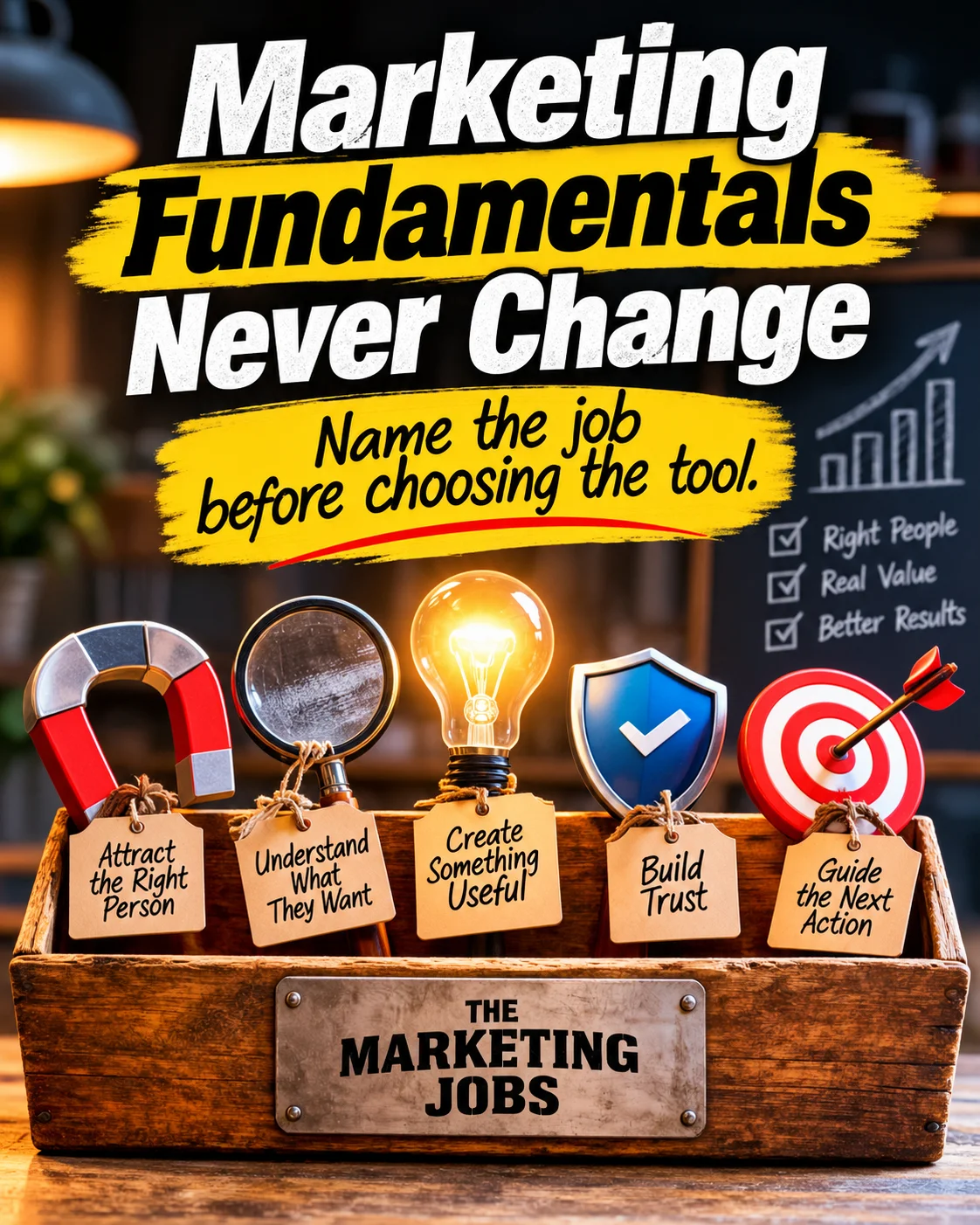
Walk around any digital marketplace today, and you hear stallholders shouting. AI writes faster; others create videos, websites, or automate tasks. Some tools are excellent, others fade quickly. The difference is rarely clever software; buyers struggle to decide which job the tool should improve. Marketing Fundamentals Never Change offers a defense against shiny-object syndrome. Instead of listing features, start with five permanent marketing jobs: attract the right person, understand what they want, create something useful, build trust, and guide the next action. Every serious marketing tool should prove its value by helping at least one of those jobs. Section two uses the New Tool Test to show how to judge the next shiny AI toy.
Start with the first job: attracting the right person. Notice the word right. Ten thousand uninterested visitors are not automatically more useful than fifty people who arrived because the subject closely matches something they already care about. Search engines, Facebook, YouTube, email, guest content and paid promotion can all drive traffic, but they are roads, not destinations. Before choosing a road, we need to know who we want travelling along it and where we want them to arrive. An AI research tool might help uncover questions people ask. A keyword tool might help us notice more specific search phrases. A social platform might help us put the message in front of a relevant community. Different machines, same old job. The question is not, “Which platform is hottest?” It is, “Which road gives the right person a sensible chance of finding this particular stall?”
The second job is understanding what that person wants. This is where our old long-tail lesson becomes especially useful. Specific questions often reveal more than broad subjects. “Retirement income” is a subject. “How can I make a little extra income from home after retiring?” begins to sound like a person. There is a situation inside it. The person may want to stay home, use existing experience, avoid complicated technology or earn something without starting another full-time career. We must not invent motives the person hasn’t given us, but we can notice additional context and build better questions around it. AI can help us organise possibilities and explore the language surrounding a topic. It can’t permit us to stop listening. When Marketing Fundamentals Never Change, understanding intent remains more valuable than merely collecting words.

Five Permanent Jobs Give Every New Tool Somewhere To Stand

When the job is named first, useful technology becomes easier to recognise, and unnecessary technology becomes easier to ignore.
Marketing Fundamentals Never Change, even when AI makes those five jobs faster to perform. The third job is to create something genuinely useful. Marketing Fundamentals Never Change, so every Crew member should earn its place by improving a job we already understand. AI’s production now occurs at remarkable speed, complicating how we value work. We can produce words, pictures, videos, and ideas at a furious pace. But production alone rarely equates to value. A retiree with forty years of lessons can save a beginner time and mistakes. AI can organise those lessons into an article, a checklist, a guide, or a video. The useful part comes from matching material to real needs. We learned that AI doesn’t create freedom by keeping us busy. Finished assets matter because they endure after the session. A finished asset earns its keep when it performs a marketing job—answers a question, explains something, aids a decision, demonstrates experience, or moves someone toward a sensible next action.
The fourth job is trust. Trust is one of those words that gets used so often online that it can lose its shape. In practice, trust is built through small, consistent pieces. Does the page answer the question it promised to answer? Does the headline match the content? Is the advice understandable? Is the offer described plainly? Does the person feel pushed, or helped? Is there evidence of care in the way the material has been prepared? AI can help improve clarity and presentation, but the machine cannot simply sprinkle “trust” onto weak material. If a digital stall promises help for retirees but every article reads like it was written for twenty-year-old software developers, the mismatch will be felt long before anybody studies the technology behind the site. Trust grows when the experience makes sense from the visitor’s point of view.
Then comes the fifth job, guiding the next action. This is where a surprising amount of useful content stops. Someone reads a good article, agrees with it, and maybe even learns something, then reaches the bottom and wonders what happens next. The next step does not always need to be a sale. It may be another article, a worksheet, a video, an email sign-up, a small product, a workshop or one carefully chosen link to the next useful resource. Think again about the old market hall. A customer looking at a product wouldn’t expect the stallholder to give a fascinating explanation and then turn around without saying what it costs, where to find more information, or how to buy it. Online, we sometimes do exactly that. A clear next step is not aggressive selling. It helps someone continue a journey they have already chosen to begin.
Now the five-job test starts becoming practical. Suppose an AI tool appears tomorrow offering to turn every article on your website into a polished short video. Instead of asking whether the software is brilliant, run it through the jobs. Will it help attract the right person? Possibly, if video opens another useful traffic road. Will it help understand the audience? Probably not by itself. Will it help create something useful? Yes, if the original article contains a useful idea and the video preserves it. Will it build trust? Perhaps, if the presentation is clear and consistent. Will it guide the next action? Only if we deliberately include one. Suddenly, the software stops being magic. We can see exactly where it fits, where it might help and what it cannot do for us.

Use It, Test It, Or Leave It On The Shelf

The best tool decision may be yes, not yet, or no.
That gives the Crew a simple three-way decision. Use it when we already have a clearly identified job, and the tool obviously improves how we do it. Test it when the match looks promising, but we do not yet have enough evidence to justify making it part of the regular system. Leave it on the shelf when we cannot name the job, when it duplicates something already working well, or when adopting it creates more work than the problem deserves. Leaving software alone is not falling behind. It is a decision. A plumber does not carry every tool ever invented into every house. Experience teaches which tool belongs in the bag because experience begins with the fault that needs fixing.
That is how I would like us to think about the AI Personal Assistance Crew as it grows. We are not collecting digital workers simply because we can. Each worker needs a job. One might help research reader questions. Another may organise a draft. Another might create imagery or turn a finished article into video. Riley may help coordinate the whole job and keep the work moving towards a usable asset. The human gaffer still decides what we are building, who it is meant to help and whether the finished result makes sense. That human-led structure becomes more important, not less, as machines become more capable.
Another Marketing Fundamentals Never Change advantage lies in this way of thinking. It makes change less frightening. If Facebook changes tomorrow, the job of attracting relevant people remains. We find another road or learn the changed one. If a favourite AI tool disappears, the job it performed remains. We replace the tool. When search changes, understanding reader intent still matters. If video technology changes, clear explanation still matters. If a new platform appears, relevance, usefulness and trust still matter. The permanent layer gives us somewhere solid to stand while the temporary layer keeps moving.
That may be why experienced people bring more to the AI age than they sometimes realise. Someone who has spent decades solving real problems has already learned to separate the job from the equipment. A heating engineer does not fall in love with a spanner because it is shiny. He wants to know whether it fits the fitting. A joiner does not begin with the saw and then search for something to cut. A market trader does not buy stock because a new till has arrived. The purpose comes first. The tool earns its place afterwards.
Digital work should be treated the same way.

Marketing Fundamentals Never Change Because The Customer Still Comes First

The technology may be new, but somebody still has to decide whether what you offer is useful to them.
So the next time an advert tells you that a new AI system will transform the way you work, enjoy the demonstration. Study the possibilities. Be curious. We certainly will. But before the credit card comes out or another dashboard joins the collection, put the tool through the workshop test.
Who will this help us attract?
What will it help us understand?
What useful thing will it help us create?
How could it strengthen trust?
What next action could it make clearer?
You do not need five yeses. A specialist tool may perform one job superbly and be worth having for that reason alone. But you do need to know what job you are buying it to perform.
That small discipline changes the relationship with technology. Instead of running behind every innovation trying to keep up, you stand at the workshop door and interview it.
“What job can you do?”
“Do we actually have that job?”
“Can you do it better than the tool we already have?”
If the answers make sense, give it a place on the Crew.
If they do not, let the salesman carry on down the road.

Open to See This Video, And This Is What’s Already Built,
Trained & Waiting For Your First Command.

Today’s Apprentice Task: Build One Front Door

Apprentice Task

Choose one Marketing Fundamentals Never Change AI tool, platform or piece of software you are currently using or considering. Do not begin by listing its features.
Write down the single marketing job you expect it to improve.
Then check it against our five permanent jobs:
Attract the right person.
Understand what they want.
Create something useful.
Build trust.
Guide the next action.
Finally, make one decision:
Use it. Test it. Or leave it on the shelf.
Because the strongest digital marketers of the AI era may not be the people who own the most tools.
They may be the people who still know what job needs doing first.
Marketing Fundamentals Never Change Choose Better Tools

Leave a Comment

Your email address will not be published. Required fields are marked *


Scroll to Top