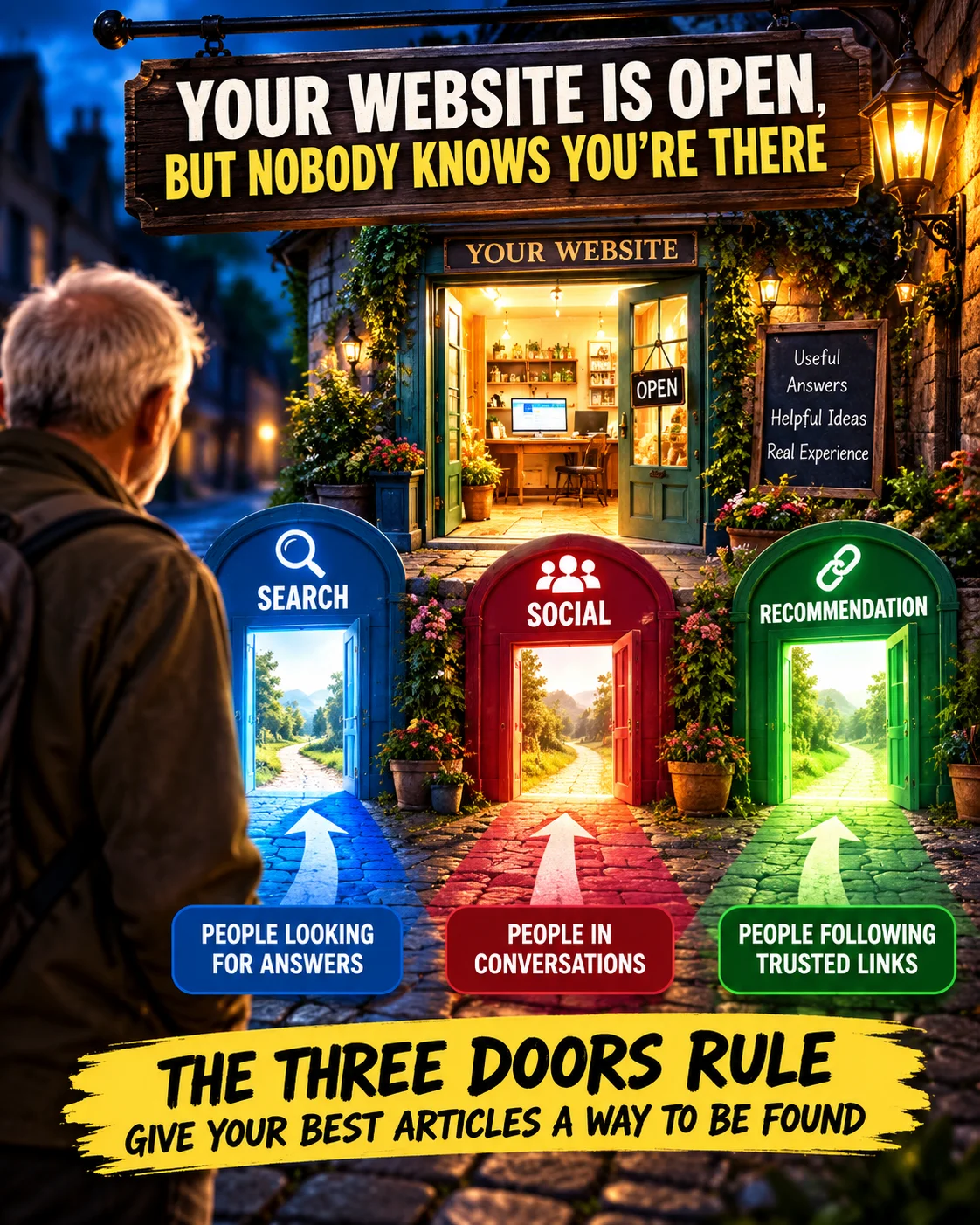
Blinking In The Dark: 3 Powerful Ways To Get Found
Discover why good websites go unnoticed and how search, social sharing and trusted recommendations help interested readers find your work.
Your Website Needs More Than Visitors
Learn why publishing useful content is only the beginning and how reaching the right audience makes your work more valuable.
The Three Doors Rule Opens New Opportunities
Explore three practical routes to website discovery and choose one manageable way to help the right people find your articles.
Blinking In The Dark: Why Good Websites Go Unnoticed
Discover why publishing a website doesn’t automatically attract visitors, and how to give interested readers a reason and a route to find your work.
The shopkeeper arrived shortly after seven, polished the front window, straightened the displays and switched on the lights. Everything was ready for opening day. He had spent weeks arranging his little business, choosing his products and making the place look welcoming. By lunchtime, however, something rather worrying had become obvious. Nobody had walked through the door. At three o’clock, he made himself another cup of tea, adjusted a display that didn’t need adjusting and waited for the afternoon rush. There wasn’t one. When closing time arrived, the till was exactly as he’d left it that morning. The shop wasn’t necessarily the problem. Neither were the products. Unfortunately, he’d opened halfway down a quiet backstreet without telling anybody he was there. He had created a perfectly respectable destination but forgotten to provide customers with a reason and a route to visit.
Move that shopkeeper into retirement, give him a laptop instead of a shop counter, and you’ve described a familiar problem in today’s digital world. Our enthusiastic newcomer has bought a domain name, chosen a WordPress theme, written several helpful articles and spent a small fortune in patience trying to make everything look respectable. Perhaps he’s even managed to get his first green light from an SEO plugin. That’s quite an achievement for somebody who may have spent most of his working life with a toolbox rather than a keyboard. Yet something remains missing. The website is online, the articles are published, and the photographs appear exactly where they should. Unfortunately, the visitors haven’t arrived. Blinking In The Dark is a remarkably accurate description of what happens when a website exists, but nobody has been shown how to find it.
When Publishing Means Blinking In The Dark
Here’s where the misunderstanding begins. When you publish an article, you make it available on the internet. You don’t automatically arrange for interested readers to discover it. Those are two different jobs, although beginners often treat them as one. Think of a television programme that has been recorded, edited and made ready for broadcasting. The production team may have done wonderful work, but if nobody knows when or where to watch it, the programme may attract little attention. A website follows a similar principle. Its articles provide the information, while search engines, social conversations and relevant recommendations provide possible routes towards that information. Without at least one realistic route, even excellent material can remain largely unseen. The lesson isn’t that creating content is unimportant. Publishing completes the first job and creates the need for a second.
For retired people beginning their digital journey, that distinction can save an enormous amount of unnecessary work. Imagine someone who spent forty years working as a plumber, electrician, gardener or bookkeeper. They have a lifetime of practical knowledge others could benefit from, and retirement finally lets them share it. Perhaps they create a website explaining ordinary household repairs, sensible gardening practices or ways to organise a small business. After publishing twenty useful articles, they discover that hardly anybody is reading them. Their first reaction might be to change the website design, buy another plugin or rewrite everything they’ve already produced. However, before making any expensive decisions, they should ask one question. Is the website failing to help people, or have the people who need that help never discovered it? The answers require very different solutions.
Blinking In The Dark Is A Discovery Problem
The distinction matters because website owners can spend months fixing things that weren’t necessarily wrong to begin with. A visitor problem doesn’t automatically mean a design problem. Neither proves the articles are poor, the subject is uninteresting, or the writer lacks ability. Perhaps the website answers questions real people are already asking, but its articles aren’t connected to those questions. Perhaps the owner shares links on Facebook without explaining why anyone should open them. Alternatively, perhaps the content is genuinely valuable but has no links from other relevant pages that would help readers find it. Each possibility deserves a different response. The sensible starting point is to investigate the route before rebuilding the destination. Otherwise, you risk spending another month polishing the shop window while the pavement outside remains empty.
This matters especially when money is limited. Somebody hoping to supplement a pension may already be paying for hosting, a domain name and perhaps a few pieces of software. Buying additional tools without understanding the underlying problem can turn an enjoyable retirement project into an expensive collection of subscriptions. Fortunately, improving discoverability doesn’t always require paid advertising or complicated technology. Often blinking in the dark, it begins with understanding who needs the information, what question they’re trying to answer and where they’re likely to look for help. Once those details become clearer, the website owner can begin making sensible decisions about attracting visitors. Instead of asking how to reach everybody on the internet, they can ask how to reach the particular people their work was created to help. That smaller question is usually much easier to investigate.
The Three Doors Rule Gives Every Article A Possible Entrance
Picture your website as a little digital shop with three possible doors leading towards it. The first door is search, where somebody actively looks for an answer to a question. The second is social sharing, where useful information becomes part of a relevant conversation. The third is recommendation, where another person, article or trusted resource helps someone discover your work. These aren’t magical traffic machines, and opening a door doesn’t guarantee visitors will arrive. They’re simply three realistic ways to think about how interested people might find something you’ve published. That’s the Three Doors Rule. Before expecting an article to attract readers, identify at least one entrance through which the right people could reasonably discover it. You don’t need to master all three immediately, and there’s no prize for opening a dozen doors that lead nowhere useful.
Consider a retired gardener who has published a detailed guide about raising tomato seedlings indoors. The guide contains useful photographs, practical observations and a simple checklist. Through the search door, a beginner might discover it while looking for help with weak or stretched seedlings. By way of the social door, someone in a relevant gardening discussion might follow a helpful explanation of the same problem. Through the recommendation door, another gardening website might link to the guide because it complements an article about growing vegetables at home. Notice what’s happening in each example. The information hasn’t changed, and the gardener hasn’t needed to create three different websites. Instead, the same helpful article becomes accessible through three different routes. Each starts with someone who already cares about what the gardener knows.
Blinking In The Dark: Reach The Right Readers
Another little trap waits for the enthusiastic website owner. Once they realise visitors matter, they may become determined to attract as many as possible. That sounds reasonable until you consider what happens when the wrong people arrive. Imagine advertising a practical guide about beginner-friendly online income methods to a crowd interested only in professional football results. The article might attract a few curious clicks, but most visitors probably won’t find what they came looking for. Now imagine the same guide being introduced to a small group of retirees who have been discussing ways to turn their existing experience into something useful online. Far fewer people may see the invitation, yet the subject is much more relevant to their interests. This doesn’t guarantee engagement, but it gives the article a better chance to connect with its intended audience.
The purpose of attracting visitors isn’t simply to produce impressive numbers on an analytics screen. It’s to help people discover information that answers a question, removes confusion or makes a useful next step easier. A visitor who reads a helpful lesson, saves the page and returns another day may be far more meaningful to your project than someone who arrives accidentally and disappears immediately. That’s why Blinking In The Dark isn’t solved merely by scattering links around the internet. The real improvement comes from matching a worthwhile destination with an entrance that interested readers might actually use. Once you understand that relationship, the problem becomes easier to investigate. You’re no longer asking why the whole internet hasn’t noticed your website. You’re asking which door the right reader might use, and whether you’ve given them a good reason to walk through it.
Section 1 complete, Marra. Section 2 will put those three doors into practice, show readers how to test an existing article, and connect discoverability to useful next steps without turning the lesson into a sales pitch.
Booooom, Gaffer! Section 2 coming down the Fleet Street printing press, Marra. We’re moving from understanding the Three Doors Rule to actually opening one, with proper newspaper paragraphs, practical teaching and a useful reader task at the end.
Stop Blinking In The Dark And Choose Your First Door
Margaret sat at her kitchen table on a wet Tuesday morning, looking at the website she’d been carefully building since retirement. Her tomato-growing article was finished, her photographs were attractive, and the instructions were clear enough for someone who’d never grown a vegetable. Unfortunately, little evidence suggested anyone had found it. She’d already spent several evenings changing colours, adjusting headings and wondering whether she should buy another WordPress plugin. Then she tried something different. Instead of asking what else she could improve on the website, she wrote one question in her notebook. “Where would somebody look if they needed the information I’ve already written?” It was a small change in thinking, but it gave her something useful to investigate. She stopped treating the website as an unfinished building project and began treating it as a destination that needed a route.
That change is particularly useful for anyone who has retired with years of practical experience but little knowledge of online promotion. You may understand your subject perfectly well without knowing the first thing about search rankings, social media algorithms or marketing campaigns. Fortunately, you don’t need to understand everything to make progress. Start by identifying one person with one recognisable problem. Perhaps it’s a retired couple looking for inexpensive gardening ideas, somebody trying to understand their first AI assistant, or a former tradesperson wanting to turn practical knowledge into a downloadable guide. Describe what that person wants to achieve and why your existing article could help. Once you’ve done that, the next question becomes much easier. Where might somebody with that particular problem already be searching, talking or asking for recommendations?
Blinking In The Dark: Let Search Open The First Door
Search is often the most natural entrance when your article answers a question people deliberately investigate. Consider Margaret’s tomato seedlings. Someone searching for “why are my tomato seedlings tall and thin” has already told you what they need. Their question reveals the problem, while the search results offer possible answers. Margaret’s job isn’t to persuade every gardener on the internet to visit her website. It’s to make her article a clear, helpful answer for the person asking that particular question. She can begin by examining the title, opening paragraph and headings. Do they describe the problem in ordinary language? Does the article answer the question without making readers search through unnecessary introductions? Are the photographs useful, and can somebody read the instructions comfortably on a mobile phone?
There’s a useful distinction between making a page understandable to a search engine and expecting that search engine to send visitors. Descriptive titles, relevant headings and internal links can help clarify what an article covers, but they don’t guarantee a prominent position in search results. Other websites may answer the same question, and search engines decide which pages to display. That’s why this entrance requires patience and realistic expectations. A sensible approach is to make an existing article as useful and discoverable as possible, confirm it’s accessible and indexable, and then watch whether it starts attracting relevant searches over time. Blinking In The Dark won’t necessarily disappear overnight, but at least the article now has a recognisable question attached to its front door.
Door Two: Join The Conversation Before Sharing Your Link
Social sharing works differently because people aren’t always actively searching for an answer when they encounter your material. They may be reading Facebook, following a conversation or enjoying photographs shared by friends. Your article must therefore earn their attention by connecting with something they already recognise. Imagine Margaret joining a gardening discussion where somebody mentions seedlings falling over. Instead of immediately posting her website address, she might explain that insufficient light is one possible cause and suggest checking where the seedlings are growing. If the discussion allows helpful links, she can then offer her more detailed article. This adds value before asking anyone to leave the platform. This creates a much more natural introduction than repeatedly announcing that she’s published another blog post.
The same approach works for our own digital retirement interests. Suppose you’ve written an article explaining how somebody can turn an old working skill into a useful online guide. Posting “Read my latest article” tells people very little. But asking “Did you spend forty years learning something that a beginner could benefit from today?” creates a recognisable connection with the intended reader. The article can then show how that experience might become a simple digital resource. The difference isn’t a clever marketing trick. It’s the difference between talking about your publishing activity and talking about a problem the reader actually cares about. Social conversations also require judgement. Follow group rules, avoid repeating promotional messages and contribute without assuming that everybody wants another link.
Door Three: Recommendations Help Stop Blinking In The Dark
The third entrance is recommendation, and beginners sometimes overlook it because they’re busy trying to attract strangers. Yet useful websites often contain opportunities to connect related material. Suppose Margaret has already published an article about growing vegetables in small gardens. A natural sentence could invite readers to her tomato-seedling guide when they’re ready to begin growing indoors. That internal link gives existing visitors another useful destination. Beyond her own website, she might reach a local gardening newsletter that wants educational material for beginners. If the editor considers her guide useful, a recommendation could introduce it to readers who already care about the subject. Neither opportunity guarantees traffic, but both establish a reasonable connection between the information and somebody who might appreciate it.
Recommendations become particularly powerful because they encourage cooperation rather than constant self-promotion. A retired bookkeeper might contribute a useful explanation to a community organisation supporting small businesses. A former heating engineer could provide a seasonal maintenance checklist for a suitable household-advice publication. Someone experienced with AI tools might recommend a beginner-friendly digital lesson to readers tackling their first online project. The key condition is that the recommendation must serve the audience. An unrelated link placed merely to attract clicks offers little genuine value. When a recommendation answers an existing need, however, the reader has a reason to investigate. The website owner is no longer simply Blinking In The Dark and hoping somebody notices. Another relevant source has helped illuminate the route.
Which Door Should You Open First?
Now comes the decision that saves people from spreading their effort too thinly. You don’t need to open every entrance at once. Choose the one that best matches your existing material, your audience, and the time you can reasonably spare. When your article answers a specific question that people are likely to search for, Door One deserves attention. If you already participate in relevant conversations where the subject regularly appears, Door Two may provide a practical starting point. If your website contains related articles or you have genuine connections with organisations serving the same audience, Door Three could be the simplest improvement. None is universally superior. The right choice depends on where interested readers are most likely to encounter your information and whether you can realistically reach them.
Here’s a useful decision rule. Choose the door you can genuinely open, not the door somebody promises will make you famous. An enthusiastic beginner might spend weeks learning complicated advertising software when a clear internal link or a thoughtful contribution to an existing conversation would have been a more manageable experiment. Equally, somebody without an established social audience shouldn’t assume Facebook is automatically their best route. They may be better served by improving an article around a specific search question. The point isn’t to find a perfect traffic source before taking any action. Choose one sensible entrance, understand why you chose it, and run a small enough experiment that you can learn from the outcome without risking money you can’t afford to lose.
What Happens After Somebody Opens The Door?
Another matter is worth addressing before you celebrate your first visitor. Imagine Margaret has successfully introduced her tomato-seedling guide through a gardening discussion. Somebody follows the link, arrives on the page and begins reading. What happens next depends partly on whether the destination delivers what the invitation promised. If the visitor expected straightforward advice about weak seedlings but finds an unrelated product advertisement occupying most of the screen, the experience may be disappointing. If the answer appears clearly, the photographs help explain it, and a printable checklist offers a useful next step, the reader has more reason to stay. This is why attracting visitors and helping visitors are connected jobs. The entrance creates an opportunity, but the article must still earn the reader’s blinking in the dark attention.
For affiliate marketers, that distinction matters even more. A referral link doesn’t automatically mean someone wants the product behind it. A helpful article should first explain a relevant problem, offer useful information and make any recommendation easy to understand. If a product genuinely helps with the task, you can introduce it honestly, with its limitations and the commercial relationship made clear. For example, a system that claims to promote affiliate links shouldn’t automatically be presented as a solution for increasing visits to somebody’s personal website. Those are different outcomes, and the reader deserves to understand the distinction. The most useful recommendation fits the reader’s problem, not one chosen merely because a commission might be available.
Measure The Journey Before Changing Everything Again
Once you’ve opened a door, give yourself a simple way of observing what happens. Write down the article, the entrance you’ve chosen, the action you’ve taken and the date. Then look for evidence that visitors may be discovering your work. Website analytics can indicate whether visits are arriving from search, social platforms or referring websites, although tracking systems aren’t always perfectly accurate. If your article contains a useful next step, you may also be able to observe whether visitors follow that link, explore another lesson or choose to subscribe. These signals don’t reveal everything about the people visiting, and they shouldn’t be treated as proof of future sales. They help you understand whether your experiment is producing meaningful activity.
Be careful about interpreting early results. A social contribution may receive a response fairly quickly, while changes intended to help search discovery can take considerably longer to show useful evidence. A quiet day doesn’t prove the article is worthless, just as a sudden rise in pageviews doesn’t prove you’ve found a profitable audience. Compare what you expected with what you can actually observe. Should nobody arrive, investigate whether the entrance is realistic and visible to the intended audience. If visitors arrive but don’t seem to engage, check whether the article answers the question they expected it to. If people engage but never take another step, make sure the next useful action is easy to recognise. Each possibility gives you a different improvement to consider.
Today’s Reader Task: Give One Article An Entrance
Before opening another blank page in WordPress, choose one useful article you’ve already published. Read it as though you’re somebody encountering the subject for the first time. Write one sentence describing the person who would benefit and another explaining the problem your article helps them solve. Then apply the Three Doors Blinking In The Dark Rule. Consider whether that person might search for the answer, encounter it during a relevant social conversation or discover it through a helpful recommendation. Choose just one entrance and make one improvement today. That might mean clarifying your search title, contributing a genuinely helpful social explanation or adding a natural link from another relevant article. Record what you’ve done so you can return later and judge whether it helped.
If you’re unsure which entry point deserves your attention, use the AI prompt that comes with this lesson. Describe your website, the article you’ve published and the difficulty you’re having attracting readers. Ask your AI assistant to compare the three possible routes, identify the most realistic starting point, and explain one manageable action you can take without buying another tool. Treat its answer as a practical suggestion to evaluate, not a guarantee. You remain the person who understands your experience, your audience and how much effort you want to invest. AI can help organise the possibilities, but the final decision should remain yours. That’s the advantage of combining lifetime experience with modern digital assistance. You don’t surrender your judgement. You use new tools to make that judgement more informed.
Today’s Apprentice Task: Build One Front Door
Stop Blinking In The Dark By Giving Your Work A Purposeful Route
Open to See This Video, And This Is What’s Already Built, Trained & Waiting For Your First Command.
Return for a moment to the little shopkeeper who opened his business on that quiet backstreet. Imagine that instead of repainting the walls or buying more stock, he put up a clear sign where interested customers could see it, explained what the shop offered, and made the entrance easier to find. He still wouldn’t be guaranteed a queue outside the door, but he’d finally addressed a problem that polishing the shelves could never solve. Your website deserves the same practical thinking. The articles you’ve already written may contain knowledge someone else genuinely needs, and that work shouldn’t be dismissed just because it hasn’t attracted attention yet. Give one useful page one realistic route to its intended reader. Observe what happens, learn from the evidence and improve the connection.
A website doesn’t become useful to its audience simply because it’s online. It becomes discoverable when the right people have a reason and a route to find it.
That’s the difference between spending another evening Blinking In The Dark and finally letting someone see what you’ve been building.
And once the right person arrives, an equally important question begins: can they recognise what’s in it for them before they decide to leave?
Section 2 complete, Gaffer. We’ve kept the newspaper treatment, carried the four-word keyword through both sections, included the practical Three Doors decision rule and given readers a proper task instead of another sales pitch.
Your Website Needs More Than An Online Address: Understanding the difference between creating useful content and helping the right people discover it.
The Missing Link Between Publishing And Being Discovered: An attractive digital shop window needs a clear entrance before it can start welcoming customers.