Priorities Shape Better Choices When Everything Seems Important
A difficult decision often becomes easier when you let one important need carry more weight than the rest.
Make The Important Trade-Off Clear
The strongest option is not always the one with the most advantages. It is often the one that best serves the most important priority.
Make The Important Trade-Off Clear
Once you know what must win, you can judge price, features, convenience and other benefits in their proper place.
Picture a kitchen table on a Tuesday morning. A laptop sits open beside a mug of tea, three browser tabs show three different computers, and each one seems to have something going for it. One is cheaper. One has a larger screen. One is lighter. Another review praises battery life. Somebody in a Facebook group recommends a different brand altogether. Nothing is obviously wrong with any of the choices, which is precisely why the decision refuses to settle. The buyer isn’t short on information. The buyer has too many advantages competing for equal attention. Price matters. Screen size matters. Reliability matters. Ease of use matters. Future usefulness matters. Yet until one of those priorities carries more weight, every new comparison can keep the decision alive instead of helping it finish.
That is the mechanism underneath Priorities Shape Better Choices. Difficult decisions often remain difficult because several sensible priorities are being treated as though they all deserve the same authority. The buyer keeps asking which option has the most advantages, but that question can create more confusion than it solves. If Laptop A wins on price, Laptop B on screen comfort, and Laptop C on portability, counting category victories doesn’t tell you which one fits the person best. It simply produces three different reasons to hesitate. A shortlist can tell you which options are acceptable. It cannot always tell you which one should win. For that, the decision needs an order. One priority has to become the boss, while the others move into supporting roles.
Riley’s Wisdom Drop #22: Give One Priority The Boss’s Chair When several choices are good enough, stop counting advantages and decide which advantage deserves the final say.
Suppose our buyer says the laptop will mostly stay at home. They’ll use it for email, online banking, Facebook, photos, Zoom and writing. The buyer also says smaller screens are becoming harder to read comfortably. That one detail changes the comparison. Portability no longer deserves the same weight because the machine rarely travels. High-end graphics matter less because the buyer does not play games. Extra processing power may help, but it is no longer impressive enough to justify a higher price on its own. Screen comfort moves to the top. The other priorities do not disappear. Price still matters. Reliability still matters. The machine still needs enough performance to do the job properly. But now those factors have an order, and the larger-screen laptop has a much clearer reason to win.
This is where people sometimes get nervous about choosing a single priority. Real life, after all, rarely contains only one consideration. Nobody buying a laptop wants to say price doesn’t matter. Nobody booking a holiday wants to say the hotel can be terrible as long as the beach is nearby. Naming a boss priority does not mean abandoning common sense. It means deciding what breaks the tie after the essential requirements are met. An unsuitable option should still be removed. A machine that cannot run the software you need becomes acceptable only because it has a lovely screen. A hotel without a lift becomes suitable for someone who cannot manage stairs simply because breakfast is excellent. The boss priority only decides among choices that already do the basic job.
That distinction makes the method far more useful. First comes suitability. Then comes priority. Imagine a retired couple choosing a hotel for a week away. Their essential requirements might include the right dates, an acceptable price, a decent location and a lift. Once those boxes are ticked, the final choice can still be difficult. One hotel is closer to the beach. Another has quieter evenings. A third is cheaper. A fourth has better views. If the couple keeps every benefit equal, the comparison expands again. But suppose easy walking and quiet evenings matter more than everything else. Suddenly the attractive hillside hotel loses some of its shine, and the lively hotel beside the bars drops down the list. The “best” hotel has not changed. The couple has finally decided what “best” means for them. This is another reason
Priorities Shape Better Choices After You Decide
The same option can move up or down a shortlist without changing at all. What changes is the weight placed on the features. A lightweight laptop sounds impressive until you realise it never leaves the spare room. A hotel beside nightlife sounds ideal until you discover the traveller wants quiet evenings. A software package with fifty features seems powerful until the user wants one simple, easy-to-operate tool. Features do not carry their own importance. People assign them importance based on the job they need done. Once that is understood, comparisons become less about collecting advantages and more about deciding which advantages deserve attention.
Riley’s Wisdom Drop #23: More Advantages Do Not Automatically Mean Better Fit Ten minor benefits shouldn’t outweigh the one advantage that matters most for the job you actually need done.
That rule protects the buyer from an old and expensive mistake. Modern products are often sold by stacking features. Increased storage. Faster performance. More automation. Extra cameras. Integrations rise. Longer lists. The eye naturally assumes the option with the most capability must be the better purchase. Sometimes it is. Sometimes the extra capability solves a real problem. But when those extras do not connect to the buyer’s main job, they can become expensive decoration. A £699 laptop may be objectively more powerful than a £599 machine, yet still be the poorer choice for someone who values a larger screen, simple everyday use and no interest in gaming. The more expensive machine has not failed. It simply wins categories the buyer doesn’t need.
Borrowed priorities make this even harder. A reviewer may care deeply about processor speed because they edit video. A frequent traveller may focus on weight. A photographer may care about storage and screen quality. A programmer may value performance in ways that never matter to a retired home user writing emails and organising photographs. Each reviewer can be completely sincere. Their advice can still be wrong for somebody else because their priorities are doing the judging. This is why recommendations become more useful when you ask not only, “What did they choose?” but also, “What mattered to them when they chose it?” Once you see the priority behind the recommendation, you can decide whether it belongs in your decision or whether you have quietly borrowed somebody else’s definition of value. Priorities Shape Better Choices when the priorities doing the judging genuinely belong to you.
A better comparison begins with one question before another tab is opened: “If I could protect only one advantage from being compromised, which one would I keep?” The answer might be simplicity, comfort, price, reliability, speed or flexibility. No single boss priority is permanently correct because the job and circumstances can change. A leaking tap that has dripped harmlessly for three weeks may make price the first thing to consider. Water beginning to damage the floor can make speed the boss within minutes. The priorities have not become inconsistent. The situation has changed which one deserves authority. That is the real advantage of giving a decision a boss. It does not make the choice simplistic. It makes the reasoning visible.
Once that priority is clear, the comparison becomes easier to inspect. You can ask whether the leading option genuinely serves what you said matters most, or whether it merely wins more minor categories. That is a much stronger test than counting features, stars or recommendations. It also gives AI something useful to work with. Instead of asking, “Which of these is best?” you can tell it, “My main priority is ease of use. Price still matters, but I would rather pay slightly more for something simpler.” Now the AI knows what should carry the most weight. It can still warn you about cost, weaknesses or missing information, but it has far less reason to substitute somebody else’s priorities for your own. That is where a comparison starts becoming a decision rather than another pile of information.
Priorities Shape Better Choices When Trade-Offs Stop Hiding
Once you know which priority deserves the boss’s chair, another useful change happens. The trade-off stops hiding. Most decisions do not offer one perfect option that wins everything. One choice may be cheaper but less convenient. Another may be easier to use but cost more. One hotel may be quieter but farther from the centre. One tradesperson may charge more but be available tomorrow. The difficulty often comes from hoping that another round of searching will uncover an option with every advantage and no sacrifice. Sometimes that happens. Often it does not. Priorities Shape Better Choices because they help you decide which compromise you are prepared to accept before the compromise decides for you. A good decision isn’t always the one with the fewest disadvantages. It is often the choice whose disadvantages fall in less important places.
Consider the laptop again. Suppose the larger-screen model costs £100 more than the smaller one. That difference is real and should not be waved away. The useful question is not whether £100 matters. Of course it matters. The question is whether saving £100 matters more than having a screen the buyer finds easier to use every day for the next several years. If comfort is genuinely the boss’s priority and the higher price remains affordable, then paying more can be a rational trade-off. If the budget is tight enough that the extra £100 creates pressure elsewhere, cost may move into the boss’s chair instead. The point is not to tell the buyer which priority should win. The point is to make the contest visible. Once the buyer can say, “I am choosing comfort over the lower price,” the decision becomes far easier to understand.
This is where a simple three-level structure helps. At the top sits the boss priority. This factor should break ties between otherwise suitable options. Underneath sit the supporting priorities. They still matter and can warn you away from a poor choice, but they don’t automatically override the boss. At the bottom sit the nice extras. These are welcome, but they should never hijack the decision. A larger screen might be the boss. Price and reliability may support it. A backlit keyboard or a particular colour can be a nice extra. Once those levels are clear, the buyer stops asking every feature to fight every other feature on equal terms. Priorities Shape Better Choices because the trade-off becomes easier to see once one need carries more weight than the rest.
Riley’s Wisdom Drop #24: A Good Trade-Off Protects What Matters Most You do not need a choice with no disadvantages. You need the disadvantages to land somewhere you can comfortably accept them.
That becomes especially valuable when attractive extras start making noise. Imagine someone choosing between two hotels. Hotel A is on flatter ground, has a lift and sits close to restaurants. Hotel B has a better sea view, a larger pool, newer rooms and a slightly lower price, but it is halfway up a steep hill. If easy walking is the top priority, Hotel B can win four impressive points and still lose the decision. The mistake would be counting advantages rather than weighting them. Four nice extras do not automatically beat one factor that shapes the whole holiday. That is why the strongest decisions often look less dramatic from the outside. The person has not ignored the extra benefits. They have refused to let minor advantages overrule the main job.
Now move the same thinking into something more ordinary. A homeowner needs a plumber. One firm has hundreds of glowing reviews but cannot attend for four days. Another has fewer reviews but can arrive tomorrow morning. A third is cheaper but cannot give a firm appointment time. If the job is a minor drip into a bucket, reputation or price may matter more. If water is damaging the floor, availability can instantly become the boss. The plumbers have not changed. The situation has changed what matters. Priorities Shape Better Choices because priority is not a permanent personality label. It belongs to the decision being made now. “I always choose the cheapest” can be just as misleading as “I always buy the best.” The right question is what deserves the most weight for this job, under these circumstances.
That distinction protects people from another common trap: confusing preference with necessity. Desiring a sea view is not the same as being unable to manage steep stairs. “I prefer a black laptop” is not the same as “I need a larger screen because smaller text is difficult to read.” “I would rather use a local family firm” is not the same as “I need somebody here before Friday.” When every preference is promoted to essential status, almost nothing qualifies. When every genuine limit is treated as optional, unsuitable options keep creeping back into the shortlist. The decision becomes cleaner when the buyer can tell the difference between what must be protected, what should be considered and what would be pleasant to have.
There is a useful little question for sorting those levels. Ask, “If this feature disappeared, would the option stop doing the job well enough for me?” If the answer is yes, you may be looking at an essential requirement or a dominant priority. If the answer is no, ask whether losing it would still make the experience noticeably worse. That may be a supporting priority. If you would shrug and carry on, it probably belongs among the nice extras. This is not a mathematical scoring system. It prevents everything on a comparison page from shouting at the same volume.
The same approach can improve the way people use AI. General-purpose AI assistants are good at producing comparisons, but they can only work with the priorities they are given or infer. If you ask, “Which of these three laptops is best?” the assistant may naturally lean towards specifications, reviews, price or whatever appears strongest in the information available. Tell it, “My main priority is screen comfort because the laptop will stay at home, while price and reliability still matter,” and the job changes. You have not told the AI what answer to give. You have told it how the decision should be judged. That is a much healthier use of AI because the human keeps control of what matters while the assistant helps organise the evidence.
This also lets you catch a recommendation that looks clever but has drifted from your real needs. Ask the AI to explain which priority drove its recommendation. If you said simplicity matters most, and the answer praises advanced automation, complex integrations and dozens of specialist features, something has gone wrong. If you said the laptop will remain on a desk, and the recommendation keeps celebrating low weight and travel-friendly battery life, the reasoning has wandered towards somebody else’s job. The problem is not necessarily that the facts are wrong. The facts may be perfectly accurate. The problem is that the wrong facts have been given too much weight. Priorities Shape Better Choices when essential needs, supporting preferences and nice extras are no longer treated as equally important.
Riley’s Wisdom Drop #25: The Best Feature Is The One Your Job Can Feel A feature matters most when it changes your real experience, not when it merely looks impressive on a comparison list.
That matters because people are surrounded by features designed to look measurable. Bigger numbers feel reassuring. Increased storage. More channels. More integrations. Faster processors. Longer feature lists. Better rankings. Yet the things that improve everyday life aren’t always the ones with the biggest numbers next to them. A simpler interface may save frustration. A larger screen may reduce daily effort. A local hotel may remove the need for taxis. A tradesperson who answers the phone may reduce uncertainty. These advantages can look modest on a specification sheet, but they become significant when they connect directly to the job. Priorities Shape Better Choices by helping the buyer notice practical value before impressive numbers steal the conversation.
Priorities Shape Better Choices After The Decision Too
Another benefit only becomes obvious after the choice is made. Clear priorities help stop the decision reopening every time you notice something attractive about the option you rejected. Buyer’s remorse often starts with one innocent comparison. After purchasing the larger-screen laptop, an advert reveals how light the other model was. You book the quieter hotel, then discover another one offered free drinks in the evening. You hire the plumber who could come tomorrow, then hear that a neighbour paid less somewhere else. If you never decided what mattered most, every new advantage can make the original decision feel questionable. The comparison starts again even though the purchase is already made.
A clear priority order helps you respond better. That laptop was lighter, but portability was not the job. “Yes, that hotel was cheaper, but quiet evenings mattered more.” “Yes, another plumber may have charged less, but getting the leak handled quickly was the main priority.” Those sentences don’t prove every decision was perfect. Nothing can do that. They remind you that a trade-off was chosen deliberately rather than discovered afterwards by accident. That makes a decision easier to defend because the reasoning connects to your life rather than a universal ranking.
This is also why one person’s brilliant choice can be another person’s mistake without either person being foolish. Two neighbours can buy different laptops after looking at the same three models. One chooses the lighter machine because they travel every week. The other chooses the larger-screen version because they stay at home. Both decisions can be sensible because their priorities differ. One retired couple can choose a lively hotel near the centre, while another chooses a quieter place farther out. The answer changes with the job. When people forget that, they start arguing over which choice is objectively better when the more useful question is, “Better for what?” Priorities Shape Better Choices because different people can reasonably give different priorities the most weight.
That phrase belongs beside almost any comparison. Better for what? Cheaper for what? Faster for what? More powerful for what? More flexible for what? Once those questions are answered, many apparently impressive features lose some of their grip. A product or service does not need to beat every competitor at everything. It needs to perform the job you are actually buying it to perform. That is where priority and context meet. Context tells you the situation. Priority tells you what deserves the most weight inside that situation. Together, they turn “best” from a vague label into a reasoned choice.
The method is simple enough to use without spreadsheets, scores or complicated decision charts. Start with the options that genuinely meet the basic requirements. Then name the one priority you most want to protect. Put the other important factors underneath it. Move the pleasant extras to the bottom. Now compare again. If the leading option serves the boss priority while remaining acceptable on the supporting ones, you probably have a strong candidate. If another option wins only because it collects more minor benefits, ask whether those benefits deserve enough weight to overturn the priority you already chose. Priorities Shape Better Choices after the decision too, because the reason for choosing remains clear when another option later catches your eye.
Today’s Practical Task: Give One Priority The Boss’s Chair
Choose one decision that is currently sitting open in your mind. It could involve a purchase, a holiday, an AI tool, a service, a tradesperson or something as ordinary as choosing between two subscriptions.
First, write down the basic requirements every acceptable option must meet.
Then choose the one advantage you would least want to compromise.
That becomes the boss priority.
Place the other important factors underneath it as supporting priorities.
Put anything that would merely be pleasant to have in the nice-extras pile.
Now look at the strongest options again. Priorities Shape Better Choices when you compare those options against the priority you decided should matter most.
Ask one final question: “Which choice protects what matters most without failing anything essential?”
Today’s Apprentice Task: Build One Front Door
Open to See This Video, And This Is What’s Already Built, Trained & Waiting For Your First Command.
If you are using AI, give it the same priority order and ask it to explain whether its recommendation genuinely follows that order.
Do not ask which option collects the most victories.
Ask which option wins where your real life says winning matters.
Because Priorities Shape Better Choices when the human decides what deserves the most weight before the features, rankings and recommendations start competing for attention.
Priorities Shape Better Choices For Better Results

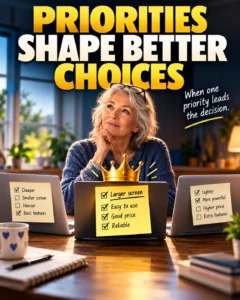 Suppose our buyer says the laptop will mostly stay at home. They’ll use it for email, online banking, Facebook, photos, Zoom and writing. The buyer also says smaller screens are becoming harder to read comfortably. That one detail changes the comparison. Portability no longer deserves the same weight because the machine rarely travels. High-end graphics matter less because the buyer does not play games. Extra processing power may help, but it is no longer impressive enough to justify a higher price on its own. Screen comfort moves to the top. The other priorities do not disappear. Price still matters. Reliability still matters. The machine still needs enough performance to do the job properly. But now those factors have an order, and the larger-screen laptop has a much clearer reason to win.
