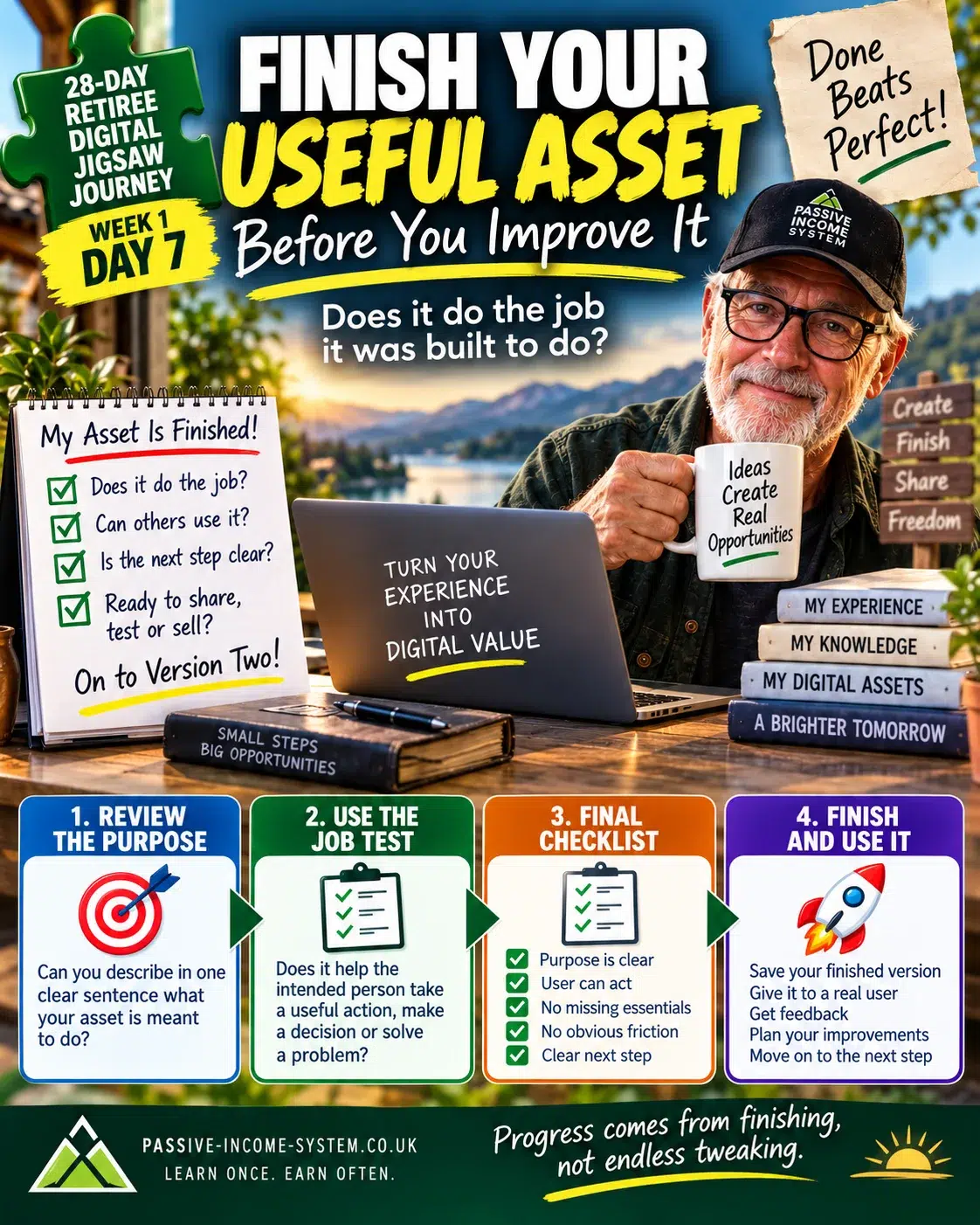
Finish Your Useful Asset By Giving It One Clear Job
A useful first version needs a finish line, not another weekend of polishing.
Finish Your Useful Asset With The Simple Job Test
Ask whether your asset already does the useful job you originally built it to do.
Before Building Version Two, Finish Your Useful Asset
Real use tells you what deserves improving far better than another afternoon spent guessing.
Step 1: Finish Your Useful Asset Before You Improve It. A useful first version needs a finishing line, not another weekend of polishing.
Finish Your Useful Asset By Giving It One Clear Job
The quickest route to finished is knowing exactly what your digital asset should achieve.
With The Simple Job Script Finish Your Useful Asset Test
Ask whether it already does the useful job you originally built it to do.
Finish Your Useful Asset Before Building Version Two
Real use can tell you what deserves improving far better than another afternoon spent guessing.
There comes a dangerous moment in the life of every homemade digital product when its creator leans back from the laptop, looks at what they have built and thinks: “You know what? That’s nearly finished.” It ought to be a moment of celebration. Instead, particularly when you are new to creating things online, it can become the moment another week’s work begins. Perhaps it needs another page. Maybe the cover could look better. One more example wouldn’t hurt. A bonus might make it feel more valuable. Before long, yesterday’s nearly finished useful asset is today’s building site again.
For retirees and online beginners, that habit can quietly become one of the biggest obstacles to producing anything at all. You aren’t necessarily short of ideas, effort or experience. The problem is that nobody ever showed you where to put the finishing line. Without one, every new idea looks like another job that must be completed before you’re allowed to release your asset from the workshop. The result is peculiar: the person trying hardest to make something useful can become the very person preventing anybody from using it.
Before You Finishing Your Useful Asset: Think Polish
 A wonderfully simple question cuts through most of this confusion: Does it do the job it was built to do? Notice what that question doesn’t ask. It doesn’t ask whether your PDF could be longer, whether your worksheet could be prettier, whether somebody else on the internet has produced something fancier, or whether another three bonuses might make your offer look bigger. It asks whether the thing in front of you performs the useful job you gave it when you started.
That distinction matters because finished and improved are not the same decision.
Finished means the asset can perform its intended job. Improved means you have found a worthwhile way of helping it perform that job better. One must happen before the other becomes useful. Otherwise, improvement becomes an endless collection of guesses made before anybody has actually had the chance to use what you created.
Imagine a retired heating engineer who has spent decades visiting homes and watching customers struggle to understand quotations. He decides to turn some of that experience into a small digital guide called Seven Questions To Ask Before Accepting A Boiler Replacement Quote. It isn’t intended to teach somebody how to install a boiler. It isn’t a plumbing textbook, a heating course or a hundred-page technical manual. Its job is to help an ordinary homeowner ask better questions before agreeing to an expensive job.
By Testing Its Original Purpose, Finish Your Useful Asset
Now our retired engineer has a proper finishing line. Are the seven questions there? Does he explain them clearly enough for an ordinary homeowner? Can the reader understand why each question matters? Could someone have the guide beside them while discussing a quotation? Do they know what sensible next step to take when they reach the end? If those pieces are present and usable, something important has happened. The guide may already be Version One.
Could he add more? Of course he bloody could. Give any experienced tradesman half an hour, and he will remember another twenty things the customer ought to know. He could explain heating controls, compare boiler types, add photographs, produce a glossary, include maintenance advice and record a video. None of those ideas is necessarily bad. The question is whether the original guide cannot perform its promised job without them.
That gives us a second useful question whenever another bright idea arrives: If I don’t add this, will the asset still do its intended job? If the answer is no, you may have found something essential. Put it in. If the answer is yes, write the idea on what we call the Later List and keep moving towards the finishing line. You haven’t rejected the idea. You have stopped Version Two barging into the workshop before Version One has left it.
Stop Making Version One Compete With Everything Online
This matters most when you are creating your first few digital assets. The internet makes comparison ridiculously easy. A twelve-page guide now appears diminutive next to a hundred-page ebook. Your straightforward worksheet looks basic beside polished software. Your first product gets compared with something produced by a company employing writers, designers, editors and marketers. Within minutes, a perfectly useful first asset can start looking embarrassingly small to the person who created it.
But size is not the test. Neither is decoration. A beautifully designed fifty-page document that leaves its reader wondering what to do next can be less useful than a scruffy five-page checklist that helps somebody make one better decision before lunchtime. The real measure is whether the asset takes the person it was created for from their starting problem towards the useful result you promised.
Before Guessing What People Need: Finish Your Useful Asset
Another reason to stop is that the job is done. Until Version One reaches another human being, many of your proposed improvements are guesses. Perhaps another example would help. You might want more explanation. You suspect the design needs changing. Perhaps you’re right. Perhaps you’re about to spend Saturday and Sunday solving a problem nobody actually has.
Our heating engineer might spend another week expanding his seven questions into twenty-five. Then he finally lets three homeowners use the guide. Two of them understand every question perfectly well but hesitate at the same point: they don’t know how to compare the different answers installers have given them. Suddenly he has something far more valuable than another afternoon of brainstorming. He has evidence. Version Two doesn’t need eighteen more questions. It may need one simple comparison box.
That is why finishing isn’t the enemy of quality. Finishing creates the evidence that makes better quality possible. Once somebody can actually read, use, question, misunderstand or act upon your asset, improvement stops being entirely imaginary. You can see where the sticking point lives. You can fix something real rather than polish something because you are afraid to call it done.
So before you add another page to the useful asset sitting on your laptop today, return to the job you originally gave it. Ask the simplest question we have used all week: does it do the job it was built to do? If the answer is no, keep working on the missing piece. If the answer is yes, resist opening another blank page just because you can.
Finish Your Useful Asset.
Version Two can wait inside the passive-income-system.co.uk workshop
Step 2: Finishing Your Useful Asset
Finished Does Not Mean Perfect
The word finished can feel uncomfortable when you are creating something from your own experience. Once you declare the asset finished, somebody else can see it. They can use it, question it, misunderstand it or decide it isn’t for them. While it remains safely labelled a draft, none of that can happen. Another afternoon changing fonts can therefore feel strangely productive when what we are really postponing is the moment our work meets another human being.
That doesn’t mean every unfinished product is hiding behind perfectionism. Sometimes a guide genuinely has a missing instruction, a worksheet doesn’t lead anywhere, or an important step is missing. Those problems deserve fixing. What we need is a way to separate a genuinely unfinished job from the perfectly normal nervousness that comes with putting Version One into somebody else’s hands.
With Five Final Finishes: Your Useful Asset Shows Up Decisions
Instead of asking whether your asset feels finished, give it a proper final inspection. Start with its purpose. Can you describe in one sentence what this asset helps somebody do? Then look at the user action. Is it obvious what the person should actually do with the information? Next, check for missing essentials. Is anything absent that would prevent the promised job from being completed? Then inspect obvious friction. Are there confusing instructions, broken links, unreadable sections or unexplained jumps? Finally, check the next step. When the person reaches the end, do they know what happens now?
Those five decisions give you something far more useful than the vague instruction to “make it better.” They turn finishing into an inspection rather than a feeling. Purpose. User action. Essentials. Friction. Next step. If one of those fails, you have found a specific job to repair. If all five work, adding more material needs a much stronger justification than simply thinking the product could still be improved.
Our retired heating engineer can use the same inspection on his boiler quotation guide. Its purpose is clear. The homeowner has seven practical questions to use. Nothing essential appears to prevent those questions from being asked. The pages are readable and understandable. At the end, the homeowner knows to compare the answers before deciding. The asset therefore doesn’t need to become the complete encyclopaedia of domestic heating before it can leave the workshop.
Every Useful Post Has To Finish Your Useful Asset Needs A Stop Rule
This leads to another useful habit: decide what will make you stop. Most beginners decide what they are going to create but never decide what conditions will mean the creation is complete. That leaves the finishing line moving every time another idea arrives. A stop rule fixes the finishing line in place before enthusiasm, uncertainty, or comparison can move it another fifty yards down the road.
For a simple digital asset, that rule might contain only three conditions. The promised job can be completed. The reader can understand and use the asset without you standing beside them. No known problem is serious enough to prevent useful use. Meet those three conditions and Version One earns the right to leave your laptop.
Notice that the stop rule doesn’t say the asset contains everything you know. That would be impossible for somebody with forty or fifty years of useful experience. Nor does it say nobody could ever ask another question. A useful digital asset is a container built for a particular job. The skill is deciding what belongs inside that container and, equally importantly, what belongs outside it.
Finish The Reader’s Job Rather Than The Document
This is where a digital product can look complete while still being unfinished. Imagine a beautifully designed PDF teaching a retired beginner how to choose the subject for their first small digital guide. It contains explanations, examples and attractive graphics. The final paragraph congratulates the reader and closes the document. Technically, the PDF is finished. But if the reader reaches the bottom with six possible subjects and no way to choose between them, the reader’s job isn’t finished.
A simple final exercise could change everything: write down the three subjects you know best, identify the one problem you could most confidently help somebody solve, and choose that as the starting point. Suddenly the document has not merely delivered information. It has helped produce a decision. That is the difference between finishing pages and finishing the useful job those pages were created to perform.
This distinction gives us another inspection question worth keeping: What should be different for the reader when they reach the end? They might understand something, choose something, complete something, avoid something, compare something or take one sensible next step. The answer depends on the asset, but it should be clear. Otherwise, we risk mistaking information delivered for usefulness achieved.
When You Finish Your Useful Asset, Let Real Use Speak
Once Version One passes its inspection, the next job isn’t automatically to make Version Two. First, let Version One earn some evidence. Give it to somebody suitable. Watch what happens. Notice where they hesitate, reread, skip, question or take action. Yesterday’s lesson taught us that those behaviours can reveal far more than simply asking whether somebody liked what we made. Today we go one stage further: we allow that evidence to decide whether another version is even necessary.
The reader may sail through the asset and achieve exactly what you intended. Excellent. Don’t manufacture a problem because you feel every digital product requires constant rebuilding. Perhaps several people stumble over the same instruction. Now you have a useful reason to change it. Someone may ask a question that reveals a missing step. Add the step. Improvement becomes targeted maintenance rather than another complete refurbishment.
That is how experienced tradespeople tend to think about practical work. You don’t pull apart something that is doing its job simply because you own more tools. You inspect it, identify the fault and work on the part that needs attention. Digital creation benefits from the same discipline.
Version One Has A Different Job From Version Two
One particularly valuable responsibility for Version One is to become real enough to use. Version Two has a different responsibility. It takes what you learned from real use and makes a justified improvement. Mixing those two jobs is how first products become trapped in permanent development. Every imagined Version Two improvement gets dragged backwards and added to Version One before Version One has produced any evidence at all.
So keep a Later List beside the job. When you think of a new bonus, extra example, video, worksheet, design improvement or additional chapter, put it there. You haven’t lost the idea. In fact, you have protected it. When real users begin showing you what deserves attention, you can return to that list and compare your original assumptions with what actually happened.
Some ideas will suddenly look important. Others will look unnecessary. A few might be good enough to become separate assets. That is another advantage of refusing to stuff every useful thought into the first product. One small finished asset can reveal the next asset instead of swallowing it.
And Complete Your Useful Asset Jigsaw
Now look back at what you have actually done during these first seven pieces. Experience started it, and you gave it a job. The idea’s usefulness was tested. We reduced it to the smallest sensible asset. We planned its structure. You created Version One. You put that version in front of real use and looked for friction. Today you make the final decision that turns all those separate pieces into one completed job.
This matters because the achievement isn’t spending seven days reading about digital products. The achievement is that something which previously existed as experience, knowledge or an idea can now exist outside your head. It has a purpose. It has a shape. Somebody else can use it. And because it exists, you can now test it, improve it, share it, package it, give it away or eventually sell it according to the job you decide it should perform.
That feels very different from endlessly preparing to start an online business. Not everyone has mastered the internet. You don’t need to. You have learned something more useful: how to take one piece of what you know and work it through a repeatable production sequence until another person can benefit from it.
Open to See This Video, And This Is What’s Already Built,
Trained & Waiting For Your First Command.
Test What Happens After You Create.
First, finish your useful asset now. Say, ” I built this “
Before you move on, open the asset one final time and resist the temptation to begin decorating it. Ask the Job Test: Does it do the job it was built to do? Run the five final decisions: purpose, user action, essentials, friction and next step. Then apply your stop rule. If something genuinely prevents useful use, fix that one thing. If nothing does, close the editing window.
Call it Finish Your Useful Asset Version One.
Save it properly. Give it a recognisable filename. Put it somewhere you can find it again. If appropriate, export the finished version into the format another person will actually receive. Keep your working copy for later improvements, but protect today’s finished version as evidence of what you completed.
Because that is the real finishing line for Week One of our 28-Day Retiree Digital Jigsaw Journey. Avoid perfection. Not applause. Not a hundred-page masterpiece. Your first fortune does not arrive before teatime.
A useful thing now exists that didn’t exist seven days ago.
And when that familiar little voice whispers, “Perhaps one more page would make it better,” you now have an answer.
Better can come later. Finished comes first.
So perform the inspection. Fix only what prevents the job from being done. Put everything else onto the Later List. Then look at those seven completed pieces and say the three words that matter far more than another weekend of preparation: I BUILT THIS.