
Build Your Traffic Path Before You Chase Bigger Online Crowds
Why A Clear Traffic Path Beats Chasing Online Crowds
Useful traffic begins when one suitable person can follow one clear route.
Start With One Person And One Clear Destination
You don’t need thousands of visitors to prove that your traffic path works.
Turn Attention Into Action When You Build Your Traffic Path
Every post should help the right reader reach something genuinely worthwhile.
Before The Morning Traffic Starts Moving
A familiar little drama plays out every morning across the digital world. Somebody makes a cup of tea, opens Facebook, checks their blog statistics and glances at yesterday’s post. The article was useful, the worksheet was finished, and the idea could genuinely help somebody, yet the expected procession of interested readers has failed to arrive. The online pavement outside remains stubbornly quiet. So the worried creator begins looking for traffic. They watch a video about Facebook, read an article about YouTube and hear somebody insisting that email is where the money lives. Before lunchtime, our once-calm beginner has opened six browser tabs, joined two groups and started wondering whether they also need to dance on Instagram. It feels like traffic work because plenty is happening, but movement is not the same as direction.
This is how a useful digital asset can disappear beneath a fresh pile of online jobs. Instead of helping somebody find the thing already built, the creator starts learning platforms, filling profiles, designing banners and chasing whichever traffic method has shouted loudest that morning. None of those platforms is automatically wrong. The problem is that nobody has decided what job each one is supposed to perform. The creator is moving, but the potential reader has no route to follow. A thousand people can pass a badly positioned sign without knowing where it leads, and attracting another thousand will not make that sign any clearer. Before trying to bring more people towards your work, you must decide where you want one suitable person to go and why the destination is worth the walk.
The Crowd That Exists Inside Our Heads
 When people hear the word “traffic,” they usually imagine a crowd. They picture thousands of visitors pouring towards a website, clicking links, downloading products and filling an imaginary digital shop. It is a powerful picture, especially after years of headlines promising enormous audiences at the touch of a button, but it can send a beginner in completely the wrong direction. The crowd-first approach encourages you to shout in several places before deciding where you want anybody to go.
It makes small numbers feel like failure and suggests that more exposure will somehow repair an unclear journey. Yet sending more people into confusion merely produces more confused people. Traffic does not become useful because more people arrive. It becomes useful when the right person can understand where to go next.
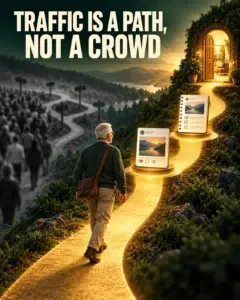
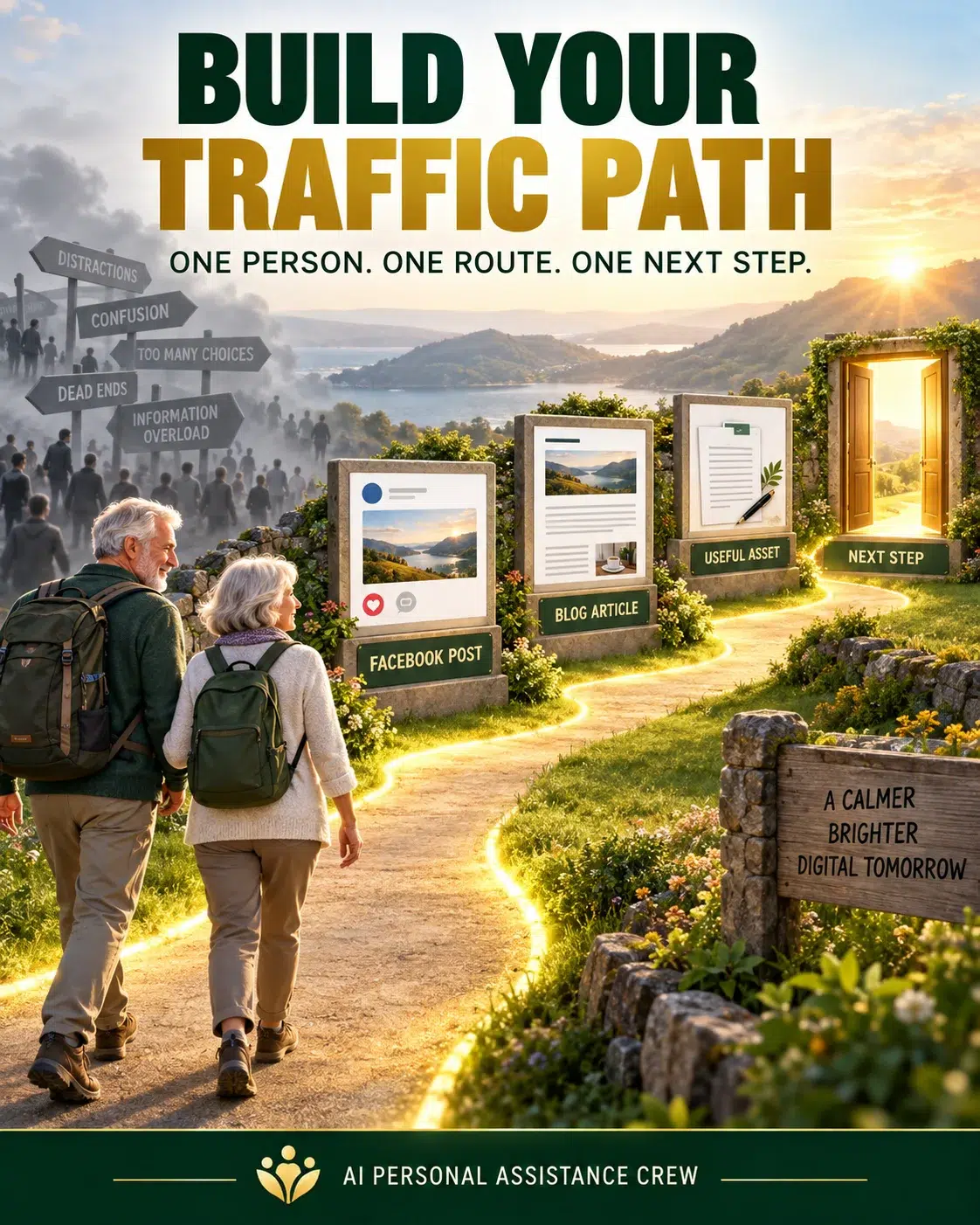
A better picture is much simpler: traffic is a path, not a crowd. A path connects one place to another. It gives somebody a reason to begin, a direction to follow and a worthwhile destination at the end. It doesn’t need to be crowded to prove it works. For a retiree building a first digital asset, that distinction changes the whole job. You are no longer trying to summon the internet or compete for everyone’s attention online. You are helping one suitable person move from somewhere familiar to something useful. That person may begin with a Facebook story, follow it to a fuller article and discover a worksheet that helps them take a practical step. If the route makes sense to one person, you have something you can inspect, improve and reuse.
One Useful Reader Can Help Build Your Traffic Path
Imagine you have created a short printable worksheet that helps somebody turn one piece of lifetime experience into a useful digital-product idea. The worksheet has survived Week 1’s tests. It has a clear purpose, another person can use it without you sitting beside them, and nothing essential prevents it from doing its job. After all the thinking, writing, testing and editing, your first useful asset is finished. The trouble is that it is still sitting quietly on your computer, rather like a well-stocked little shop built at the end of a lane with no sign at the turning. The crowd-first response demands followers, reach, impressions, several social accounts and a complicated advertising campaign before the worksheet has even been shown to one suitable person.
The path-first response is calmer because it begins with three connected decisions. Where is one suitable person already spending time? What familiar problem or experience might make that person stop and pay attention? Where should they go after you’ve earned their interest? Suppose your intended reader is a retired tradesman with years of useful knowledge who still receives requests for practical advice, although he does not believe he has anything worth turning into a digital asset. He already uses Facebook to keep in touch with family, former workmates and local groups. He can read a post, leave a comment and follow a link without needing another bloody instruction manual. That gives you a sensible starting point before you have to learn a single new platform.
Let A Familiar Story Build Your Traffic Path
You write a short Facebook story about the day somebody asked this retired tradesman how to solve a household problem he had dealt with hundreds of times. The post explains that the information people repeatedly ask you for may be the beginning of a useful guide. It does not try to teach the entire subject, present five competing offers or send the reader to a homepage with four hundred unrelated articles. Its job is to help the right person recognise himself and become curious enough to take one clear next step. The Facebook story then points towards a fuller blog article explaining how ordinary working knowledge can be separated into one small, useful asset idea.
At the end of that article, the reader is invited to use the printable worksheet. The worksheet gives him something practical to complete, and when he finishes, it might invite him to reply, join a conversation or continue to the next lesson. Now the pieces do more than occupy separate corners of the internet. The Facebook post earns attention, the article develops understanding, the worksheet creates action, and the invitation keeps the relationship moving. Four random posts may briefly produce more views, but they leave the visitor to work out what happens next. Four connected pieces create a journey where each step prepares the person for the next. That is the beginning of a real traffic path.
Choose The Destination Before Building The Road
Many online beginners unknowingly start at the wrong end. They choose Facebook, YouTube, LinkedIn or another platform first, then wonder what they should publish and where it should lead. Building your traffic path becomes easier when you reverse that decision. Begin with the useful destination. Decide what you want the right person to find, understand or use, then work backwards and choose the most natural place to reach it. If the destination is a printable worksheet, a story-led Facebook post might lead towards the explanation that prepares somebody to use it. If the destination is a practical demonstration, a short video may provide a clearer road. If the reader already knows you through email, a direct invitation may be enough.
The platform is not the plan. It is only one piece of the road. Choosing the platform before choosing the destination is like ordering a fleet of buses before deciding where the passengers need to go. You may create plenty of activity, but you cannot tell whether any of it is useful. Every workable path therefore needs a starting point where the right person can notice you, a destination worth reaching and a next step that prevents the journey ending in a digital cul-de-sac. If one of those is missing, the route is incomplete. Even when all three are present, however, another quiet problem may be waiting at the first junction: too many signs, too many doors and too many well-intentioned choices competing for the same reader’s attention.
Section two – now you’ve found your Groooove, baby.
Remove Confusing Signposts As You Build Your Traffic Path
You have probably met the real-world version of this problem while following a country footpath. The track reaches a fork, but the wooden sign has fallen sideways. One arrow points through a gate, another appears to lead behind a hedge, and a third has faded until nobody can read it. The walker pauses, looks around and eventually turns back. Online visitors behave in much the same way. They arrive at a useful article only to be presented with a menu, three advertisements, four colourful buttons, two downloadable gifts, a newsletter invitation and several links to completely different subjects. Every choice may be perfectly reasonable on its own, but together they turn a clear path into a busy junction where the visitor is expected to become the traffic planner.
The creator believes they are being helpful by offering more, while the reader faces a decision they did not expect. This is where the one-door rule earns its place: at each point on your traffic path, make one next doorway easier to see than all the others. That does not mean your website can contain only one link, or that you must push your reader toward something they do not want. It means the most natural continuation should be unmistakable. If somebody has just read about turning their experience into a digital asset, the visible next doorway might be the worksheet that helps them identify their own idea. An unrelated affiliate link may still exist elsewhere, but it shouldn’t stand in the middle of that road waving its arms.
Let Every Piece Answer The Previous Question
Return to our retired tradesman. The Facebook story helps him recognise that his everyday knowledge may be useful, which naturally creates the question, “Could I turn something I know into a small digital asset?” The blog article answers that question and creates another: “Which piece of my experience should I use?” The worksheet helps him decide, then leaves him wondering what to build from it. Each part of the path answers the question the previous part created while gently preparing the reader for the next. Curiosity opens the first door, useful teaching earns the next step, and clarity prevents the person from becoming lost between the two.
Beginners sometimes worry that one clear doorway will feel pushy, but pressure and guidance aren’t the same. Pressure tells people what they must do for the creator’s benefit, usually with an artificial deadline or an exaggerated promise attached. Guidance shows them the most sensible next step. “Buy this before midnight or lose your chance forever” is pressure. “If you would like to test your own idea, use this one-page worksheet” is guidance. The difference lies in whether the invitation continues the useful job the visitor has already chosen to begin. A good traffic path doesn’t drag somebody toward an unwanted destination. It removes the unnecessary confusion that might otherwise stop an interested person from reaching something genuinely helpful.
Every New Platform Creates Another Bloody Job
Another platform will always promise attention. Facebook may be where your intended readers already stop, read stories and join conversations. YouTube may be helpful when your subject needs to be demonstrated. Email may help you continue a relationship after somebody has asked to hear from you. None of those platforms is automatically essential, and none becomes valuable merely because you have opened an account there. Its value comes from the job it performs inside the journey. Before adding another platform, ask what missing part of your traffic path it will improve. If you cannot name the job, you may be adding activity without adding direction. You build your traffic path more calmly when every platform must earn its place.
This matters particularly for retirees and online beginners because every new platform carries a hidden cost. Another password to remember, another profile to complete, another set of buttons to learn, and another stream of advice demanding attention. The apparent shortcut can quietly create a second job before the first is finished. Perhaps people understand your written explanation but need to see the method demonstrated; in that case, a short video could solve a real problem. Visitors use the worksheet but forget to return, so that a simple email might reconnect them with the next useful step. Those are job-based decisions. “Everybody says I should be on there” is not. The rule is simple: build the route, watch how people use it and add only what makes their journey clearer.
Make Today’s Work Strengthen Yesterday’s Work
A connected traffic path also changes how you decide what to do each morning. Instead of waking up wondering what you should post everywhere, you can look at the journey and ask which part needs attention. Perhaps today you write the Facebook story that introduces the problem. Tomorrow you strengthen the article it leads towards. The following day, you make the worksheet easier to use, then create the invitation that helps somebody continue. Each job improves the same route, so your effort accumulates rather than disappearing into separate social-media streams. You are no longer feeding platforms simply because their empty boxes are waiting to be filled.
This is where the 28-Day Retiree Digital Jigsaw Journey begins to show its real shape. Week 1 did not produce an isolated worksheet that would be forgotten when the next subject arrived. It produced the destination for part of Week 2. Today’s Facebook post, blog article or invitation can lead towards the asset you have already built, while tomorrow’s work can strengthen another part of the same journey. Every piece should give a previous piece somewhere to lead and a future piece something to continue. That is how a small collection of useful assets begins behaving like a simple system. The value comes not only from the quality of each piece, but from the connections that let one piece of work keep another moving. When you build your traffic path around one suitable reader, every piece gains a clearer job.
Walk The Whole Route After You Build Your Traffic Path
Before sending another person down your new traffic path, become its first traveller. Start at the exact Facebook post, email, video or social message where the journey begins and try to forget everything you know as its creator. Can a new visitor tell who the message is for? Is there a recognisable problem, desire or moment that would make the suitable person stop? Is the next step visible without hunting around the page? Follow the link and check whether the destination delivers what the opening message promised. If the post offers a useful worksheet but the link opens a general homepage containing dozens of articles, you have placed the visitor in reception and expected them to find the correct room.
Continue walking until you reach the final invitation. Does the article make sense to somebody arriving cold? Can you find and open the worksheet? Is the page comfortable to read on a phone? Does the button look like something you should press, and does the promised action actually happen? These details may not feel like marketing, but they decide whether interest becomes movement. A brilliant message cannot rescue a broken link, and a useful worksheet cannot help somebody who never finds the download. If you cannot complete the journey without relying on private knowledge you have as the creator, the path isn’t ready. Useful traffic includes more than arrival. It includes the visitor’s ability to continue.
One Completed Journey Gives You Something To Improve
Ten thousand passing glances cannot repair a confusing route. More visitors merely give more people the opportunity to become lost. One suitable person completing the journey can show whether the opening message feels relevant, whether the article builds understanding, whether the asset can be used and whether the next invitation makes sense. That is evidence you can work with. If people notice the Facebook story but do not visit the article, the bridge may be unclear. If they read the article but do not use the worksheet, its value or invitation may need attention. If they complete the worksheet but disappear afterwards, the next doorway may be missing.
Without a path, all you see is a disappointing number and feel tempted to change everything at once. With a path, you can see where movement stops and fix what’s blocking the next useful step. You do not have to abandon the asset, rewrite the entire article and join another platform because the first attempt was quiet. First check whether one suitable person can see the route, understand the destination and know what to do after arriving. Once that works, you can help a second person find it, then a third. A crowd may come later, but the path must work before greater numbers become useful. The purpose is to build your traffic path until one suitable person can complete the journey.
The Ultimate Online Business Startup Kit
Today’s Apprentice Task: Draw The Road To Your Asset
Take one sheet of paper and write the name of your finished Week 1 asset inside a box on the right-hand side. On the left, write one familiar place where a suitable person might already notice you. It could be your Facebook page, a relevant conversation, your blog, an email list or another place you already understand. Draw a line between that starting place and your asset, then write on the line the message, story, article or invitation that will help the person travel between them. After the asset, add one final box showing the single useful action the person should take next.
Your first route may be no more complicated than a Facebook post leading to a helpful article, the article leading to your useful asset and the asset leading to a follow-up invitation. Don’t add another platform unless it does a necessary job, and don’t offer several doors when one clear doorway will do. When your drawing is complete, place your finger at the starting point and walk through every piece in order. Ask whether one suitable person could see this path, follow it and know what to do next. If the answer is yes, you have not merely posted something online.
You have built your first traffic path.
AI Personal Assistance Crew -> Passive-Income-System.co.uk -> Facebook: Aidigitalpacrew