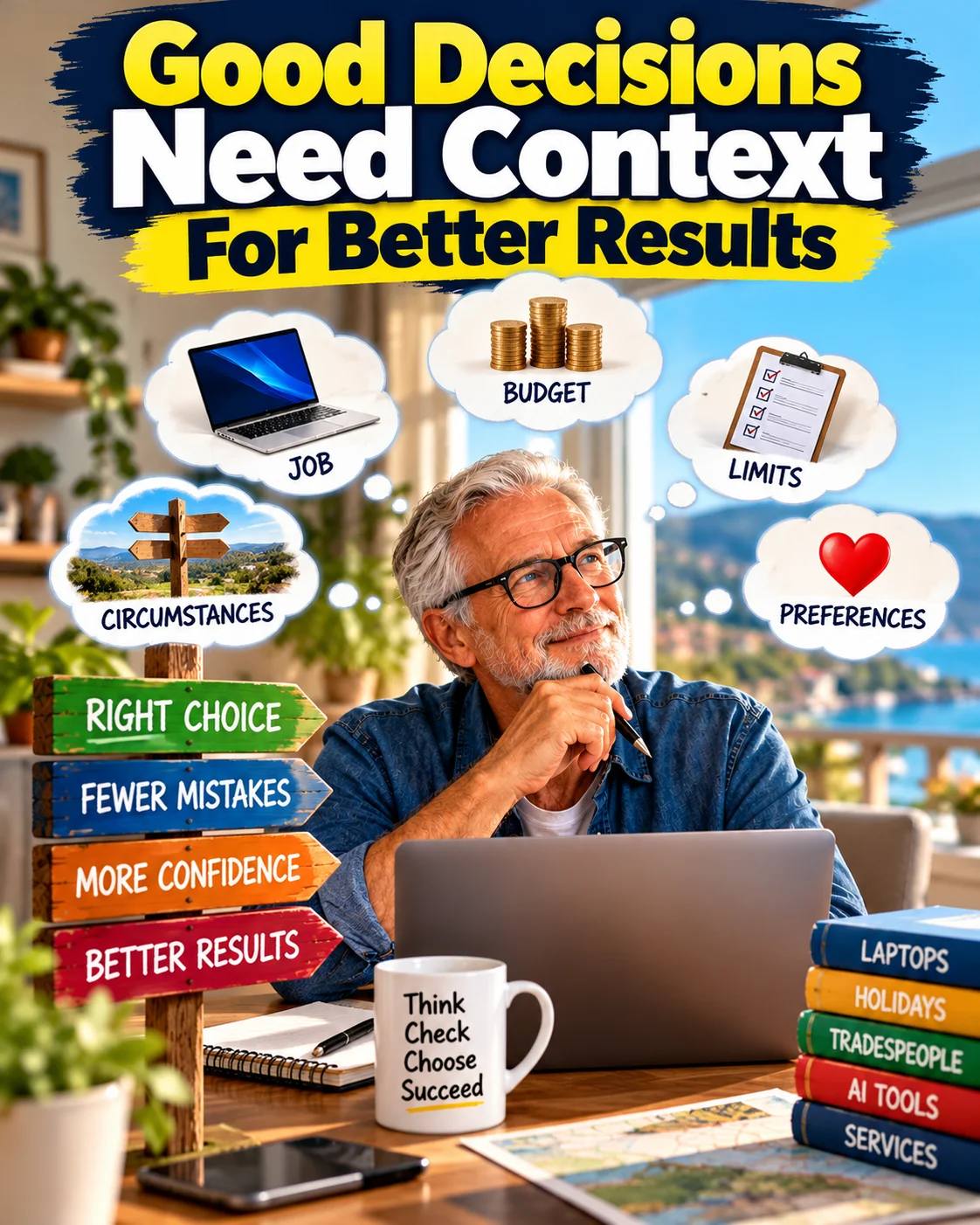
Good Decisions Need Context Before You Compare Options The right choice depends on the job, budget, limits and circumstances surrounding the decision.
Good Decisions Need Context When Personal Priorities Change The Answer
A highly rated option can still be the wrong fit when someone else’s priorities shaped the ranking.
Good Decisions Need Context Before AI Can Recommend What Fits
Clear context helps AI eliminate unsuitable choices and explain why one option better matches your real situation.
Why Good Decisions Need Context Before You Ask What’s Best
A recommendation can sound intelligent and still be wrong for the person receiving it. The missing ingredient is often not more information about the product, service or option. It is enough information about the person and the situation.
Good Decisions Need Context Because “Best” Changes From Person To Person
The same laptop, hotel, broadband package, AI tool or local service can be an excellent choice for one person and a poor choice for another without anything about the option itself changing.
Good Decisions Need Context Before Rankings Become Useful
A useful recommendation starts with the job, budget, limits, preferences and circumstances, then judges the options against that reality.
There is a type of online question we are trained to ask. Which laptop is the best? Which broadband deal is the best? What is the best holiday destination? What is the best AI tool? It feels sensible because we expect a clear winner. Still, reality often disagrees: no single product holds universally better specs. Yet the moment a real human being enters the picture, the neat little ranking begins to wobble. The person asking may have a budget. A bad knee may influence choices. A dislike of small screens or a dog can matter. A deadline next Tuesday or no interest in half the features being praised is possible. Suddenly ‘best’ stops being a fixed label. It becomes something much more useful: best for this person, doing this job, in these circumstances.
That is why Good Decisions Need Context. Without context, recommendations drift towards averages. They may be reasonable, popular and technically defensible, but they still try to serve a person they don’t understand. Imagine asking an AI assistant for the best laptop under £700. It can probably produce a respectable shortlist. Yet it has no idea whether the machine will travel every day, sit permanently on a desk, run demanding software, store thousands of photographs or merely handle email, banking, Facebook and Zoom. It cannot know whether a larger screen matters more than weight, whether the buyer wants something simple or likes tinkering, or whether £700 is an absolute ceiling or merely a rough guide. The question contains a price. It doesn’t yet include a life.
Now give that same AI a short description of the situation. “I’m retired. The laptop will mainly be used at home for email, online banking, Facebook, Zoom, photographs and writing. I prefer a larger screen because I find smaller ones harder to read. I do not play games, and I would rather not pay for performance I will never use.” Nothing about the laptop market has changed. Yet the useful answer can change considerably. Portability drops in importance. Screen size rises. High-end graphics become unnecessary. Ease of use matters more. Paying extra for specs designed for another type of customer looks less attractive. AI hasn’t become cleverer in thirty seconds. It has been given enough context to stop answering for an imaginary average person.
Riley’s Wisdom Drop #18: “Best” Needs An Address A recommendation becomes useful when you can say who it is for, what job it must perform, and which circumstances change what matters.
This same mistake appears everywhere because rankings feel reassuring. Five stars. Number one. Editor’s choice. Bestseller. Most popular. Top ten. Those signals can help, but they answer a different question. They tell you what performed well by someone else’s standards. They do not automatically tell you what fits your criteria. A hotel can have thousands of glowing reviews because it sits beside nightlife, bars and restaurants. For somebody wanting that energy, the rating may be completely justified. For a retired couple wanting quiet evenings, easy parking, a lift and somewhere fairly flat for walking, the very qualities driving those reviews may make the hotel less suitable. The hotel has not become worse. The context has changed what good looks like.
That distinction is easy to miss because we tend to treat facts as though they carry their own importance. They do not. A feature matters only when it connects to the job. A laptop weighing one kilogram may sound impressive, but if it never leaves the house, that advantage has little practical value. A hotel being ten minutes from the nightlife may sound attractive, but not if the customer wants peace. An AI platform having fifty advanced features may look superior, but not if the user wants one simple tool to help write emails. The fact remains true. Its value changes with context. That is the deeper mechanism beneath Good Decisions Need Context: context does not merely add personal colour to a recommendation. It determines which facts deserve weight.
A useful way to think about this is to give every meaningful decision five anchors: the job, the budget, the limits, the preferences and the circumstances. These are not forms to fill in for the sake of bureaucracy. They are filters. The job identifies what must actually be accomplished. The budget keeps decisions within a realistic spending range. The limits remove options that cannot work, no matter how attractive they look. Preferences help separate two acceptable choices. Circumstances reveal the real-life details that make an otherwise sensible answer wrong. Together, those anchors turn a general market into somebody’s actual decision.
Take the choice of a holiday. “Where is the best place to go in Spain?” is so broad that almost any recommendation has to rely on generic popularity. Add context and the question becomes useful. A retired couple wants a quiet week, easy walking, restaurants nearby, a hotel with a lift and no need to hire a car. That immediately changes the field. Resorts praised for clubs and late-night entertainment become less relevant. Beautiful hillside towns may become less attractive if steep walking is difficult. A slightly less fashionable destination with flat access, nearby restaurants and easy transfers may become the better recommendation. Again, nothing about Spain changed. The conditions used to judge the options changed.
And this is where another distinction becomes important. Not every detail deserves equal attention. Someone might say they like blue laptops. Fine. But if the machine only comes in silver, does that genuinely change the decision? Probably not. Now suppose they say small screens make it hard because of their eyesight. That detail can immediately change the shortlist. One detail is preference around the edges. The other affects job fit. Good context, therefore, isn’t about giving AI your life story. It is about supplying the few details with enough weight to change the answer.
Riley’s Wisdom Drop #19: The Useful Detail Is The One That Can Flip The Choice If changing a fact could change the recommendation, it belongs near the front of the decision. If it would not change anything, it is probably background.
That question alone can improve the way someone asks for help. Before adding another detail, ask: Could this realistically change which option I choose? If yes, include it. If no, do not let it dominate the comparison. This prevents context from becoming another form of information overload. The goal is not to bury the decision under dozens of personal preferences. The goal is to identify the few conditions that decide fit. In many cases, three or four strong pieces of context do more useful work than twenty weak ones.
The same principle becomes even more valuable with AI because general-purpose assistants readily answer incomplete questions. Ask for the best AI tool, and you may receive an impressive list. Yet “best AI tool” is not really a complete job. Is the person writing blog posts, making images, editing video, researching products, answering customer enquiries, working with spreadsheets or trying to understand a letter they received? A retiree wanting help turning forty years of trade experience into useful articles needs something quite different from a programmer selecting a coding assistant. Both may ask the same five-word question. Their context should produce different answers.
This is where AI users sometimes blame the tool when the problem began with the request. A vague question invites a broad answer. The assistant has to fill the missing gaps itself, and every assumption moves the recommendation further from the real person. A better request does not need clever prompt engineering. It simply needs a situation. This is what I am attempting to accomplish. That is the budget I can allocate. Here is what I cannot accept. Here is what matters most.” That is enough to turn a generic recommendation into something that can be reasoned about.
This approach also has a powerful built-in checking mechanism. If you tell the AI that the laptop will stay at home and that screen comfort matters more than portability, and it recommends a tiny, ultra-light machine because it weighs less, you can spot the mismatch instantly. Context doesn’t just help produce the answer. It helps you inspect the answer. You can ask, “Which parts of my situation drove this recommendation?” If the reasoning points back to the things you actually said mattered, the answer becomes easier to trust. If it celebrates features unrelated to your job, you know the recommendation has drifted.
That gives us a rule worth keeping beside yesterday’s lesson about finishing decisions:
Context defines the job. The job defines what matters. What matters defines the best fit.
Get that order wrong, and you can spend hours comparing options on criteria that should never have mattered. Get it right, and many choices start removing themselves before the serious comparison even begins.
So the next time you are tempted to ask an AI assistant, search engine, friend or reviewer, “What’s the best one?” add one sentence first.
“Here’s what I need it to do, and here’s what matters in my situation.”
That small change can turn a generally sensible recommendation into a personally useful one.
Because Good Decisions Need Context, and without it, “best” is often just somebody else’s answer to somebody else’s problem.
Good Decisions Need Context When One Detail Can Change Everything
Once you start judging choices through context instead of rankings, something else becomes obvious. Not every detail deserves equal weight. Some facts merely decorate the decision. Others can turn the recommendation upside down. That is where Good Decisions Need Context becomes especially useful, because the real skill isn’t collecting everything you can say about yourself. It is identifying the handful of details powerful enough to change the answer. A buyer might mention that they prefer a silver laptop, like a particular brand or have seen one advertised on television. Those details may influence preference, but they might not change what performs the job best. Now add poor eyesight, limited hand movement, software that runs only on one operating system, or a strict £600 ceiling. Suddenly the shortlist can change completely. Those are not background details. They are decision-changing context.
That gives us a useful diagnostic before asking AI for another recommendation. Take each detail and ask: If this fact changed, could the best choice change too? If the answer is yes, that fact deserves attention. If the answer is no, it may still be worth mentioning, but it should not dominate the comparison. This helps prevent the opposite problem, where someone learns that context matters and responds by telling the AI everything from their favourite colour to what they had for breakfast. More context is not automatically better context. Useful context has weight. It changes what qualifies, what matters, what gets eliminated or what wins when the strongest options are compared.
Imagine a retired couple choosing somewhere for a week away. Their first request might be, “Find us a good hotel near the coast.” An AI could produce dozens of perfectly respectable suggestions. Then one of them adds, almost as an afterthought, “My wife has arthritis and struggles with steep hills.” That single sentence can be more important than twenty other preferences. Suddenly terrain, lift access, transfer distance and walking routes deserve more attention. A picturesque hotel halfway up a hillside may have glowing reviews, sea views and an attractive price, yet become the wrong recommendation. A less glamorous hotel on flatter ground may now provide the better holiday. The hotel ratings have not changed. The couple’s needs have revealed which ratings matter.
This is why the order of the questions matters. Most people compare products first and add personal circumstances later. A stronger method reverses that. Start with the situation, then allow the situation to shape what gets compared. When mobility matters, filter for mobility before judging sea views. When the laptop must run particular software, establish compatibility before admiring battery life. If a tradesperson is needed urgently, availability becomes a first-stage filter rather than something discovered after reading twenty reviews. If an AI tool needs to produce videos rather than write emails, eliminate tools that cannot perform the core job before comparing subscription prices. Context should narrow the market before it starts shouting back.
Riley’s Wisdom Drop #20: Context Should Remove Before It Ranks The first job of good context is not to tell you which option wins. Its job is to keep unsuitable options from reaching the final comparison.
That one change can save an enormous amount of wasted attention. Without it, people can spend an hour carefully comparing two choices when one should have been removed in the first five minutes. The mistake happens because attractive features make unsuitable options hard to let go of. A hotel looks beautiful. A laptop has impressive specifications. A software package has fifty features. A tradesperson has hundreds of reviews. Yet if one non-negotiable requirement fails, those advantages may no longer matter. Good decision-making is not about giving every option a fair hearing. It is about recognising which options have earned a place in the serious comparison.
The same thinking helps with budgets. A budget is not merely the number someone hopes to spend. It provides context about what trade-offs make sense. Suppose somebody says they have £700 available for a laptop, but would happily spend only £500 if the cheaper machine comfortably does everything required. That is different from saying £700 is available and the goal is maximum performance within that figure. Both people have the same numerical ceiling. Their context around the money is different. One values avoiding unnecessary spend. The other values getting as much capability as possible. An AI that knows only “budget £700” can miss that distinction. An AI that knows what the budget means can reason much more usefully.
Preferences work differently from limits. A limit says an option cannot work. A preference says one workable option may be more attractive than another. Good decisions need context. Keeping those two separate makes decisions much cleaner. “I cannot manage stairs” is a limit. “I would like a sea view” is a preference. “The software must run on Windows” is a limit. A statement such as ‘I prefer a black laptop’ signals a preference. “I need the plumber this week” may be a limit. “I would rather use a local family firm” may be a preference. When every preference is treated as non-negotiable, almost nothing qualifies. When every limit is treated as optional, unsuitable choices sneak back onto the shortlist. Context becomes useful when the buyer knows which is which.
This gives us a very practical way to structure a decision without turning it into a complicated form. Start with four questions. This option must do what? What must it not violate? I would strongly prefer this. What circumstance could change the answer? Those questions are enough to expose much of the context that matters. They also give AI something more useful than a vague request for “the best.” The assistant can filter using the must-haves, rank using the preferences, and pay special attention to the circumstances powerful enough to reverse the recommendation.
The Best Answer Should Explain Why It Fits
There is another reason context matters. It lets the reader inspect the recommendation instead of accepting it blindly. A recommendation becomes much more useful when the reasoning points back to the situation. A buyer can check every part of that logic when an AI says, “I recommend this laptop because it has the largest screen among the suitable options, you told me it will mainly stay at home, and you do not need gaming performance.” If those priorities are correct, the recommendation feels grounded. If one assumption is wrong, the buyer can correct it. The AI is no longer presenting a mysterious answer. It is showing the path it used to get there.
That matters because Good Decisions Need Context, but they also need visible reasoning. Context hidden inside a recommendation is difficult to inspect. Context connected directly to the recommendation is useful. Request that the AI reveal which facts most influenced the answer. Determine which option was removed due to a limit. Ask which preference separated the final two. Ask what single new fact would be most likely to change the recommendation. Those questions expose the decision mechanism without requiring the user to understand every technical specification behind the product or service.
Riley’s Wisdom Drop #21: A Recommendation Should Point Back To Your Life If the reasons for choosing something don’t connect to the situation you described, the recommendation may be impressive, but it isn’t personal yet.
Consider a local tradesperson example. Someone needs a leaking radiator repaired. They find three firms. One has the most reviews. One is cheaper. One can attend tomorrow morning. If the leak is minor and contained, waiting four days for the highly reviewed firm may be perfectly reasonable. If water is damaging the floor, speed suddenly becomes a major part of the job. The “best plumber” has changed without any plumber changing at all. Urgency changed the context. That is why a recommendation made yesterday can become wrong today when circumstances change. Context is not a permanent profile. It belongs to the decision taking place now.
This also explains why copying someone else’s recommendation can go wrong. Your neighbour may genuinely love their broadband provider. Their house may have different infrastructure. Your friend may swear by a particular laptop because they travel regularly. Yours may never leave the spare room. Somebody in an online group may insist one AI platform is unbeatable because they use it for coding. You may want help writing simple emails and organising ideas. Their recommendation can be honest, informed and completely unsuitable for you. The useful question is not, “Do they know what they’re talking about?” It is, “How similar is their context to mine?”
That also makes reviews easier to read. Rather than counting praise and criticism, look for reviewers whose situation resembles yours. A complaint about a laptop being too heavy matters little if you’ll keep it on a desk. Praise for an enormous hotel entertainment programme means little if you intend to spend every evening somewhere quiet. A software review celebrating complex automation may be irrelevant if simplicity is your priority. Context turns reviews from verdicts into evidence. You stop asking whether the reviewer liked the product and start asking whether their reasons for liking or disliking it apply to you.
The same good decisions need context rule can protect people from paying for features they do not need. Modern products are often sold by adding more capability. Additional storage. Faster performance. Increased automation. Additional cameras. Additional channels. More integrations. More everything. It becomes easy to assume the option with the longest feature list must be the better buy. Yet every additional capability matters only when it connects to a useful job. If the extra £200 buys performance you will never notice, it is not automatically added value. If paying slightly more buys the one feature that removes a daily frustration, the higher price may be entirely sensible. Context gives price something to be judged against.
This is where our earlier lesson about better decisions and today’s lesson join together. Yesterday the buyer needed permission to stop searching. Today we give them a better way to decide what deserves searching in the first place. First, define the context. Next, filter. Then compare. Then finish. Doing it the other way creates mountains of information about options that may never have suited the person in the first place.
So before opening another comparison page, use what I would call the Context Fit Check:
The Job: What must this choice actually do?
The Limit: What would make an option unsuitable immediately?
The Preference: What would make one suitable option nicer than another?
The Circumstance: What detail about my real situation could change the recommendation?
The Fit: Which remaining option best matches those four things without asking me to pay for advantages I do not need?
That is simple enough to use for a laptop, holiday, broadband package, AI tool, tradesperson, course, service or almost any everyday comparison. It keeps attention on fit, not popularity.
Today’s Apprentice Task: Build One Front Door
Open to See This Video, And This Is What’s Already Built, Trained & Waiting For Your First Command.
Today’s Practical Task: Add The Missing Context
Choose one decision you are already thinking about.
Do not search for more options yet.
Provide one sentence describing the job.
Write one limit the choice must respect.
Write one preference that would make the experience better.
Then identify the one circumstance most capable of changing the answer.
Now give those details to the AI you already use and ask it to recommend the strongest fit, not the generic winner.
Finally, inspect the reasons it gives you.
Do they point back to your job, limits, preferences and circumstances?
If they do, you have something worth considering.
If they do not, the problem may not be the recommendation.
The AI may still not understand the situation well enough.
Because even the smartest answer in the world can be wrong when it answers the wrong version of your life.

 That is why Good Decisions Need Context. Without context, recommendations drift towards averages. They may be reasonable, popular and technically defensible, but they still try to serve a person they don’t understand. Imagine asking an AI assistant for the best laptop under £700. It can probably produce a respectable shortlist. Yet it has no idea whether the machine will travel every day, sit permanently on a desk, run demanding software, store thousands of photographs or merely handle email, banking, Facebook and Zoom. It cannot know whether a larger screen matters more than weight, whether the buyer wants something simple or likes tinkering, or whether £700 is an absolute ceiling or merely a rough guide. The question contains a price. It doesn’t yet include a life.