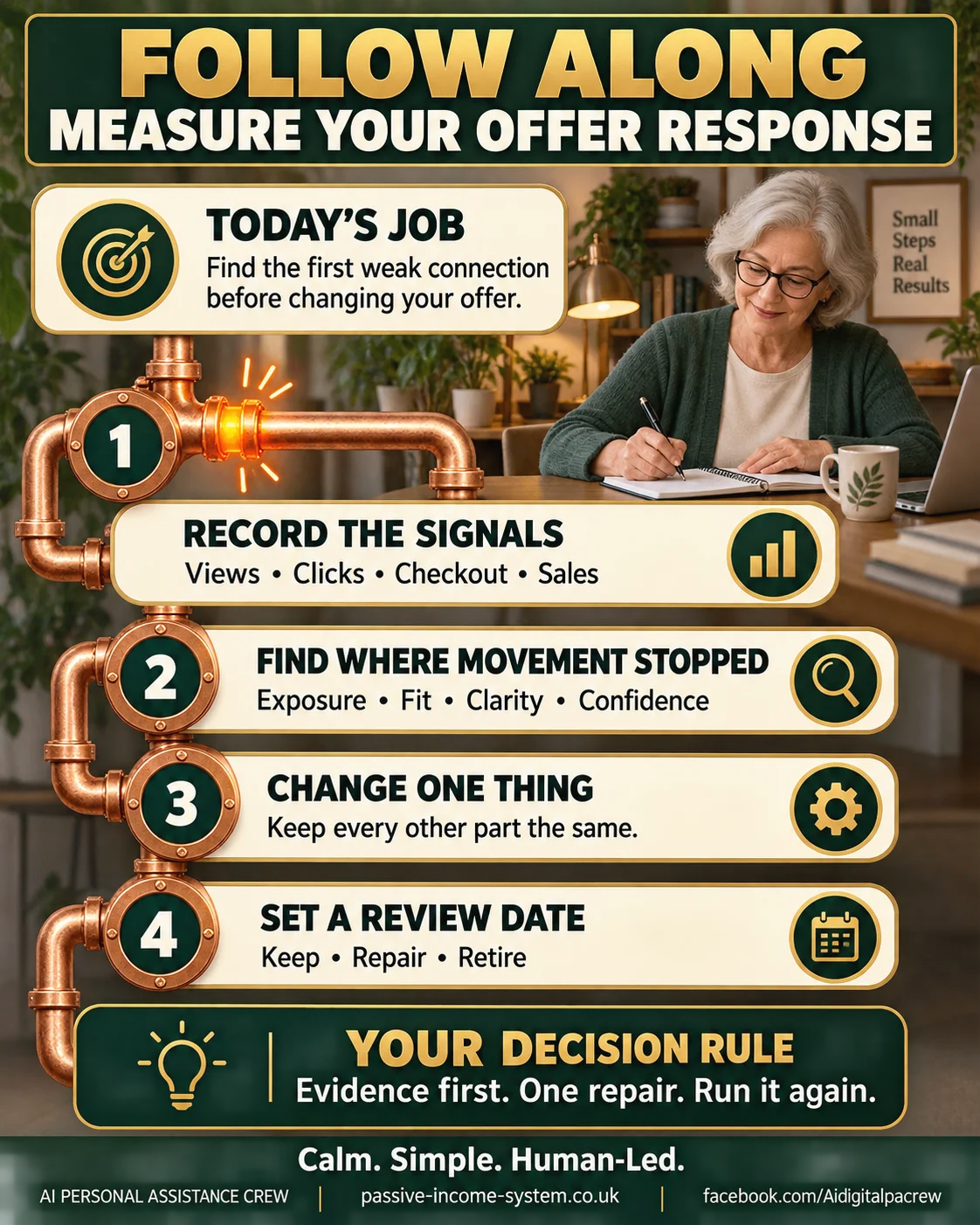
Measure Your Offer Response
Measure Your Offer Response Before Rebuilding Everything
A quiet sales page signals an unfinished journey, not an unwanted product.
Find The First Place Your Interested Reader Stopped
Views, clicks, checkout visits and questions reveal different parts of the buying journey.
Change one connection and run the same route again. Keep the rest of the offer steady so the next response teaches you something useful. The offer had been live for twenty-seven minutes when its creator conducted the first official inspection.
No sales. He refreshed the page. Still no sales.
He opened the sales page in another browser, checked the button and returned to the statistics. Nothing had happened during his absence. The internet, in its famous lack of bedside manner, hadn’t produced a customer simply because he had looked away.
By lunchtime, the headline was under suspicion. Shortly afterwards, the price joined it. The product image was replaced, the button colour was changed, and a new bonus was added to rescue an offer that had barely been given enough time to take its coat off.
By teatime, the entire sales journey was different. Unfortunately, that meant the next response could no longer explain what had been wrong with the first one.
This is the peculiar difficulty of selling something online. A heating system that refuses to warm the radiators gives you physical clues. You can hear the pump, feel the pipes and inspect the pressure. A digital offer sits quietly on a screen. When nobody buys, every part appears equally guilty.
That is why beginners must learn to measure your offer response before reaching for the online equivalent of a large hammer.
A Sale Cannot Explain The Whole Journey.
 The order arrives. The payment notification appears. Somebody has bought the product.
That is the result every new seller hopes to see, and understandably so. A genuine transaction proves that another person found enough value, clarity and confidence to exchange real money for the offer.
However, a sale is the final signal in a longer chain.
Before somebody buys, the offer normally has to pass several smaller tests.
The right person must encounter the message. Something must earn their attention. The promise must feel relevant. The link must work. The sales page must make sense. The payment route must feel safe, and the final button must do what it says.
Each stage passes the reader to the next.
Treating the sale as the only measurement is rather like judging an entire heating installation by whether one radiator became warm. The warm radiator is excellent news, but it doesn’t tell you whether the remaining ten are working, whether the boiler is cycling correctly or whether somebody has left a valve closed upstairs.
The useful question is not merely: Did anybody buy?
It is: How far did interested readers travel before they stopped?
That question turns disappointment into diagnosis.
Measure Your Offer Response Through The Handovers
Imagine that you publish a Facebook post introducing a £7 beginner’s guide. The post reaches 600 people. Twenty readers visit the sales page. Four begin the checkout process, and nobody completes the payment.
No sale, but there is certainly a response.
The exposure tells us the message was displayed. Clicks tell us some readers found the subject relevant enough to investigate. The checkout activity suggests that at least a few moved beyond casual curiosity. The final absence of payment points towards a later connection in the journey.
Perhaps an unexpected charge appeared. The checkout page may have looked unfamiliar. The payment button could have failed on a mobile phone. The buyer may have needed one final reassurance about delivery or compatibility.
We still don’t have a confirmed diagnosis, but we now know where to start.
Compare that with a second offer that receives six impressions, no clicks and no sales. It would be foolish to blame the checkout because almost nobody reached the message, let alone the payment page.
Both offers produced zero sales. Yet they have entirely different problems.
That is the value of measuring the handovers. It prevents the final number from disguising everything that happened before it.
Silence Is A Symptom, Not A Verdict
Online sellers can be remarkably harsh judges of their own work.
One quiet afternoon can feel like proof that the product is wrong, the audience is uninterested, and the entire online-income experiment should be buried behind the shed before the neighbours notice.
But silence has several possible causes.
The offer may not have received enough exposure. It may have reached people who were never likely to need it. The headline may have attracted attention without explaining the result. The page may have answered the wrong question. The purchase route may have introduced uncertainty at the exact moment confidence was required.
Those possibilities belong to four broad inspection areas:
- Exposure: Did enough people encounter the offer?
- Fit: Were they the people most likely to value it?
- Clarity: Did they understand the problem, promise and next step?
- Confidence: Did the page and payment route feel credible and safe?
These are not four clever marketing labels to admire on a worksheet. They are four different faults requiring four different repairs.
Increasing exposure will not rescue an unclear promise. Rewriting the headline will not repair a broken payment link. Reducing the price will not help if the message reached the wrong audience.
Before changing anything, locate the earliest weak connection.
Questions Can Be Part Of The Offer Response
A buyer’s question is sometimes treated as an interruption to the sales process.
It is usually the opposite.
Suppose three readers ask whether the digital guide requires paid software. None buys immediately. It would be easy to record the day as another failure because the sales column remains empty.
Yet those questions reveal something commercially useful. The readers were interested enough to investigate, but one uncertainty stood between interest and action. The sales page had explained the product without explaining the equipment needed to use it.
That uncertainty can now be answered honestly on the page.
Likewise, a reader who asks, “Is this suitable for somebody who has never used AI?” is not rejecting the offer. They are trying to decide whether the offer includes someone like them.
Questions reveal missing clarity. Repeated visits can suggest unresolved interest. Checkout abandonment may reveal friction. Replies such as “I’ll look later” may indicate that the next step feels larger than expected.
Not every reaction deserves a rewrite. One passing comment may be nothing more than one person’s preference. But when similar uncertainty appears repeatedly at the same connection, it becomes evidence worth examining.
To measure your offer response properly, record behaviour and language, not merely completed orders.
Don’t Repair Four Things At Once
The temptation to improve everything is strongest when confidence is lowest.
A seller sees no purchases and changes the headline, image, price, bonus, button and audience before publishing the offer on another platform. The second attempt performs better.
Excellent.
What caused the improvement?
Nobody knows.
The new headline may have clarified the result. The original audience may have been poorly matched. The price reduction might have helped, or the new platform may have provided greater exposure. Because every component changed together, the response cannot teach us which repair mattered.
The offer has moved, but the evidence is gone.
A better rule comes directly from practical fault-finding: Change the earliest suspected weak connection, then run the whole route again.
If people see the message but don’t click, inspect the promise and invitation. If they visit the page but don’t continue, examine clarity and relevance. If they begin checkout but don’t finish, inspect confidence, payment friction and delivery information.
One repair gives the next attempt a job.
It must answer one clear question: Did this change help more readers cross the weak connection?
That is how a beginner gradually turns an offer from a hopeful guess into a working sales route.
Give The Offer Enough Time To Answer
By the following morning, our impatient seller had discovered a fresh problem.
The new headline had received a click.
Was that enough evidence to declare it the winner?
He was already hovering over the editing button when common sense arrived, slightly out of breath and several hours late. One click could be encouraging, but it could also be a returning visitor, an accidental tap or somebody checking whether the page still existed.
A single response can tell you that movement is possible. It cannot always tell you why it happened or whether it will happen again.
This is where online selling demands a quality rarely celebrated in marketing advertisements: the ability to leave something alone long enough to learn from it.
The seller must decide in advance when to inspect. That may be after a set number of posts, a reasonable period of promotion or enough page visits to reveal where people repeatedly stop. The right review point depends on audience size and how often you show the offer.
The important part is deciding before emotion takes over.
Without a review date, the offer is judged whenever the seller feels nervous. With one, the offer gets a fair runway before you consider changes.
Measure Your Offer Response With A Small Scoreboard
You don’t need a control room filled with flashing screens.
For a first small offer, a simple record can reveal more than a complicated dashboard nobody understands. The purpose isn’t to collect every available number. It is to follow the reader from first contact to the intended result.
Record these five signals:
- Exposure: How many people saw the message?
- Interest: How many reacted, replied or showed relevant curiosity?
- Visits: How many continued to the offer page?
- Checkout movement: How many began the buying process?
- Sales: How many completed the purchase?
Add one final note:
What questions, hesitations or repeated comments appeared?
That small addition matters because numbers show where movement stopped, while reader language can help explain why.
Suppose 500 people see the post, 25 visit the offer page, six begin checkout and two buy. The offer has produced evidence at every handover. That doesn’t mean the system is perfect, but it means the route works.
Now, 500 people see another post, and nobody visits the page. The checkout and payment system haven’t been tested by real behaviour yet. The first repair belongs much earlier, where the social message should create enough relevance and curiosity to earn the click.
The scoreboard keeps every part of the journey in its proper place.
The Earliest Weak Connection Comes First
A central-heating fault can appear far away from its cause.
One cold radiator might suggest a problem with the radiator itself. Yet the real cause may be trapped air, a closed valve, poor balancing or inadequate flow somewhere else in the system. An experienced tradesman doesn’t begin by replacing every visible component. He follows the system until the first abnormal result appears.
An offer deserves the same discipline.
If exposure is poor, polishing the checkout page adds little value. If people notice the message but the wrong readers respond, the audience reference may be too broad. If the right readers visit the page but don’t understand what they’re getting, the promise or product explanation needs attention.
The earliest weak connection affects everything that follows it.
That gives us a practical inspection order:
- Did the offer receive meaningful exposure?
- Did the intended kind of reader notice?
- Did the message earn a visit?
- Did the sales page maintain interest?
- Did the buying process feel clear and safe?
- Did the customer complete the purchase?
Stop at the first place where expected movement repeatedly disappears.
That is the repair point.
Measure Your Offer Response Without Blaming The Reader
One of the easiest conclusions in marketing is that people “just aren’t serious.”
They clicked but didn’t buy. They asked a question and vanished. They said they were interested but didn’t return. Therefore, the theory goes, the audience lacks commitment.
That conclusion protects the offer from inspection by placing all responsibility on the stranger.
A more useful response is to ask what the reader experienced when they stopped.
The social post promised a simple starter system, but the sales page introduced twelve tools, six bonuses and three upgrades. Maybe the button said “Get Instant Access,” while the checkout required an account, password and several unfamiliar decisions. The reader may have expected one manageable step and encountered an entire staircase.
This doesn’t mean you must remove every hesitation or persuade every visitor to buy. Some people will never be suitable customers. Others may like the idea but have no immediate need.
However, when several interested readers stop at the same point, the offer should earn the right to blame them only after it has inspected its own route.
Clarity is the seller’s responsibility. Choice remains the reader’s.
Don’t Let A Small Audience Pretend To Be A Verdict
A new offer placed in front of twelve people may produce no sales.
That result is true, but its meaning is limited.
It tells us that none of those twelve people bought during that particular attempt. It does not prove that nobody wants the product, that the price is impossible or that the seller should abandon the project.
Small numbers require modest conclusions.
Instead of claiming that the offer has failed, record exactly what occurred. Perhaps eight people saw the post, two clicked, and one asked whether the guide was printable. That is not enough evidence to forecast a business, but it is enough to show that the subject earned some attention and the printable format mattered to at least one reader.
The disciplined beginner learns to say: This is what happened during this attempt.
That sentence is far more valuable than: This always works.
It is also more useful than: Nothing works for me.
Both dramatic conclusions reach further than the evidence allows.
Set A Decision Date Before Emotion Sets One
Every offer eventually needs a decision.
Continuing forever without learning is not patience. Removing an offer after one quiet morning is not decisiveness. A useful decision sits between those extremes.
At the chosen review point, place the evidence into one of three categories.
Keep The Offer Running
Keep it when readers are moving through the journey, the message is reaching suitable people, and the process remains manageable.
The offer may not produce large numbers yet. It simply needs enough healthy movement to justify another run. Preserve the working route and continue gathering comparable evidence.
Repair One Weak Connection
Repair it when reader movement repeatedly stops at one identifiable point.
The repair might be a clearer headline, a stronger explanation of who the product is for, a visible answer to a common doubt or a simpler buying step. Change the relevant component and keep the rest of the journey stable.
Then run it again.
Retire The Offer With A Reason
Retire it when repeated, fair attempts produce no meaningful interest, the audience-product fit remains weak, or the offer no longer deserves the time required to maintain it.
Retirement isn’t a personal defeat. It is a business decision supported by recorded evidence.
More importantly, the seller keeps what was learned. The next offer begins with a better understanding of the audience, message and buying journey.
Measure Your Offer Response Before Adding More Traffic
More traffic is attractive because it appears to solve everything at once.
If ten visitors produce no sales, perhaps one thousand visitors will. Unfortunately, increased traffic multiplies whatever already exists.
A clear offer placed in front of more suitable people may grow. A confusing offer in front of more people only creates confusion faster.
Before paying for promotion or adding another platform, inspect the route already carrying readers.
Can the intended person recognise themselves in the message? Is the promised result easy to understand? Does the page explain what they receive? Is the price visible? Does the buying button work? Is delivery explained? Can a cautious beginner see what happens next?
If those connections are sound, greater exposure may help.
If they are not, traffic becomes an expensive way to discover a problem that was already sitting on the page.
The Offer Is A Working Route, Not A Final Monument
The first published offer will rarely be the final version.
That is not a flaw. It is how the route learns.
A product creator begins with judgement, experience and a reasonable promise. Real readers then reveal what they notice, what they misunderstand, what they question and where they hesitate. The offer improves because evidence replaces assumption, one connection at a time.
This is why the first small sale matters so much.
It isn’t merely seven pounds entering an account. It proves that one reader travelled from exposure to attention, from attention to interest, from interest to confidence and from confidence to action.
The seller now has a complete journey to inspect and repeat.
Until that happens, every useful response still shortens the distance. A click proves curiosity. A relevant question reveals missing information. A checkout visit shows stronger intent. Even a broken link, discovered early, prevents the same fault from wasting tomorrow’s traffic.
When you measure your offer response, silence stops being a verdict and becomes part of the inspection.
Apprentice Task: Inspect Your Live Offer
Today’s task is to examine one live offer without changing everything around it.
Write down the complete route:
Traffic source: __________________________________
Message or post: _________________________________
Offer-page destination: __________________________
Checkout or payment route: _______________________
Intended result: _________________________________
Now record the response:
☐ I recorded how many people appeared to see the message.
☐ I checked whether suitable readers reacted or replied.
☐ I recorded visits to the offer page.
☐ I checked whether anybody began the payment process.
☐ I recorded completed purchases.
☐ I noted any questions, hesitation or confusion.
☐ I identified the earliest weak connection.
☐ I chose one repair rather than changing everything.
☐ I set a date for reviewing the next attempt.
☐ I checked whether suitable readers reacted or replied.
☐ I recorded visits to the offer page.
☐ I checked whether anybody began the payment process.
☐ I recorded completed purchases.
☐ I noted any questions, hesitation or confusion.
☐ I identified the earliest weak connection.
☐ I chose one repair rather than changing everything.
☐ I set a date for reviewing the next attempt.
Complete this sentence:
The first place reader movement appears to stop is:
Now choose one decision:
KEEP: The route is producing useful movement.
REPAIR: One connection needs a specific change.
RETIRE: Repeated fair attempts show that this offer should end.
Finally, write the one question your next attempt must answer:
Did this change help more readers to:
Open to See This Video, And This Is What’s Already Built,
Trained & Waiting For Your First Command.
Your job today isn’t to force the numbers to look impressive. It is to make the next decision less dependent upon guesswork.
The offer is live. The route can now be inspected. Record what happened, repair the earliest weak connection and let the next journey provide the evidence.
That is how a quiet sales page begins teaching you how to build a working one.