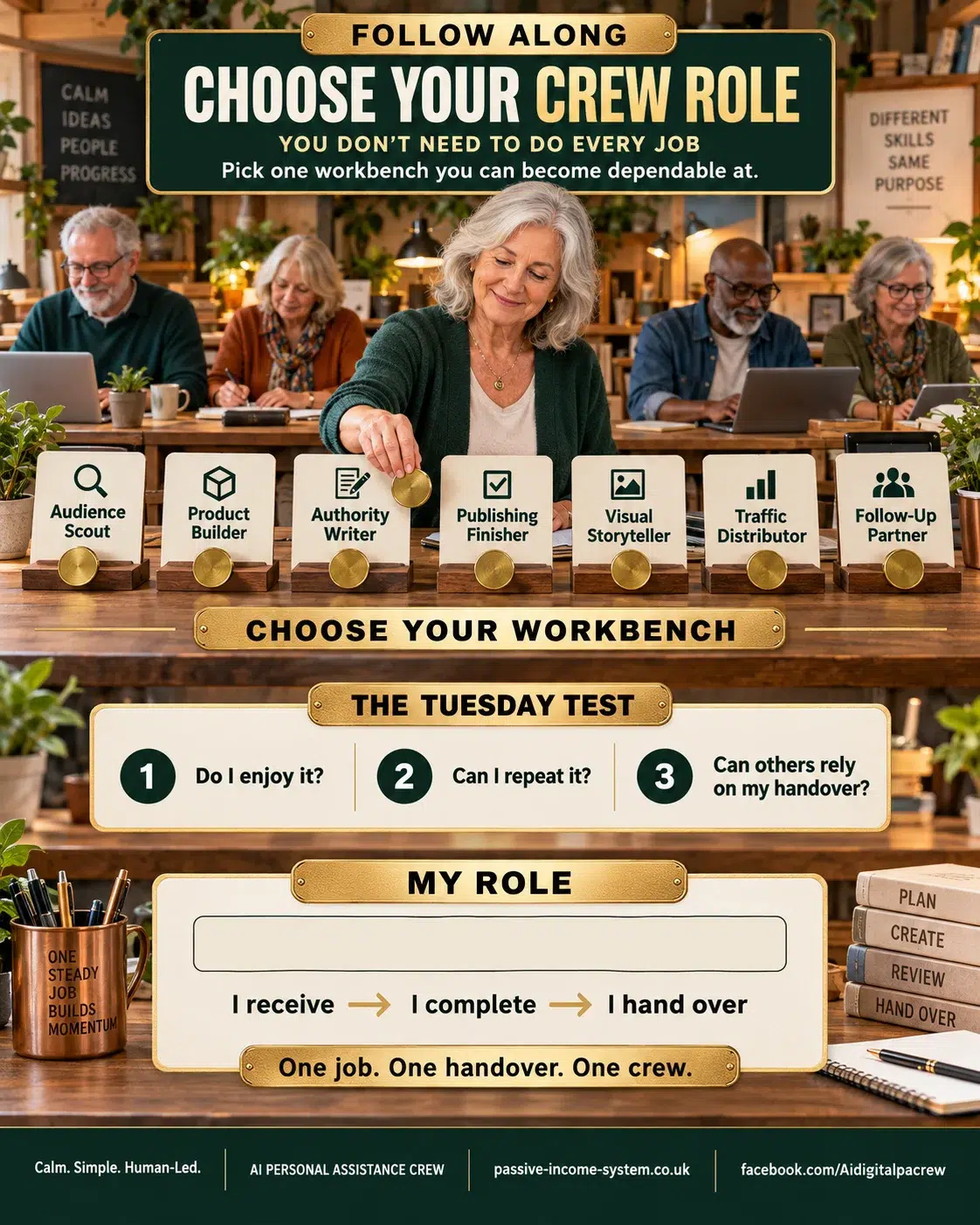
Choose Your Crew Role Instead Of Becoming The Whole Business
A digital-product business contains several trades, and few people naturally enjoy all of them.
One Reliable Handover Beats Ten Half-Learned Digital Skills
A specialist becomes valuable when the next crew member can use their finished work immediately.
Let The Control Room Set One Shared Direction
The Ideas Generator chooses the product while the Crew Leader turns it into clear individual jobs.
The noticeboard shows seven brass cards. Additionally, research. Next, begin the build. Additionally, write. Next, publish. Next, illustrate. Then distribute. Additionally, follow up.
A group of experienced men and women stand in front of it, studying the jobs very differently from how they once examined another online business opportunity. Nobody is being asked to buy another enormous course, become a marketing expert by Friday or construct an entire digital empire between breakfast and Bargain Hunt.
This time, the invitation is smaller.
Choose the job you would enjoy becoming dependable at.
 Meanwhile, one person moves towards the research card. Another immediately notices the visual workbench. A retired administrator studies the publishing role because organising pages, checking details and finishing jobs properly already feels familiar.
Additionally, for the first time, nobody is being asked to do everything.
That is the central idea behind Choose Your Crew Role. A successful digital product may appear to come from one creator, but the finished result contains several separate kinds of work. The problem begins when one beginner is expected to do every one of them before they have built confidence in any.
The Lone Creator Has Too Many Hats And Only One Head
However, typical online-business advice sounds wonderfully simple.
Moreover, find a profitable idea. Then identify your audience to guide the next steps. Moreover, create the product. Then write the sales page. Next, design the graphics. Build the website. Attract traffic. Additionally, answer questions. Follow up with prospects. Measure the results. Improve everything.
Then repeat.
Nevertheless, each instruction may be reasonable on its own. Placed together, they become a job description for an entire company wearing one cardigan.
The beginner isn’t merely learning how to create a digital product. They are simultaneously becoming a researcher, instructional designer, writer, editor, web publisher, search specialist, graphic designer, video producer, traffic manager, customer-service representative and sales analyst.
When the work stalls, they naturally assume something is wrong with them.
However, the real fault may lie in the job’s design. We handed one person the complete workshop and wondered why no finished product came out of the other end.
In traditional work, this would look absurd. The architect doesn’t usually pour the concrete, fit the windows, wire the building, produce the advertising brochure and answer every telephone enquiry about the finished property.
Online, we call it getting started.
Choose Your Crew Role By Looking At What You Already Do
People often choose digital roles according to which one sounds most important.
“Product creator” has a certain grandeur. “Marketing strategist” could probably acquire its own parking space. “Chief Executive Officer” looks impressive beneath a profile photograph, even when the entire executive department consists of one person and a slightly temperamental laptop.
A better role begins with behaviour rather than status.
What do you naturally do when a group encounters a problem?
Some people ask questions until the real cause becomes visible. Others begin organising the information. One person reaches for a notebook and starts explaining. Another notices that the page looks untidy. Somebody else wants to tell everyone about the result, while the natural conversationalist wonders what the customer thought.
Those instincts point towards different workbenches.
The investigator may become an Audience Scout. The practical organiser may suit Product Building or Publishing. The storyteller may enjoy Authority Writing. The visual thinker could create graphics and videos. The connector may distribute the work, while the listener could become the Follow-Up Partner.
Your best crew role may already be hiding in work you have done for years without giving it a digital name.
The Control Room Decides What Today’s Job Must Produce
A crew cannot operate by allowing seven people to build seven unrelated things.
Somebody must decide what the day’s work must accomplish.
That responsibility belongs in the Control Room.
The human Ideas Generator chooses the theme, identifies the audience problem and decides which product or offer the work will support. The Crew Leader then turns that direction into job cards, sequences the handovers and checks whether each result still points toward the same destination.
If today’s theme is helping retirees turn lifetime experience into a small digital guide, the researcher shouldn’t wander off to investigate cryptocurrency. The writer shouldn’t produce an article about social-media algorithms, and the visual builder shouldn’t return with a photograph of two pensioners climbing a mountain at sunset.
Everybody may have worked hard, but the installation won’t connect.
The Control Room prevents useful effort from separating into unrelated activity. It tells the entire crew:
- What are we building?
- Who is it for?
- What problem should it solve?
- Which offer does it support?
- What must be finished today?
Leadership doesn’t mean doing every task. It means making sure every task belongs to the same job.
Workbench One: The Audience Scout Finds The Real Problem
The Audience Scout is the crew member who enjoys finding out what people actually need.
They investigate questions, comments, search phrases, repeated frustrations and previous attempts. They notice the difference between what a potential buyer says publicly and the quieter concern preventing them from moving forward.
For example, a retiree may say, “I don’t know what digital product to create.”
The first answer could be a list of product ideas. Yet further investigation may reveal a deeper problem. The person possesses useful experience but doesn’t recognise it as something another beginner would value. Their difficulty isn’t a shortage of ideas. It is translating familiar knowledge into a clear, useful outcome.
That discovery changes the product.
Instead of producing another enormous catalogue of online-business ideas, the crew might build a short Experience-to-Asset Workboard that helps the reader identify one practical skill and convert it into a checklist, guide or template.
The Audience Scout’s finished handover must state:
- Who needs the help
- What they are trying to accomplish
- What repeatedly stops them
- What they have already attempted
- Which uncertainty matters most now
That is a complete job. The Scout doesn’t need to design the product or write the sales page. They must deliver reliable evidence that the next crew member can use.
Workbench Two: The Product Builder Makes The Help Usable
The Product Builder receives the audience evidence and asks a different question:
What could we build that helps this person take a useful step?
This crew member enjoys organising knowledge into something practical. They may create a worksheet, checklist, prompt collection, planning board, short guide, video lesson or simple toolkit.
Their strength is turning explanation into use.
Suppose the Audience Scout discovers that older beginners feel overwhelmed because every digital-product course presents dozens of possible business models. The Product Builder doesn’t add another fifty possibilities. They create a calm decision tool that helps the reader compare three realistic options and choose one.
The job has boundaries.
A Version One product doesn’t need twelve modules, seventy bonuses and enough video to survive a wet bank-holiday weekend. It needs to do the job it promised the intended user.
Before handing it over, the Product Builder applies a simple test:
- Is the purpose clear?
- Can the intended person understand it?
- Can they use it without extra equipment or unexplained knowledge?
- Does it help them act or decide?
- Is the next step obvious?
If the answer is yes, the product is ready to move. The builder resists the temptation to keep adding rooms after the house has passed inspection.
Workbench Three: The Authority Writer Connects Problem And Solution
A useful product cannot speak for itself while sitting quietly in a folder.
The Authority Writer gives it a voice.
This role suits somebody who enjoys explaining, storytelling, teaching or finding the phrase that makes a complicated idea suddenly feel manageable. They take the Audience Scout’s evidence and the Product Builder’s solution, then create the content that connects them.
The article may begin with a recognisable scene. The email may answer one reader’s doubt. The social post might expose a mistake without embarrassing the person making it. The sales page shows who the product helps, what job it performs and what happens after purchase.
Good authority writing doesn’t decorate a weak product with excitement. It helps the right reader recognise the usefulness already present.
The writer’s completed handover could contain:
- One strong article
- One clear product promise
- One reader-facing AI prompt
- One social-media introduction
- One honest next step
Their job is finished when the reader understands the problem, sees the practical mechanism and decides whether the solution belongs in their situation.
The Writer doesn’t need to upload the page, configure the SEO or distribute the message across seven platforms. Another workbench is waiting for that handover.
That is what makes Choose Your Crew Role more than a pleasant exercise in self-discovery. Each role has a purpose, a boundary and a finished result.
Nobody is merely “helping with the business.”
Everybody owns one essential part of the installation.
Workbench Four: The Publishing Finisher Builds The Shopfront
The Authority Writer hands over a finished article.
At that moment, the words may still be sitting inside a document, looking very pleased with themselves but earning no visitors, clicks or customers.
The Publishing Finisher takes responsibility for turning that document into a working destination.
This role suits the person who enjoys order, accuracy and the satisfaction of seeing every component sitting in its proper place. They load the article into WordPress, arrange the headings, position the graphics, check the links and make sure the offer button leads somewhere more useful than a blank page.
They also complete the SEO Pack, social appearance and appropriate schema. However, their real job is larger than satisfying a collection of coloured scores.
They protect the reader’s journey.
A heading must help the reader continue. An image should strengthen the lesson. A link must carry the visitor towards the next useful destination. The page must work on a mobile phone as well as the large screen used to build it. The Publishing Finisher’s handover is simple:
One complete, tested and publicly accessible page.
Not a draft that someone else has to tidy up later. Not a link followed by the cheerful instruction, “There may still be one or two little things.”
The page is ready to receive traffic.
Choose Your Crew Role Where Details Matter
Some people find checking details tedious.
Others cannot walk past a crooked picture without straightening it.
That difference matters when people choose your crew role. A Publishing Finisher doesn’t need to be the loudest member of the team. They become valuable because they notice the wrong heading level, the missing image description and the button that works perfectly on a desktop but disappears behind the furniture on a mobile screen.
Every crew needs somebody who enjoys the final ten per cent.
In the heating trade, completing most of an installation wouldn’t impress the customer. Ten radiators connected beautifully and one leaking through the ceiling still produced an awkward conversation.
Digital work is no different.
A missing link, confusing form or unexplained checkout can waste everything completed before it. The Audience Scout may have identified the correct problem. The Product Builder may have created a useful solution. The Writer may have explained it beautifully. Yet the reader still needs a functioning route.
The Publishing Finisher ensures the work doesn’t fail at the final joint.
Workbench Five: The Visual Storyteller Makes The Idea Visible
The next crew member thinks in scenes, layouts, colours and movement.
While the Writer sees a sentence, the Visual Storyteller sees a retired beginner standing before seven workbenches and realising they only need to choose one.
That ability gives an abstract idea a memorable form.
The Visual Storyteller creates the featured image, social graphic, follow-along board, short video and supporting visual assets. Their job isn’t to fill empty spaces with decorative photographs. Every image must help the audience notice, understand or use the message.
For Choose Your Crew Role, the central visual isn’t a generic team shaking hands across a conference table. It shows a group of experienced older adults choosing the job that fits them, while the Control Room holds the shared direction.
The visual teaches before the first paragraph.
One person chooses research. Another sits at the writing desk. Somebody works with images. A natural communicator prepares to answer questions. Nobody looks lost because nobody has been handed the complete business.
The Visual Storyteller keeps the branding recognisable, the text readable and the central idea dominant. Their finished handover includes the correct sizes, filenames and accompanying image descriptions so the next person can publish without rebuilding anything.
Workbench Six: Choose Your Crew Role: The Traffic Distributor Opens The Road
A finished page can remain beautifully invisible.
The internet contains millions of useful pages sitting quietly while their creators wait for somebody to arrive. Unfortunately, search engines and social platforms have never signed an agreement promising to deliver visitors simply because we tried very hard.
The Traffic Distributor carries the work towards readers.
This role suits someone who enjoys sharing, connecting platforms and observing which messages encourage people to keep going. They publish the Facebook introduction, prepare the Reel, place the article link in the first comment and adapt approved material for the selected distribution channels.
Their job isn’t to insert the same link under every conversation they can find.
Useful distribution begins with fit.
Which people need today’s lesson? Where are they already paying attention? Which part of the article gives them a reason to visit? What destination should receive the click?
The Traffic Distributor keeps a record of the route:
Source → Message → Destination → Next Step
When the route repeats, the crew can compare results. They can see which opening earned attention, which platform sent interested readers and where the process became quiet.
The finished handover is not “posted everywhere.”
It is:
The correct message placed in front of a suitable audience with one trackable destination.
Workbench Seven: Choose Your Crew Role: The Follow-Up Partner Listens After Publication
Most digital-product systems appear to finish when the Publish button is pressed.
Real commercial learning begins afterwards.
Readers comment. They ask questions. Some click but hesitate. Others visit more than once. One person may say, “This sounds useful, but I’m not sure it will work with the software I already have.”
Those responses contain the next improvement.
The Follow-Up Partner enjoys conversation, listening and helping people make an informed decision. They reply to comments, record repeated questions and guide interested readers towards the most useful next step.
Sometimes that will be another article. It may be an email sequence, a product page or a personal answer. Not every conversation should be dragged towards a checkout.
The role requires judgement.
A genuine prospect needs clarity. A customer needs support. A casual commenter may deserve a friendly reply. The Follow-Up Partner notices the difference without treating every human interaction like a loose coin beneath the sofa.
They also record the useful signals:
- Relevant comments
- Reader questions
- Article visits
- Offer-page clicks
- Checkout movement
- Completed purchases
- Repeated hesitation
Their finished handover returns to the Control Room as evidence. Tomorrow’s theme, product improvement or message can now be based upon what real readers did rather than what the crew imagined they might do.
The Choose Your Crew Role Handover Test Makes Every Crew Role Valuable
A role isn’t complete because somebody spent two hours working on it.
It is complete when the next person can use the result immediately.
That distinction protects the entire crew.
The Audience Scout cannot hand over a folder containing thirty random links and announce that the important insight is “in there somewhere.” The Writer cannot submit half an article with a note suggesting the Publisher might like to finish it. The Visual Storyteller cannot deliver the wrong image size and expect the Traffic Distributor to repair it.
Every role needs four visible parts:
- The input: What does this person receive?
- The job: What are they responsible for doing?
- The finished result: What must exist before the task is complete?
- The next handover: Who receives it?
This is where a small crew becomes a working system, not a collection of helpful volunteers.
Each person knows where their responsibility begins and ends. More importantly, everybody can see how their work contributes to the commercial result.
A specialist doesn’t need to understand every detail of the complete installation. They do need to finish their own stage reliably.
Choose The Job You Would Repeat On Tuesday
People often choose a new role when enthusiasm is highest.
The project sounds exciting. The title looks impressive. Everyone imagines themselves enjoying it during the grand launch meeting.
The better test arrives on a common Tuesday.
Would you still enjoy investigating reader questions when nobody is applauding? Could you write the article when the weather is miserable, and the kettle has already been visited three times? Would checking every link feel satisfying or unbearable?
Apply the Tuesday Test before you choose your crew role:
- Do I naturally enjoy this kind of work?
- Do I understand what a good result looks like?
- Can I complete it without draining the rest of my day?
- Can I improve through repetition?
- Can other people rely upon my handover?
The correct role doesn’t need to feel effortless. Every useful skill requires practice. However, it should provide enough satisfaction to make improvement desirable.
The strongest role is often the one you can imagine becoming quietly excellent at.
One Missing Role Can Stop The Entire Crew
A team may contain excellent writers, designers and product builders yet still produce no commercial result.
The missing role creates the bottleneck.
If nobody owns publishing, finished articles pile up in folders. Without distribution, complete pages remain unseen. When follow-up belongs to everyone, no one often does it.
The Control Room must therefore inspect the complete journey:
Direction → Research → Product → Writing → Publishing → Visuals → Traffic → Follow-Up
Where does work repeatedly stop?
That point may reveal the next person the crew needs.
Recruitment should not begin by asking, “Who would like to join our exciting project?” It should begin with a visible unfinished job:
We need somebody who enjoys this specific work and can produce this specific handover.
That makes the opportunity understandable. A potential crew member can inspect the workbench and decide whether it suits their ability, time and temperament.
They aren’t being promised instant income or handed a mysterious title. They are being invited to learn one useful digital trade inside a complete working system.
Apprentice Task: Choose Your Crew Role
Look at the seven available workbenches:
☐ Audience Scout
☐ Product Builder
☐ Authority Writer
☐ Publishing Finisher
☐ Visual Storyteller
☐ Traffic Distributor
☐ Follow-Up Partner
☐ Product Builder
☐ Authority Writer
☐ Publishing Finisher
☐ Visual Storyteller
☐ Traffic Distributor
☐ Follow-Up Partner
Now answer these questions:
What type of work do I already enjoy?
What task have others trusted me to complete before?
Which workbench could I practise repeatedly without dreading it?
What finished result could I reliably hand to the next person?
Choose a primary role:
My first crew role is:
Write its handover:
Items I receive:
I complete:
I hand over:
The next crew member can then:
Finally, complete the Tuesday Test:
☐ I would enjoy improving at this work.
☐ I understand what finished means.
☐ I can complete it within the agreed time.
☐ I can produce a reliable handover.
☐ My work moves the shared product forward.
☐ I understand what finished means.
☐ I can complete it within the agreed time.
☐ I can produce a reliable handover.
☐ My work moves the shared product forward.
You don’t need to become the whole digital-product business.
You need one clear workbench, one useful skill and one crew depending upon you to complete your part.
The Control Room will choose the direction. The system will show you where the work enters and where it goes next.
Open to See This Video, And This Is What’s Already Built,
Trained & Waiting For Your First Command.
Your first job is to choose your crew role and become dependable at it.
One job. One handover. One crew.