Join our newsletter

Insights and updates delivered straight to your inbox.

Placing Your Marketing Content

Placing Your Marketing Content Where Questions Already Live

The right readers are already asking for help.

Find The Reader’s Question Before Choosing A Blog

Recent posts and comments show what people need to learn.

A Busy Blog Is Not Always The Best Match

Choose relevance before you choose reach.

Placing Your Marketing Content begins long before you ask a blog owner for space. The retired heating engineer had finished an article drawn from forty years of work, turning a familiar job checklist into a lesson a beginner could use. Now came the awkward part: where should he put it?

Placing Your Marketing Content Where Readers Already Have Questions

Placing Your Marketing Content: Awesome Secrets For Happy ReadersA useful article needs the right readers.
Find The Question Before You Choose The Blog
Recent posts and reader comments reveal what people need help with.
A Busy Blog May Still Be The Wrong Place
Audience fit matters more than a large visitor count.
The article was finished. The retired heating engineer drew on forty years of work, turned a familiar job checklist into a lesson, and wrote something a beginner could actually use. Now came the awkward part. Where should he put it? He found a busy blog about making money online. Plenty of posts and a steady stream of new material. At first glance, it looked like the obvious place to ask for a guest article. Surely more readers meant a better chance of being noticed.
▶ Watch Today’s Video

Then he read what those readers were talking about. They wanted comparisons of software, advertising methods and ready-made offers. His article, about turning practical experience into a small digital guide, would arrive like a plumber carrying a tool bag into a meeting about choosing wallpaper. He might be useful eventually, but nobody had asked for that job.
A smaller blog told a different story. It helped people over 55 learn digital skills. Under one recent post, a former community organiser wondered whether her experience could become a guide. Another reader knew how to plan a productive garden but couldn’t imagine anyone caring about his routine. They weren’t short of experience. They couldn’t see which part of it would be useful to someone else.
Suddenly the engineer’s article had a proper place. It answered a question already sitting in the room.

Placing Your Marketing Content Starts With Listening

It is easy to search for blogs that accept guest posts. The harder, more valuable job is figuring out whether their readers need the specific lesson you can teach. A blog may cover your subject without serving people at the right point in their journey.
Take digital products. On one site, readers may be asking how to choose their first idea. On another, they may already have products and want help getting visitors to a sales page. Both sites discuss digital products, but an article about finding your first useful idea belongs much more naturally on the first.
This is the distinction to remember: a matching topic is a starting clue; a matching reader question is the stronger reason to place an article.
So, before approaching a blog owner, read three recent posts. Look at the comments if there are any. Notice what readers ask, what they misunderstand and where the owner’s answer leaves room for a practical next step. If the comments are quiet, look at the questions the owner has chosen to address in recent articles or social discussions.
Then finish two sentences for yourself:
These readers are trying to…
It seems they get stuck when the process starts.
“They want to make money online” is too broad to help. “They have useful work experience but can’t choose one small problem to solve in a beginner’s guide” gives you an article to offer. It also gives the blog owner a reason to consider publishing it.

The Right Reader Must Be At The Right Stage

There is a further wrinkle. Readers don’t always describe the real problem in tidy marketing language. “I wouldn’t know what to put in a guide” might mean “I don’t have an idea.” It might also mean “I have too many stories and can’t decide which ones would help a beginner.” The article that serves them depends on which problem they actually face.
That is why you should read a comment alongside the conversation around it. Has the owner already explained how to come up with an idea? Are several readers now struggling to finish their first draft? If so, another article about finding ideas may repeat what they know. A lesson on deciding what belongs in Version One could be much more useful.
Our retired engineer can make that lesson concrete. He needn’t tell the former community organiser to write everything she knows about events. He can ask her to choose one job, such as preparing a room before guests arrive, and list the checks she learned through experience. Now she has the beginning of a guide with a clear purpose.
The article earns its place because a reader can try that method right away. Even if nobody follows a link, the host blog has gained a useful contribution for its audience.

Give The Blog Owner A Clear Reason To Say Yes

A guest article takes space on someone else’s site. Its owner has spent time earning readers’ trust, so “I have an article I’d like to publish” is a thin offer. “Your readers are asking how to turn their experience into a small guide; this article helps them choose one useful outcome and sketch its first steps” is a proposal they can judge.
The same thinking applies if you pay for a placement. Paying may secure the space, but it doesn’t make an unrelated article valuable to the people who see it. First establish the match between the reader’s question and your answer. Only then decide whether the opportunity is worth your time or money.
For today’s apprentice task, choose one article you have written or could write. Find one possible host blog and read three recent posts. Write down the question its readers appear to be asking and the specific part your article would answer. If you can’t make that connection clearly, keep looking or reshape the article before you approach the owner.

Placing Your Marketing Content Is A Two-Sided Decision

Before sending his article to the smaller blog, our retired engineer rereads it with the host’s readers in mind. He notices that the opening spends too long describing his own career. Those years explain why he knows the subject, but readers have a more immediate concern: “What could I put in a guide?”
So he moves the practical example nearer the beginning. He shows how a familiar work checklist can become a useful first page, then invites readers to try the method with their own experience. The article is still his. It now reaches the reader’s question sooner.
That small edit captures the two sides of a good placement. The host needs an article that helps their readers. The writer needs to know those readers care about the problem the article solves. When both sides line up, asking for space becomes a sensible proposal rather than a favour.
It also makes the approach easier to write. The engineer can say which reader question he noticed, what his article teaches and why he thinks it belongs on that blog. He doesn’t have to claim it will bring traffic or sales. He can let the usefulness of the piece make the case.

Let The Next Step Continue The Same Conversation

Some readers will finish the guest article and want to do the exercise. Where should they go? A general homepage may contain plenty of good material, but it asks them to search all over again. They have just learned how to choose one useful guide idea. A matching worksheet or short demonstration gives them somewhere clear to continue.
For this project, that matching resource could eventually live at the AlanSkinner.net Product Hub. The blog article teaches the method in full. The linked resource helps someone put it to work. The reader can decide whether to follow it, and the host’s article remains valuable even if they don’t.
This gives you another check before you place content: does the destination carry on the exact conversation that earned the click? If someone reads about choosing a crew role, send them towards the matching role lesson or task. If they read about making a first guide, lead them towards the guide exercise. A visitor shouldn’t have to guess why they arrived.

One Answer Can Travel To More Than One Place

Placing Your Marketing Content does not end when the article appears on one blog. Once its central lesson is clear, it can provide the basis for an audio version, a short video or a social post. Each format needs to suit the place where people will encounter it.

Once an article has proved useful as a lesson, it can provide the basis for an audio version, a short video or a social post. That doesn’t mean copying the entire article into every available space. Each place gives people different time and different ways to pay attention. The engineer might make a brief video showing the moment a trade checklist becomes a beginner’s guide outline. His social post could ask, “What do people still ask you to explain?” Both grow from the article’s central lesson. Each gives someone a reason to explore it further without pretending a short post can do the whole teaching job.
Here, too, placement comes before format. A video made from a good article still needs viewers who care about its question. A social post needs to make sense among the conversations on that platform. Repurposing saves you from inventing a fresh lesson every day; it doesn’t remove the need to consider the person receiving it.

Give Interested Readers Somewhere Useful To Go

Finding the right blog is only half the job. When someone reads your article and wants to keep going, the next page should help answer the question that brought them there. That is how a useful placement becomes the beginning of a reader path.

📬 Free Guide: Affiliate Marketing From Scratch

Learn the basics of affiliate marketing and how a useful article can help the right readers discover a relevant offer.


We respect your email privacy.

Think of the retired heating engineer in our example.

His guest article helps readers recognise one piece of knowledge they could turn into a guide.

A reader who wants to keep learning should find a clear next step, not land on a general page and wonder where to go.

The same rule applies on your own site. Tell people what the free guide covers, let them decide whether it is useful, and make the route from the article to the guide easy to follow.

The article must still do its teaching job for anyone who decides not to sign up.

Watch The Crew Put One Lesson Into More Than One Format

We are applying this idea to our own work. The written post teaches the full lesson; the video gives people another way to meet the Crew and see how an apprentice can begin. This first video explores choosing your crew role.

Want to see the related offer? View the offer details here and decide whether it fits the work you want to do.

A Paid Placement Should Answer A Small Question First

The host may offer sponsored space instead of guest articles. The engineer can still use the same reader test. Are these people asking something his article can help them solve? Is there a clear next step for those who want to continue? If the answers are unclear, paying for the placement won’t make the match clearer. Placing Your Marketing Content in paid space still begins with the same question: are these the readers your article can genuinely help?
If the fit looks promising, he can decide on a small amount he is comfortable spending and one thing he wants to learn. Did readers visit the matching resource? Did they use the exercise or explore the next lesson? A first placement needn’t carry the weight of proving an entire business idea. It can show whether this particular answer reaches this particular group.
That is a calmer way to think about marketing content. You write something useful, find people who are already asking for that help, and offer the lesson where it belongs. Then you pay attention to what happens. You can improve the article, choose a different host or make the next step easier to follow.

Placing Your Marketing Content: Today’s Apprentice Task
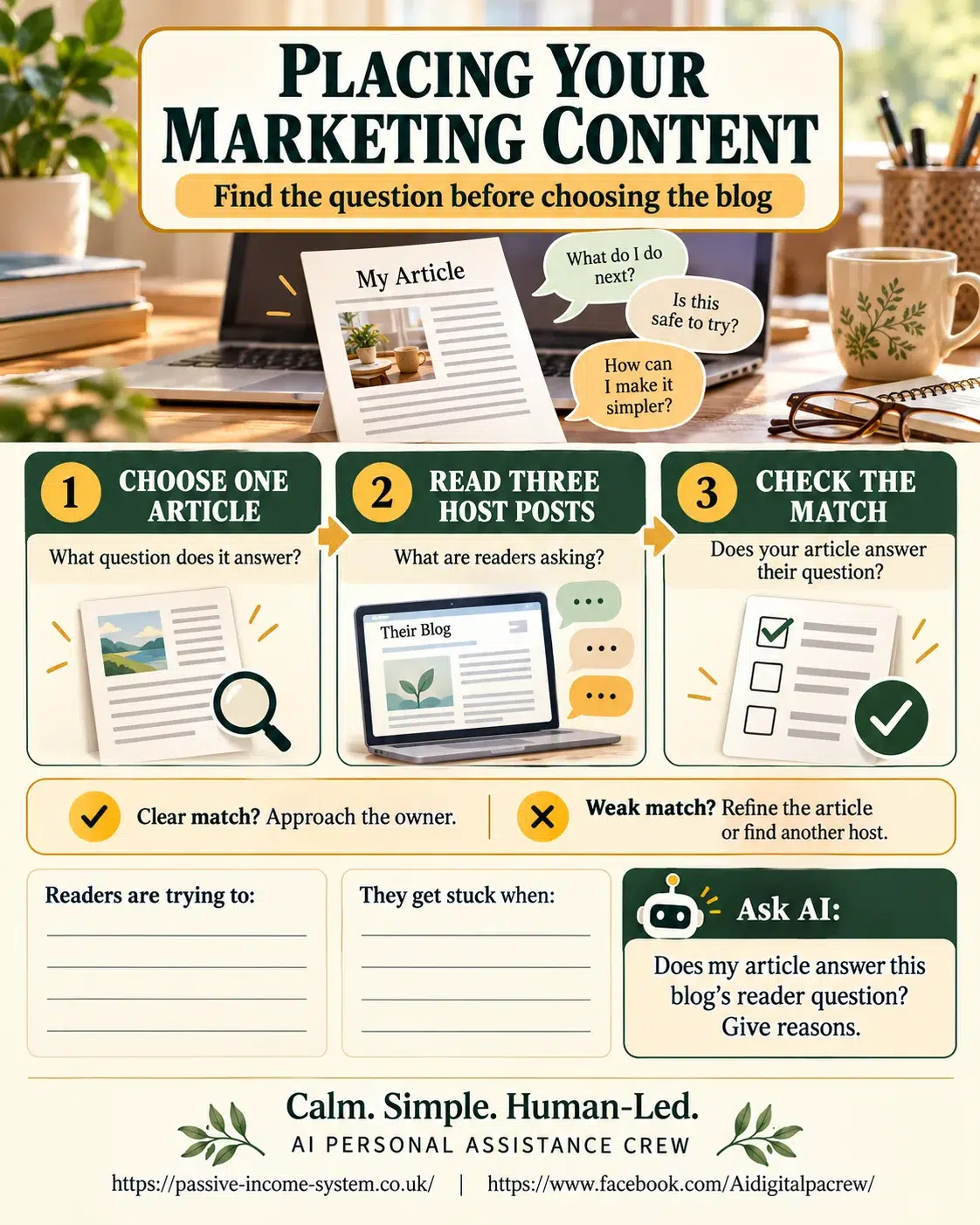
Choose one article you have written or could write. Find one possible host blog and read three of its recent posts, along with any relevant reader comments. Complete these two sentences: “These readers are trying to…” and “They seem to be getting stuck when…”
Now name the question your article answers and the page you would offer readers who want to take the next step. If the question, article and destination fit together, you have a placement worth exploring; if they don’t, adjust the article or choose a better host before you ask for space.
Placing Your Marketing Content: Awesome Secrets For Happy Readers

Leave a Comment

Your email address will not be published. Required fields are marked *


Scroll to Top