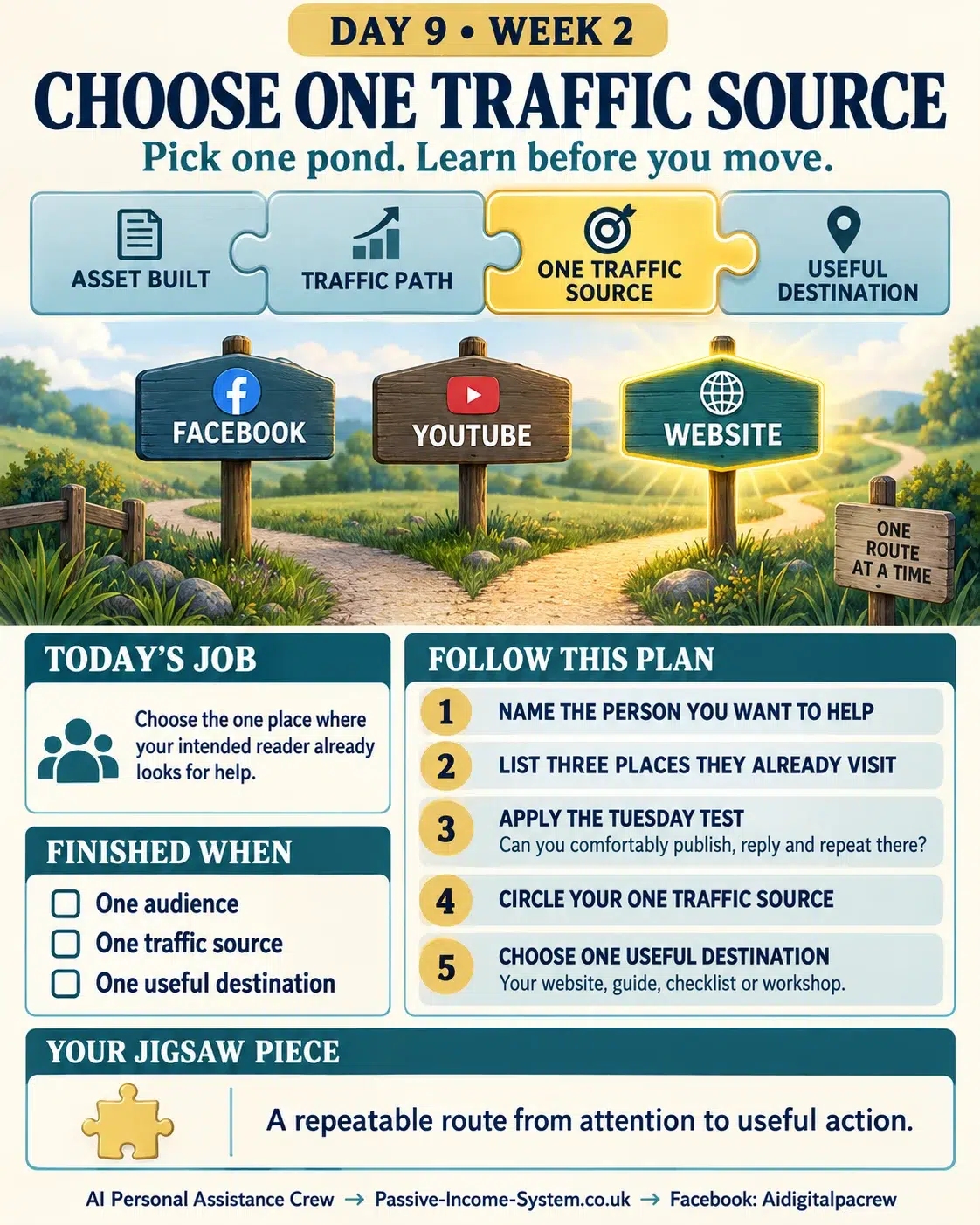
Choose One Traffic Source And Stop Scattering Your Best Work
Choose One Traffic Source Rule Beats Fishing Across Every Available Platform
Concentrated effort produces clearer feedback than scattered activity across several online platforms.
Let The Tuesday Test Help You Choose One Traffic Source
Your best platform should fit your audience, available time, energy, and natural communication style.
Turn Borrowed Attention Into Progress You Actually Control
Guide interested people from social content to your website, a useful asset, or your email list.
It was barely eight o’clock on Tuesday morning, yet the imaginary marketing department was already in trouble.
Facebook wanted a post. YouTube wanted a video. Instagram appeared to want a perfectly framed photograph of breakfast. LinkedIn demanded something thoughtful, TikTok expected movement, and somebody had just suggested opening accounts on three platforms whose names sounded like new kitchen appliances.
The retired beginner sitting in front of the laptop had not sold anything, attracted anyone, or learned which message worked. However, he had already found seven places where he felt behind.
This is how many sensible people become scattered online. They’re told that more platforms create more opportunities, so they start casting lines into every pond they can find. One post goes on Facebook, another appears on LinkedIn, a video goes on YouTube, and three days later the whole expedition quietly collapses.
The problem isn’t a lack of effort. The problem is that the effort has been spread too thinly to teach them anything useful.
That is why the first rule of a manageable traffic path is simple: choose one traffic source and stay there long enough to learn from it.
Traffic And Feedback Before It Is A Number
 Most beginners think traffic begins when a large number appears on a screen. Fifty visitors feel better than five. Two hundred video views appear more promising than twenty. A growing follower count looks like progress, even when nobody clicks, replies, downloads or returns.
Yet the earliest value of traffic isn’t volume. It is feedback.
Every time the same useful asset is placed in front of the same recognisable kind of person, the market gives you a small piece of information. People may stop and read. They may ask a question, click through to your website, save the post, or ignore it completely.
None of those responses should be treated as a personal verdict. They signal whether the subject, message, and audience fit together.
Those signals become much harder to understand when every piece of content goes somewhere different.
Imagine a retired heating engineer who has created a short guide titled “Five Checks To Make Before Calling A Heating Engineer.”
He posts it on Facebook on Monday. On Wednesday, he makes a different point on LinkedIn. On Friday, he uploads an unrelated YouTube video. Each platform receives a single isolated experiment, so none provides enough Choose One Traffic Source evidence to guide the next decision.
Now imagine that he chooses one Facebook Page where homeowners over fifty already respond to practical household advice. For four weeks, he teaches from the same guide. One post explains a common radiator problem. Another warns against an expensive misunderstanding. A third shows what information to collect before making a telephone call.
The asset stays the same, the audience stays identifiable, and the traffic source stays consistent. The message is the only thing being tested.
That is the deeper purpose of the One-Pond Rule. It removes enough moving parts for you to see what is actually happening.
If the platform, audience, asset, and message all change together, you don’t have an experiment. You have four guesses.
More Traffic Source Than The Crowd Before The Platform
The loudest platform isn’t automatically the best place to begin. Popularity tells you how many people use a platform, but it doesn’t tell you whether the people who need your help are paying attention there.
A fashionable video platform might tempt a retiree teaching traditional gardening skills because everybody seems to be talking about it. Yet the people most likely to value his seasonal planting calendar may already be exchanging advice inside a focused Facebook group. They aren’t waiting to be entertained by another fast-moving video. They’re discussing poor soil, troublesome slugs and what to plant before the first frost.
This gives us a more useful order of decision:
Find the crowd first. Choose One Traffic Source the platform second.
Begin by asking where your intended person already looks for answers, shares problems, or discusses the subject. Notice how they communicate when they get there. Do they watch demonstrations, search for detailed explanations, join conversations, save checklists, or ask other members for recommendations?
The answer should influence your choice more than the latest claim about which platform is growing fastest.
YouTube may suit a person whose subject becomes clearer through demonstration. Facebook may suit someone who teaches through conversation, stories and practical examples. A search-focused website may suit a topic people investigate privately when a problem appears. None is universally superior. The right Choose One Traffic Source traffic source brings together your intended person, your useful material and a repeatable way of working.
That final condition matters because a platform can contain the perfect audience and still be the wrong starting point for you.
Your One Traffic Source Best Platform Must Pass The Tuesday Test
Online plans are often made in moments of unusual enthusiasm. The desk is tidy, the coffee is fresh, and an energetic expert has just explained how easily one short video can become fifteen pieces of content.
Real businesses, however, aren’t built only on unusually energetic mornings. They also have to operate on ordinary Tuesdays.
The Tuesday Test asks one practical question:
Could you comfortably create, publish, respond, and repeat on this platform during a normal week?
Not during a launch. Delay it until after you buy a new tool. Not while enjoying a sudden burst of determination. Could you do it when the washing machine needs attention, the dog wants walking, and your laptop has decided to perform every simple task at the speed of a council meeting?
To Choose One Traffic Source passes the Tuesday Test when it suits your available time, energy, confidence, and natural way of communicating. Someone who enjoys writing and answering questions may find a Facebook Page sustainable. Someone who explains things more naturally while demonstrating them may prefer YouTube. Another person may enjoy recording one useful conversation and turning it into several short clips.
The test isn’t asking whether you could learn every platform. You probably could. It asks whether this one can become part of your working rhythm without swallowing the rest of your life.
Choosing one traffic source doesn’t mean signing a lifelong contract with it. It means giving yourself a fair learning period in which repetition produces evidence. During that period, you aren’t trying to conquer the internet. You’re trying to discover whether one useful message can repeatedly attract one recognisable person and guide them towards one sensible next step.
That is a much smaller job.
It is also the job that turns random posting into the beginning of a traffic system.
Borrowed, Searched To Choose One Traffic Source: Attention Is Not Owned Progress
A Facebook post can attract attention. A YouTube video can earn views. A thoughtful reply inside an online group can begin a conversation. These are useful events, but they take place on someone else’s property.
The platform owns the pond. It controls the water level, changes the fishing rules and decides which lines are seen.
This doesn’t make social platforms bad places to work. It simply means we must understand the difference between borrowed attention and owned progress.
Borrowed attention happens when somebody notices your work on a platform. Owned progress begins when that person takes a useful step towards something you control, such as your website, email list, downloadable Choose One Traffic Source guide, workshop page, or growing collection of helpful material.
The mistake is expecting every social post to make an immediate sale. That often makes the next step feel too large. Someone who has just discovered you may not be ready to buy anything. They may, however, be willing to read a related article, download a checklist or look at a page that answers the question your post raised.
Every useful piece of social content therefore needs a bridge.
The bridge doesn’t have to be complicated. A Facebook post about avoiding common heating problems could point towards the retired engineer’s free household checklist. A short gardening video could lead viewers towards a seasonal planting calendar. A post about turning experience into digital value could guide retirees towards one calm workshop lesson.
The post attracts attention. The bridge gives that attention somewhere useful to go.
Without the bridge, every successful post begins and ends on borrowed ground. With it, even a modest response can strengthen the traffic path you are building.
Give Every Traffic Source Post One Useful Destination
A post becomes confusing when it asks the reader to do too much.
Follow the Page. Visit the website. Download the guide. Watch the video. Join the community. Buy the product. Tell your friends. Ring the church bells.
The person reading it may like the idea, yet quietly do nothing because no single next step feels obvious.
A better rule is to give each post one useful destination.
That destination should match the post’s subject and the reader’s current level of interest. Should the post teach a small lesson from a checklist, the natural destination may be the complete checklist. If the post answers one question from a longer article, the article becomes the next step. If a short video demonstrates the beginning of a process, a workshop page can show the full sequence.
This creates a simple traffic bridge:
Useful message → interested response → useful destination
The destination isn’t necessarily a sales page. Its first job is to reward the person for taking another step. When the promise made by the post continues naturally on the destination page, trust grows because the journey makes sense.
Consider a retired bookkeeper who has created a one-page guide titled “Seven Records To Keep Before Completing Your Tax Return.” She chooses Facebook as her traffic source because local self-employed people and older sole traders already gather there.
Her first post says, “The receipt most people lose isn’t always the one that causes the biggest headache. The real problem is forgetting why the purchase was made.”
She then explains how to add a short note to each digital receipt and points towards her free records checklist.
The post doesn’t try to teach the entire subject. It opens one useful door and shows the reader where to find the next room.
A week later, she teaches a different point from the same checklist. Then she answers a question raised in the comments. Instead of inventing a new product for every post, she uses several messages to lead towards one useful asset.
This is where choosing one Choose One Traffic Source begins to save work. The creator isn’t constantly changing the pond, rebuilding the bridge and searching for a new destination. She is improving one connected route.
Stay Until The Platform Teaches Your One Traffic Source
The first few posts may receive little visible response. That doesn’t automatically prove that the platform is wrong.
A quiet post can have several causes. The subject may be too broad. The opening line may not give people a reason to stop. The example may not feel relevant. The destination may be unclear. The right people may not have seen enough of your work to recognise its value yet.
Changing platforms immediately hides the cause.
The beginner leaves Facebook for YouTube, leaves YouTube for Instagram, and then concludes that online traffic is mysterious. In reality, no traffic source was given enough consistent attention to reveal a pattern.
This is why Choose One Traffic Source must be followed by a short learning cycle:
Publish. Observe. Compare. Adjust. Repeat.
Publish one useful message for the audience you have chosen.
Observe what people actually do. Look for questions, saves, useful comments, link clicks, replies, and signs that somebody recognized their own problem.
Compare the response with your previous posts. Don’t compare yourself with a creator who has been building an audience for ten years. Compare Tuesday’s message with last Tuesday’s message.
Adjust one meaningful Choose One Traffic Source element. You might strengthen the opening, use a more specific example, or clarify the next step.
Then repeat before changing everything again.
The point isn’t to produce endless content while hoping for a miracle. The point is to gather enough comparable feedback to make a better decision.
When one post uses a personal story, another uses a checklist, and a third answers a direct question, you can begin to see which doorway your audience prefers. Regular responses to practical examples, in contrast to ignored general encouragement, indicate that the information is useful. If they watch videos but never visit the linked page, the bridge may need attention. If a small number of people ask detailed questions, those questions may be more valuable than many casual views.
Count Then Choose One Traffic Source Signals Of Interest, Not Applause
Vanity numbers are tempting because they’re easy to see. Views, likes, and followers can encourage, but they don’t all carry the same meaning.
A person clicking “Like” may have enjoyed the photograph. A person asking, “Would this work for somebody who has never created a digital product?” is revealing a possible need. A reader who visits the workshop page and returns the following week shows stronger interest than someone who watches three seconds of a video.
The smallest numbers can therefore contain the clearest signals.
Useful traffic measurement begins by separating applause from intent.
Applause includes quick reactions that say, “I noticed this.”
Intent appears in actions that say, “This may help me, and I want to know Choose One Traffic Source more.”
Questions, meaningful replies, saves, return visits, downloads, and clicks towards the promised next step can all indicate intent. None guarantees a future sale, but each gives you better information about how well your message fits the audience.
This distinction protects beginners from two opposite mistakes. It stops them from celebrating empty reach as if the job were finished, and it stops them from dismissing a modest audience that contains several genuinely interested people.
Ten useful conversations can teach you more than a thousand unexplained views.
Go With One Traffic Source For A Fair Trial
You don’t need to promise that Facebook, YouTube, or any other source will remain your permanent home. You only need to give one suitable source a fair, focused trial.
Choose the crowd you understand. Select the platform they already use to seek help. Use an asset you have already created. Give every message one useful destination. Then work through the same learning cycle long enough for patterns to appear.
At the end of the trial, ask three questions:
Did the right kind of person respond?
Could I maintain this Choose One Traffic Source work on an ordinary Tuesday?
Did the platform help people move towards something useful that I control?
If the answer is yes, continue improving the path.
When the audience responds, but the work feels exhausting, simplify the format. If the routine feels comfortable but the wrong people arrive, sharpen the message or reconsider where the intended crowd gathers. If attention appears but nobody takes the next step, repair the bridge before abandoning the pond.
Base that decision on evidence, not impatience.
Today’s Apprentice One Traffic Source Task: Choose Your Pond
Write down the three traffic sources you are most tempted to use.
Beside each one, answer these questions:
- Are the people I want to help already looking for this kind of information there?
- Could I comfortably publish and respond there during an ordinary week?
- Can each post naturally lead to one useful asset or destination I control?
Now circle the strongest Choose One Traffic Source answer.
That is your traffic source for this first focused trial.
Choose one existing asset, identify one recognizable audience, and decide where every interested reader should go next. Publish one useful message, observe the response and make only one informed adjustment before publishing again.
Don’t ask, “Which platform could make me famous?”
Ask, “Which one pond can teach me how to become useful?”
Once that pond begins producing recognisable signals, the next job isn’t to rush towards a larger crowd. It is to make the route from first attention to useful action easier to follow.