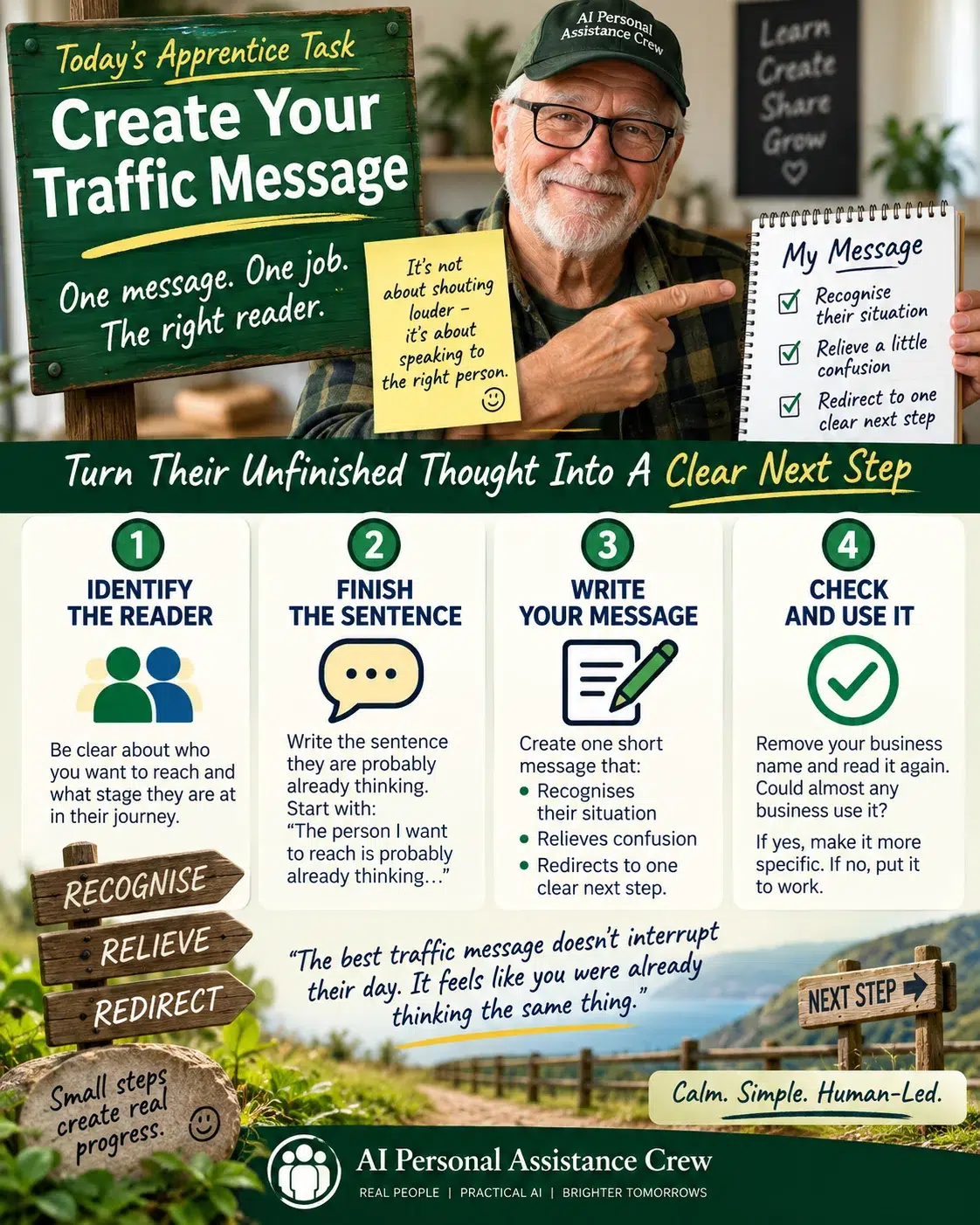
Create Your Traffic Message By Joining Their Conversation
Your first traffic message should recognise what your reader is already thinking before asking them to go anywhere.
Create Your Traffic Message From The Reader’s Starting Point
The strongest traffic messages begin with the problem already running through the reader’s mind.
Create Your Traffic Message To Finish Their Sentence
Recognition comes before promotion when the reader feels you understand the situation they are already in.
A familiar scene plays out in homes across the country. A newly retired man or woman sits at the kitchen table with a laptop open, a mug of tea going cold and half a dozen browser tabs staring back at them like unpaid bills. They have watched the videos, downloaded the guides, joined the groups and perhaps even had a first go with AI. They know more today than they did six months ago, but one irritating little thought keeps circling back: “I have learned all this stuff, but I still don’t know what I am supposed to do next.” That sentence is where today’s traffic lesson begins.
Yesterday, the job was to choose one traffic source instead of running around the internet like a man trying to catch six buses at once. Today, the job changes. Once you have chosen where you are going to show up, what are you actually going to say when you get there? This is where beginners can make life much harder than it needs to be. They assume a traffic message has to be clever, persuasive, punchy and polished enough to stop the whole of Facebook in its tracks. It doesn’t. It has to make one suitable person think, “Hang on, that sounds like me.”
That is the part most people miss. The reader doesn’t wake up wondering what you want to promote. They wake up with their own problems, unfinished jobs, doubts, ambitions and mild irritations already rattling around their head. If you barge into that private conversation shouting, “Here is my new guide,” you are asking them to stop thinking about themselves and start thinking about you. Sometimes they will. Most of the time they won’t. A better traffic message begins at the reader’s end of the table, not yours.
So before you write a headline, a Facebook post, an email or a Reel caption, ask one simple question: What sentence might this person already be trying to finish? That question is far more useful than asking, “What do I want to tell them?” because it forces you to think about the situation they are already in. It turns traffic from broadcasting into recognition, and recognition is a much calmer place for a beginner to start.
Create Your Traffic Message From The Reader’s Starting Point
Suppose you have created a short worksheet helping retirees turn one piece of work or life experience into a small digital asset. You could announce it with something perfectly respectable such as, “Download our new Digital Product Starter Worksheet.” Nothing wrong with that. The words are clear, the offer is understandable, and nobody is likely to call Trading Standards. But the reader still has to do the mental work of deciding whether this new worksheet has anything to do with the problem they were thinking about five seconds earlier.
Now try it from the other end. “If you have spent months learning about online business but still haven’t finished one useful thing of your own, start smaller.” Suddenly, the message feels different. The message does not start with the worksheet. It begins with the frustration. It gives the reader a chance to recognise themselves before the product appears. Only then do we say, “This simple worksheet helps you choose one piece of experience and turn it into something another person can actually use.” Same worksheet. Same creator. Entirely different starting point.
That is because the strongest traffic messages often behave like the second half of a sentence. The reader is already thinking, “I keep learning but…” or “I finally made something but…” or “I know I should post on Facebook but…” Your job is not to invent a new conversation and drag them into it. Your job is to recognise the one already taking place and join it without sounding like you have just burst through the front door carrying a sandwich board.
This is especially useful for retirees and online beginners because so much internet marketing language starts at the wrong altitude. “Build your financial freedom.” “Create your dream business.” “Transform your retirement.” Those phrases may describe a distant ambition, but they are rarely what somebody is worrying about at ten past ten on a Monday morning. Their actual problem may be, “I have made a PDF and nobody has seen it,” or, “I have joined Facebook groups but I do not know what to post without sounding salesy.” The current problem is usually smaller than the grand promise, and that is exactly why it is easier to recognise.
Create Your Traffic Message To Finish Their Sentence
This reflects an old tradesman’s logic. When you walk into a house to look at a heating problem, you do not unload every tool you own into the customer’s hallway and start waving them about. You first look at the job. What is actually wrong? Where is the fault? What needs attention now? Marketing beginners can save themselves a lot of grief by thinking the same way. The traffic message is not the whole van. It is the first tool needed for the job in front of you.
Imagine the reader has finally finished their first useful digital guide. A week ago they were worrying about what to create. Now they have something sitting on the desktop with a proper filename and perhaps even a tidy cover. The problem has changed. Their unfinished sentence is no longer, “I don’t know what to make.” It is, “That’s all very well, but how is anybody going to find it?” If your message still talks to them as though they haven’t started, you’re on the wrong bit of road.
This gives us a very practical test. Before writing any traffic message, complete the sentence: “The person I want to reach is probably already thinking…” Then finish it in plain language. No marketing words. Avoid product titles. No promises. Just the likely irritation, question or unfinished job. “I’ve made my first PDF, but I haven’t a clue where to put it.” “I know Facebook could help, but I don’t know what to say.” “I’ve got years of experience, but I don’t know which part of it is useful online.” That is your raw material.Notice the difference between a distant ambition and a current problem. “I want a successful online business” is broad. “I’ve created something useful and nobody has seen it” is immediate. “I want freedom” is vague. “I don’t know which traffic source to concentrate on” is specific. The closer your message gets to the exact piece of road the reader is standing on, the less explanation they have to do for themselves. And when they have to do less translation, recognition improves.
Recognition Comes Before Promotion
At this point, there’s a temptation to think that once the reader recognises the problem, we have done the job. Not quite. Recognition opens the door, but somebody still has to walk through it. A useful traffic message needs to move the person forward without dumping the whole sales process into their lap. This is where messages often become overloaded. The creator finally gets somebody’s attention and immediately tries to explain the product, tell their life story, list six benefits, overcome three objections and squeeze in a special bonus before the poor soul has finished their tea.
A calmer sequence is Recognise → Relieve → Redirect. First, recognise the situation already occupying the reader. Second, relieve some of the confusion by making the problem feel smaller or clearer. Third, redirect them towards one sensible next action. That might be reading an article, watching a short video, opening a worksheet or answering one question. The next action does not need to be the sale. In fact, it often shouldn’t be.
Suppose somebody has made a small digital asset but thinks they now need Facebook, YouTube, Pinterest, LinkedIn, email and half the internet before they can get anywhere. Recognition might be: “You have finally made something useful, but now it feels as though you have to be everywhere to get anybody to see it.” Relief might be: “You do not need seven traffic sources to begin learning what attracts the right person.” Redirect might be: “Choose one place where the people you want to help already spend time and start there.” One message, three small movements, no circus required.
And that brings us to today’s useful distinction. Your traffic message does not need to finish the sale. It needs to earn the next step. If the right person reads it and thinks, “I want to know a little more,” the message has done its job. The article can take over. The video can take over. The worksheet can take over. The conversation can take over. Good traffic is not one giant leap from stranger to customer. It is a series of sensible handovers, and today we are learning to make the first one properly.
SECTION 2
Create Your Traffic Message With One Clear Job
Once you begin thinking in handovers, another common mistake becomes obvious. We ask one small traffic message to perform the work of an entire marketing department. It has to stop the scroll, explain the idea, prove our authority, reassure the beginner, tell them who we are, describe the product, answer objections and somehow close the sale before the first paragraph has had time to get its coat off. No wonder the message ends up sounding as though it has swallowed the brochure.
A better question is: What one job does this message need to complete before the next piece takes over? When the message aims to get someone to read an article, let the article do the teaching. If it is meant to get someone to watch a short video, do not cram the whole video into the caption. If it is meant to get someone to try a worksheet, give them one solid reason to open it. Traffic improves when each piece knows its job.
This is exactly the kind of thinking that makes a production line work. The first man does not try to finish what belongs to the next man. He gets his stage right and hands the job over properly. Online work is no different. The Facebook post can be the initial stage. An article can serve as the second. Your worksheet can be the third. Your follow-up can be the fourth. The whole thing becomes much easier once you stop expecting every individual piece to behave like the finished machine.
That is also why the phrase “one traffic message, one job” is worth keeping beside you. If the message feels muddled, ask what jobs you have accidentally piled into it. Do you educate and sell at the same time? Are you trying to explain your entire system when the reader only needs a reason to click? Are you trying to prove everything before they have even shown interest? Remove the extra jobs and the message usually becomes clearer almost immediately.
Specific Problems Beat Grand Promises
Another place beginners go wrong is scale. They assume a traffic message becomes stronger as the promise becomes bigger. So we get phrases such as “change your retirement,” “build financial freedom,” or “start your dream online business.” There is nothing automatically wrong with those ambitions, but they can be far too distant from the problem in the reader’s hands today. A man struggling to decide what to post on Facebook does not necessarily need a speech about freedom. He needs help with Tuesday morning.
Specificity works because it reduces the interpretation the reader has to do. “Build a better future online” could mean almost anything. “You have finished your first useful PDF but do not know where to share it” is unmistakable. “Create passive income” is broad. “You have joined three Facebook groups but still do not know what to post without sounding promotional” is a recognisable situation. The more clearly you name the current difficulty, the quicker the right person can decide whether the message belongs to them.
That does mean some people will ignore you. Good. They were probably not the people you needed to reach with that particular message. Beginners sometimes fear specificity because they think every post needs to appeal to everybody. But a message written for everybody often lands properly with nobody. The aim is not universal applause. The aim is a moment of recognition from the right person at the right stage.
Here is a handy little test. Remove your product name, website name and business name from the message. Now read what remains. Could almost any company use it? “Unlock your potential today.” “Discover a smarter way.” “Take your business to the next level.” You can drop these phrases into almost any market without causing an argument, which is exactly the problem. They tell us very little about the person, the situation or the job that needs doing.
Create Your Traffic Message For The Stage They Are In
Two people can be the same age, interested in the same subject, and still need completely different messages because they’re at different stages of the job. Take two retirees interested in turning their experience into digital value. One has not yet created anything. The other has finished a useful guide but has no idea how to get the first reader. On a demographic chart, they may look identical. In the real world, they have entirely different unfinished sentences.
The first may be thinking, “I have years of experience, but I do not know what part of it could become something useful.” The second may be thinking, “I finally made something, but nobody knows it exists.” If both people see the same broad message about “starting an online business after retirement,” we have ignored the most useful piece of information: where each person is in the job.
This is why knowing your audience is only half the work. You also need to know the stage of the problem. A beginner choosing an idea needs a different message from somebody building the asset. Someone building the asset needs a different message from somebody testing it. Someone who has finished it needs a different message again when traffic becomes the next problem. The person may not have changed. The sentence in their head has.
Before publishing, ask: What has this person probably already done before they need this message? That one question can sharpen your writing enormously. It stops you talking to someone as though they are at the beginning when they have already taken three steps. It also stops you pushing them towards a step they are not ready for. Good traffic messages meet people where they are standing, not where we wish they were.
Let Real Behaviour Improve The Message
There is, of course, one sensible warning attached to all this. We are not mind readers. When we write the unfinished sentence, we are making an informed guess about what the reader may be experiencing. That guess should come from the problem the asset was designed to solve, from the questions people ask, from conversations and from observation. It should not be dressed up as secret knowledge of what everybody is thinking.
Once the message goes out, real people start teaching us. Perhaps they click. Perhaps they comment. They may ask a question that reveals we have misunderstood the problem. One phrase starts conversations while another disappears without a ripple. None of that means the exercise failed. It means the traffic message has moved from guesswork into evidence, and evidence is where Version Two begins to earn its keep.
This is another reason not to spend three days polishing the perfect social post before anybody has seen it. The market can tell you things your imagination cannot. A sentence you adore may do nothing. A plain little line may cause three people to say, “That’s exactly where I am.” The job is not to fall in love with your wording. The job is to learn which wording helps the right person recognise themselves and move forward.
That turns traffic into something far less mysterious. You are not searching for a magical headline hidden somewhere on the internet. You are improving your ability to recognise real situations and describe them clearly enough that the right people notice. The better you become at that, the less you need to lean on hype, dramatic promises or clever tricks.
Create Your Traffic Message With Your AI Crew Beside You
This is also a cracking little job for an AI Personal Assistance Crew, because AI can help you examine the message before you publish it. Instead of lazily asking, “Write me a Facebook advert,” give it the asset or article and ask what unfinished sentence the likely reader may already be trying to finish. Then ask it to apply the same structure we have used today: Recognise, Relieve, Redirect.
That gives the AI a proper workshop job. It is not being asked to replace your judgement or invent a sales pitch from thin air. It helps you think through the reader’s starting point, identify where the message may be too broad, and suggest a clearer handover. You remain the gaffer. You decide whether the language sounds natural, fair and useful. The AI assists with the thinking and the alternatives.
The difference matters. “Write me an advert” invites the machine to fill the page. “Help me identify the sentence already running through this reader’s mind” gives it a diagnostic job. One tends to produce marketing copy. The other can help produce understanding. And understanding is much more useful when you are trying to build trust with people who have already seen enough internet promises to last them through several retirements.
So today’s Apprentice Task is not complicated. Go back to the one traffic source you chose yesterday. Write: “The person I want to reach is probably already thinking…” Finish that sentence in ordinary human language. Then write one message that recognises the situation, relieves one piece of confusion and redirects the person towards one clear next step.
When you have written it, give it one last inspection. Does the message sound as though it starts in your business, or in the reader’s world? Does it try to do six jobs, or one? Is the problem specific enough that the right person could recognise it quickly? Is the next step obvious without asking them to make a giant decision? If the answers are right, stop polishing and put the message to work.
Yesterday you chose where you would show up. Today you have decided how to open the conversation when you get there. That may sound like a small move, but the Week Two jigsaw is beginning to reveal its shape. The asset exists. The traffic source has been chosen. The message now has a job. Each piece is starting to hand the reader naturally to the next.
And that is the larger lesson hiding underneath today’s work. Traffic isn’t really about pushing more people toward your stuff. It is about creating a useful path between a person who already has a problem and something you have built to help with it. The better you understand their side of that path, the less shouting you need to do from yours.
Create Your Traffic Message by beginning with the sentence your reader is already halfway through. Then give them one useful reason to finish it with you. That is not flashy marketing. It is simply good communication, and for a retiree building something useful online, that is a bloody good trade to learn.
Create Your Traffic Message And Win Genuine Reader Attention
Create Your Traffic Message And Win The Right Attention

 Suppose you have created a short worksheet helping retirees turn one piece of work or life experience into a small digital asset. You could announce it with something perfectly respectable such as, “Download our new Digital Product Starter Worksheet.” Nothing wrong with that. The words are clear, the offer is understandable, and nobody is likely to call Trading Standards. But the reader still has to do the mental work of deciding whether this new worksheet has anything to do with the problem they were thinking about five seconds earlier.