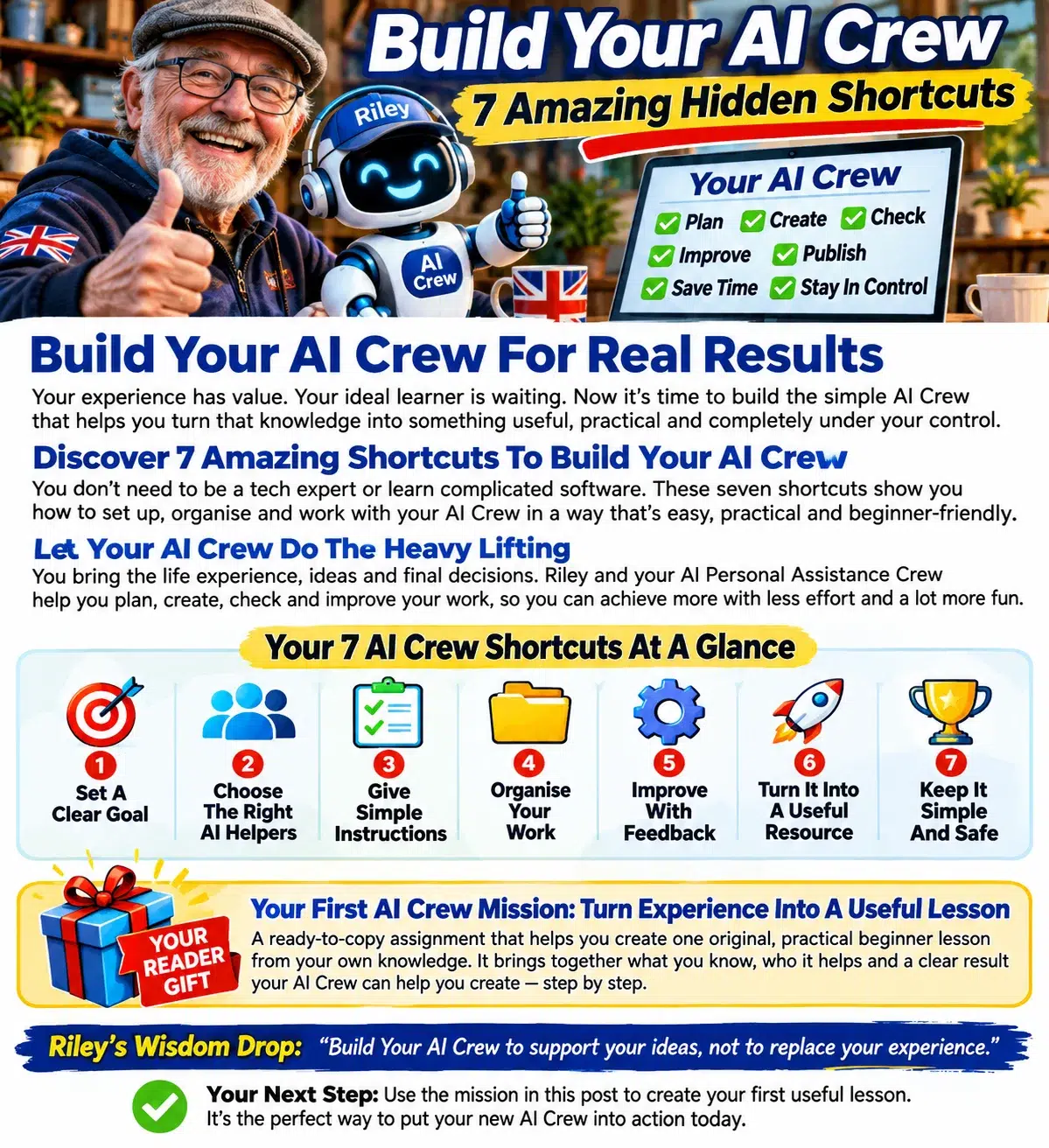
Create Your AI Team And Discover Seven Amazing Shortcuts
What if the knowledge you’ve spent a lifetime collecting could become a useful beginner lesson without you having to write, research, organise and design everything yourself?
Turn Your Experience Into Something Useful
You’ve discovered what you know and identified somebody who might need it. Now learn how to give your AI helpers clear responsibilities while keeping every important decision in human hands.
Meet Your AI Crew Manager And Start Building
You remain the Gaffer. Riley helps organise the work, while your Research Assistant, Visual Worker and Proofreader each tackle a specific job. Together, we’ll turn one useful idea into a practical teaching resource, with fewer unnecessary clicks.
Create Your AI Team Before Writing Another Ebook
You don’t have to become a researcher, professional writer, graphic designer, proofreader and digital publisher just because you want to share something useful. The real opportunity is learning how to organise AI assistance around the knowledge you already possess.
Create Your AI Team With A Crew Manager
Most beginners open ChatGPT and ask it to write something. Our approach begins differently. We give an AI Crew Manager a clearly defined job, then let that manager organise the supporting work while the human remains in charge. When you Create Your AI Team around one clear purpose, you can stop juggling every task yourself and concentrate on the knowledge only you can provide.
Meet Riley, Your Model For An AI Crew Manager
I’m Alan Skinner, the human Gaffer of the AI Personal Assistance Crew. Riley helps me develop ideas, organise production and inspect finished work. Our Crew roles cover authority, content development, research, writing, graphics and proofreading. Today, we’ll show you how to adopt the same practical working method for your own knowledge-sharing project.
Stop Asking AI To Write Before It Understands The Job
Imagine a retired plumber who wants to turn some of his experience into a useful guide for homeowners. He opens an AI assistant and types, “Write me an ebook about plumbing.” Within moments, the computer may produce a professional-looking document with an introduction, chapters and a conclusion. Unfortunately, the result could be far too broad, contain unsuitable technical instructions or explain subjects the intended reader doesn’t understand. It may sound convincing while offering little help with the actual difficulty a beginner faces. The mistake occurred before the first paragraph was written. Nobody identified the person the guide was intended to help, the precise result it should deliver or the knowledge that needed checking. The AI was instructed to produce pages, not manage a useful teaching project. That’s why our first AI worker should act as a manager rather than immediately becoming a writer.
A good Crew Manager begins by understanding the assignment. Who is the reader? What difficulty are they experiencing? What does the human contributor genuinely know? What useful resource should be completed? These questions don’t require specialist computer knowledge. They’re the same questions an experienced contractor might ask before starting a job. If a customer wants a new heating installation, a responsible professional doesn’t begin by ordering random equipment and hoping it suits the property. They establish the requirements, investigate the circumstances and decide what work is appropriate. Our digital publishing method applies a similar discipline. The Crew Manager defines the objective before commissioning the supporting tasks. This gives the work direction and helps prevent the exhausting cycle of producing large drafts, finding they’re unsuitable, and starting again.
Create Your AI Team With Clear Responsibilities
Let’s give the retired plumber a more useful assignment. He has noticed that homeowners often struggle to explain a heating problem when contacting an appropriately qualified professional. The resulting digital resource could be a short homeowner preparation checklist. It might help someone record symptoms, equipment information, relevant dates and questions they want to ask during an appointment. It should avoid instructions for undertaking hazardous repairs and make clear when professional assistance is needed. The Crew Manager now has a defined outcome. The resource is for a homeowner, it addresses one problem, and it provides a practical benefit. Our plumber remains responsible for checking technical content against appropriate guidance. The AI doesn’t pretend to be an independently qualified heating engineer. Instead, it helps organise a safe, understandable communication resource based on the human’s experience. The real advantage when you Create Your AI Team is having clearly defined responsibilities, so research, presentation and proofreading support the same useful beginner lesson.
The Crew Manager’s next task is to identify what supporting work must be completed. Some information comes directly from the plumber’s experience. Other details may need checking against current authoritative guidance. The teaching instructions must be written in plain language. Any illustrations should clearly show the information being recorded, without suggesting unsafe operations. The finished checklist needs proofreading and a final review. These requirements become the production plan. Notice how different this is from asking for a generic ebook. The job is now small enough to understand, specific enough to inspect and useful enough to test with a suitable reader. This is our first practical shortcut: define the finished result before asking the AI to produce the content.
Give The Crew Clear Jobs Without Buying Five AI Accounts
When you Create Your AI Team, named responsibilities make production easier to organise without requiring five separate AI accounts. Riley acts as Crew Manager. A.C.E. represents the authority-content role and helps uncover the strongest practical teaching angle. Copilot handles research, Derek covers visual production, and Peter handles proofreading. These names aren’t magic instructions, and they don’t mean that five separate AI agents have independently completed work. A beginner can start with one general-purpose assistant and ask it to perform those responsibilities in a sensible sequence. The benefit comes from the organised process. Each responsibility has a clear purpose, and the Crew Manager keeps the tasks connected to the same intended result. When more specialised tools become useful, the workflow can be expanded without changing the human’s role as final decision-maker.
Create Your AI Team Without Disconnected Production
Consider what happens without management. The retired plumber asks one AI conversation to write a guide, another to design a graphic and a third to produce promotional text. The different outputs may use inconsistent terminology, describe different objectives or introduce claims that weren’t present in the original explanation. He then spends hours comparing versions and correcting mistakes. With a Crew Manager, the original assignment becomes the shared reference. The manager helps establish the intended reader, practical result, approved terminology and quality requirements. Writing and visual responsibilities work toward those same objectives. When the final materials are prepared, the manager checks whether they remain consistent. That doesn’t guarantee perfection, but it gives the human a much clearer basis for review. The task isn’t to create more content. It’s to produce a coherent resource with less unnecessary work.
This leads to a second shortcut: give your Crew the knowledge before giving it the writing assignment. AI systems can suggest plausible explanations, but they may misunderstand specialist details or supply information that doesn’t match your experience. The human should describe what they’ve actually observed and identify the limits of their expertise. Our plumber might explain common customer questions without supplying technical repair instructions. A dressmaker may describe her method for recording measurements. A gardener could outline a beginner’s observation exercise while checking horticultural guidance. The Crew can then arrange that information into a useful teaching structure. If a factual claim needs checking, identify it rather than disguise it with confident wording. Your experience gives the resource its distinctive substance, while the AI helps make that knowledge accessible.
Five Questions Make Every Crew Assignment Clearer
One other problem I caught in your uploaded post… who will use it? What problem does that person face? What experience or evidence can I contribute? What finished result should the resource provide? What checks must be completed before it is shared? You don’t need lengthy answers. A few precise sentences can give the Crew Manager a useful starting point. For the homeowner checklist, the intended user is someone preparing to contact a qualified heating professional. The problem is uncertainty about what information to provide. The human contributes experience of common customer questions. The finished result is a usable preparation sheet. The checks include technical accuracy, safety boundaries, clarity and layout. Now the manager can organise a meaningful job instead of inventing an entire publishing project from a vague title.
Create Your AI Team Without Losing Human Control
A well-organised Crew still needs a human quality inspection. AI can make mistakes, misunderstand instructions and generate convincing statements that aren’t supported by evidence. Graphics may contain inaccurate labels, and proofreading can miss important technical misunderstandings. That’s why the human contributor must remain involved in decisions affecting factual accuracy, safety and suitability. For a sewing worksheet, the dressmaker should check the illustrations and terminology. For a gardening lesson, current advice may need to be verified against reliable references. For subjects involving health, finance, electricity or gas, the boundaries must be especially clear. Our Crew Manager should flag uncertain information instead of silently presenting it as fact. It should also distinguish between jobs actually completed and suggestions for work that still requires a tool or human action. Trustworthy production is more valuable than impressive claims about automatic AI capabilities.
Now consider the number of manual operations involved. One approach produces several incomplete drafts, asks the user to repeat information and requires numerous transfers between applications. The alternative gives the Crew Manager one clear brief and asks for a complete, checked result in the appropriate format. Alan calls this principle “ALAN AI CLICKS LESS.” Our system measures useful progress by the amount of unnecessary human work removed, not by the quantity of words produced. A polished article that needs twenty corrections isn’t necessarily more valuable than a shorter resource completed with fewer mistakes. Likewise, a digital workshop isn’t finished simply because the AI has written its lessons. The instructions must be usable, the illustrations accurate, the supporting materials consistent, and the reader able to perform the activity. A good Crew helps reduce the workload without removing responsible human judgement.
Create Your AI Team Around One Useful Result
Return to the teaching idea developed in our earlier windows. You’ve identified some valuable experience, considered the beginner who might need it and chosen one useful outcome. That’s enough to begin working with an AI Crew Manager. Open ChatGPT or another suitable general-purpose AI assistant and explain that you’re the human Gaffer. Describe your experience, the intended beginner, the problem and the practical result. Ask the assistant to organise its work using separate research, writing, visual and proofreading responsibilities. Require it to identify uncertain facts and avoid inventing evidence or qualifications. Then ask for a one-page teaching brief before developing a complete digital product. The brief should describe the purpose, intended learner, proposed resource, key teaching points, reader activity and necessary checks. This gives you something concrete to approve.
Create Your AI Team And Save Yourself Work
Once the brief has been prepared, examine it as if you were commissioning a practical job from another person. Does it reflect your experience? Is the intended reader recognisable? Can you tell what the finished resource should accomplish? Have safety or factual uncertainties been identified? If something important is missing, correct the brief before requesting further production. When the objective is clear, the Crew can move towards creating an original worksheet, guide, checklist or other suitable teaching asset. You don’t need to create five accounts or buy a collection of specialised subscriptions to begin. One AI assistant can demonstrate the basic method, although available features and usage limits vary. Additional tools can be considered later when they genuinely improve the workflow.
The important lesson is that your AI Crew doesn’t need to imitate our personalities or reproduce every part of our established working relationship. It needs responsibilities that match your own project. A gardener may require stronger visual teaching support, while a retired office administrator might benefit from templates and document organisation. A dressmaker may need carefully checked illustrations, and a former tradesperson may place particular importance on technical accuracy and safety boundaries. The Crew Manager’s task is to organise those requirements around the human contributor’s objective. The system becomes useful because it adapts to your knowledge rather than forcing your experience into a generic marketing formula. That’s how we turn access to AI into a working production method.
Today’s Reader Task: Appoint Your Crew Manager
Take the single teaching idea selected in your digital diary and describe it in a few sentences. Include the beginner, their difficulty, your relevant experience, the useful result and anything that requires careful checking. Give those details to your AI assistant and ask it to act as a Crew Manager.
Commission a one-page teaching brief, not a complete ebook. Review the result and correct anything that misrepresents your knowledge. Save the approved brief because it becomes the foundation for creating and testing your first resource. As you Create Your AI Team, remember that success begins with one useful result for a real learner, not with collecting more AI tools.
Riley’s Wisdom Drop
“Your first AI employee doesn’t need to write faster. It needs to understand the job before the rest of the Crew starts working.”
The rule to remember: The human defines the outcome. The Crew Manager organises the work. The human approves the result.
AI Personal Assistance Crew
Calm. Simple. Human-Led.
Imagine a retired gardener who understands how to prepare containers for spring planting. Their learner has repeatedly lost plants through poor drainage. Instead of creating an enormous gardening handbook, the Crew can help produce a short checklist explaining what to inspect before planting. The gardener checks every instruction against genuine experience, while the AI Crew helps organise the information for a beginner.
Give Your Crew Manager One Clear Job
Copy the following assignment into your AI assistant. Replace the three bracketed details with your own answers. Keep the result small enough to finish and check.
MY FIRST AI CREW MISSION
Act as my AI Personal Assistance Crew Manager. Help me turn my genuine experience into one original, practical beginner lesson.
My experience: [INSERT YOUR SKILL]
My ideal learner: [DESCRIBE ONE BEGINNER]
The result they want: [DESCRIBE ONE SMALL ACHIEVEMENT]
Produce a teaching brief containing:
A clear lesson title that promises one realistic result.
A short description of the beginner and their problem.
Five practical steps written in plain British English.
Three common mistakes and how to avoid them.
Any important safety limits or situations requiring professional help.
A simple checklist the learner can use to review their progress.
Three questions I should ask a real beginner to test whether my instructions are understandable.
Do not invent facts, testimonials, customer demand or income claims. Mark anything that needs checking. Ask me to verify technical advice against my own expertise and reliable information.
Finish with one sentence explaining the practical benefit the learner should receive.
Your Finished Brief Is The First Real Deliverable.
Today’s Apprentice Task:
Open to See This Video, And This Is What’s Already Built, Trained & Waiting For Your First Command.
When the Crew returns its draft, read it as the experienced human responsible for the lesson. Correct weak advice, remove unnecessary jargon and check that every step supports the beginner’s intended result. Where safety matters, do not publish instructions until they have been properly verified.
You now have something concrete: an original teaching brief that could become a checklist, a short guide, a demonstration or the foundation of a larger workshop.
It is not proof of a profitable business. It is the first useful resource in a process you can test, improve and eventually explore as a potential digital product.
Riley’s Wisdom Drop: “Your first AI Crew success isn’t an impressive answer on a screen. It’s a useful result that a real person can understand and apply.”
Today’s Reader Gift: Save your completed teaching brief. You have just connected your lifetime experience, your ideal learner and your AI Crew in one practical assignment.

 Imagine a retired plumber who wants to turn some of his experience into a useful guide for homeowners. He opens an AI assistant and types, “Write me an ebook about plumbing.” Within moments, the computer may produce a professional-looking document with an introduction, chapters and a conclusion. Unfortunately, the result could be far too broad, contain unsuitable technical instructions or explain subjects the intended reader doesn’t understand. It may sound convincing while offering little help with the actual difficulty a beginner faces. The mistake occurred before the first paragraph was written. Nobody identified the person the guide was intended to help, the precise result it should deliver or the knowledge that needed checking. The AI was instructed to produce pages, not manage a useful teaching project. That’s why our first AI worker should act as a manager rather than immediately becoming a writer.