The Hundred-Person Workshop Reveals A Hidden Problem
Picture a village hall filled with a hundred people. At the front stand Phillip and Wilson, two retired craftsmen who have spent decades repairing furniture, making practical household items and solving problems that younger people now encounter for the first time. Phillip announces that he is preparing a digital guide about traditional woodworking skills. Almost everybody politely applauds. Wilson takes a different approach. He asks who has ever bought a second-hand wooden chair only to discover it wobbles. A few hands go up. He then asks whether those people would like to know how to identify the cause before attempting a repair. Suddenly, several faces show genuine interest. Wilson has not proved that a product will sell, but he has uncovered something far more useful than polite applause: a recognisable problem and people who want to understand it.
Phillip’s idea is not necessarily bad. His knowledge may be excellent, and his finished guide might eventually become valuable. The difficulty is that he began with the subject he wanted to teach rather than the result somebody wanted to achieve. Wilson started with the learner’s situation. He could now ask what the chair does, whether it feels unsafe, what tools are available and whether the owner wants to assess the problem or attempt a straightforward repair. Some chairs will require professional attention, so a responsible lesson must explain when not to proceed.
Nevertheless, Wilson already has a clearer teaching direction. He knows a beginner isn’t looking for a lifetime of woodworking theory. They want to understand one familiar household problem without being overwhelmed by information.
Find Your Ideal Learner Among The People Who Need A Result
This distinction applies just as strongly to gardening, dressmaking, cooking, administration, plumbing and dozens of other everyday skills. An experienced gardener might love explaining soil structure, but a new homeowner could be asking why three newly planted shrubs have wilted. A retired dressmaker might know hundreds of techniques, while a beginner wants to shorten a pair of curtains without spoiling them. A former office administrator might understand entire filing systems, yet a small charity volunteer needs to organise receipts so they can be found again. Each subject contains many possible lessons, but the immediate problem points towards the first useful one. To Find Your Ideal Learner, look for the person asking a specific question rather than everybody who might vaguely appreciate your expertise.
An important warning here, particularly for our restless retirees considering digital products. A person can genuinely need help and still have no intention of paying for a guide. They might prefer free advice, lack the time to practise or need a service rather than teaching material. That does not make the conversation a failure. It simply means that usefulness, interest and willingness to buy are three different things. A small group of relevant learners can provide better feedback than a large crowd with no particular interest, but neither audience size nor relevance guarantees sales. We are looking for evidence that an instructional problem exists. Decisions about products, pricing and potential income come later, after we have checked whether the lesson actually helps.
Three Hidden Opportunities Sit Inside Everyday Conversations
The first hidden opportunity appears when somebody asks you to explain something you consider obvious. Perhaps a neighbour says their seedlings never survive after being moved outdoors. Maybe a family member cannot understand why an online form keeps rejecting an entry. You might reply in two sentences because you have answered the same question for years. The other person may regard those two sentences as a breakthrough. Pay attention when that happens. The useful asset is not necessarily the complicated technique you mastered over decades. It may be a simple distinction that lets a novice stop guessing. Write down the question in the person’s own words, because beginners rarely describe their problems using an expert’s vocabulary.
The second opportunity appears when somebody repeatedly makes the same understandable mistake. Experienced people often forget how many tiny decisions are hidden inside a familiar task. A skilled cook can tell when dough needs more mixing, but a beginner may be relying on a recipe that never explains what the dough should feel like. An experienced gardener recognises the difference between damp compost and saturated roots, while a newcomer may interpret every drooping leaf as a request for more water. A useful beginner lesson can reveal the clues, demonstrate a safe check and explain what to do next. When you Find Your Ideal Learner, repeated confusion often identifies a better starting point than an impressive list of everything you know.
The third opportunity appears when somebody wants to achieve a small result but cannot see the steps connecting their present position to that outcome. Consider a grandparent who wants to record a family story, a retired hobbyist who hopes to photograph handmade items or a new volunteer who needs to prepare a simple event checklist. These people may not want a complete course on writing, photography or project management. They want a modest achievement that makes the next step possible. A short lesson that creates one useful result can establish more confidence than an enormous collection of facts. It also gives you a practical way to test your teaching. Did the learner finish the task? What remained unclear? Which explanation made the difference?
Find Your Ideal Learner With Three Simple Questions
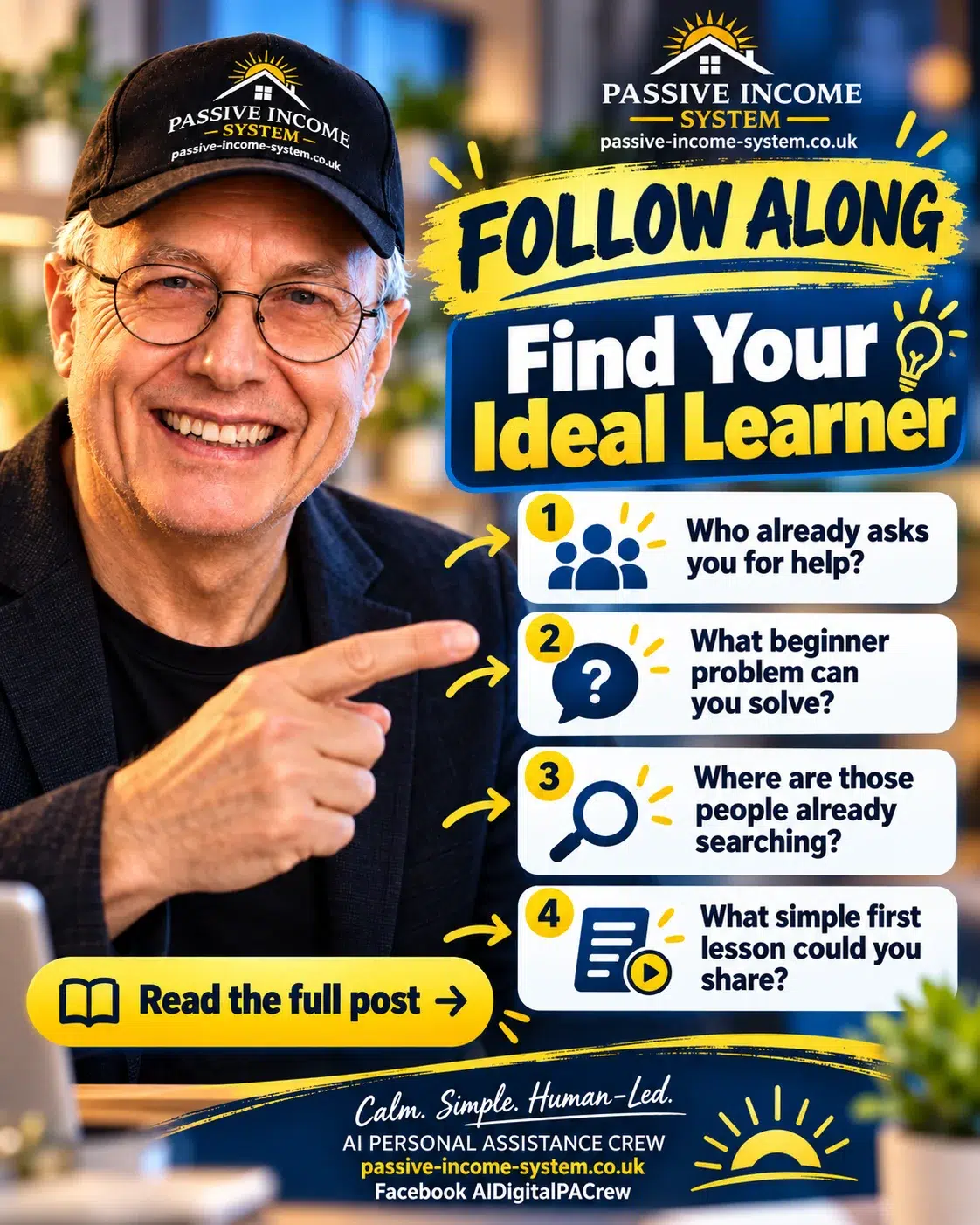
By now, the Crew has three useful places to look: unanswered questions, repeated mistakes and desired small results. Before rushing to design a digital product, put each possible idea through three questions. First, who experiences this problem? Describe an actual kind of beginner, not an age group so broad that it tells you nothing. Second, what are they trying to achieve? State the result in everyday language. Third, what prevents them from achieving it now? The obstacle might be missing knowledge, confusing instructions, fear of damaging something or simply not knowing where to begin. These questions reveal whether you have a teachable problem rather than merely an interesting subject. They also prepare the next stage of our workshop, because every good AI Crew assignment needs a clear audience and purpose.
Build A Learner Profile That Feels Like A Real Person
Let us return to Wilson and his wobbly chair. His first thought might be to teach “woodworking for beginners”, but that phrase could include furniture construction, carving, cabinetmaking and a hundred other activities. Instead, he describes a new homeowner who has bought a second-hand wooden dining chair and wants to understand why it moves from side to side. The person has basic household tools but little repair experience. Their immediate concern is whether the chair is safe to use, and they need to recognise when professional repair is appropriate. Notice how this small description changes the lesson. Wilson no longer needs to teach everything about timber. He needs to explain the first checks clearly, including when the learner must stop rather than risk injury.
A learner profile is not a fictional biography stuffed with birthdays, favourite colours and invented purchasing habits. It is a practical description of somebody’s situation. Good profiles capture what the person is trying to achieve, what they already understand, where they are confused and what would count as progress. You may discover useful differences between two people who appear almost identical on paper. Two retired beginners could have the same age, hobbies and income, yet one wants a small activity for enjoyment while the other wants to create something to share with grandchildren. Their motivations change what counts as a helpful lesson. To Find Your Ideal Learner, build your description around the problem and intended result rather than assuming that everyone in the same demographic wants the same thing.
Find Your Ideal Learner Through Evidence, Not Guesswork
We have identified how a question, mistake or unfinished task can reveal a learning opportunity. Now we must check whether our imagined beginner resembles somebody in the real world. That does not require a research department, expensive advertising or a month of complicated surveys. Begin with conversations and questions that are already accessible to you. Look at what people actually ask in hobby communities, beginner discussions and the everyday situations around you. Search for recurring wording rather than collecting hundreds of unrelated comments. If you belong to a community, observe its rules and participate respectfully. The purpose is to understand what beginners find difficult, not to arrive with an unsolicited sales message. One genuine conversation can improve your teaching plan, though it cannot establish market size by itself.
Suppose our retired dressmaker wants to teach curtain alterations. She searches for beginner questions and discovers that people are confused by measuring finished length, allowing for hems and handling fabric that hangs unevenly. She might initially have planned an impressive guide to sewing machine techniques. The evidence suggests a smaller first lesson: how to measure curtains before deciding where to cut or sew. That lesson must still be tested, particularly because different fabrics and hanging methods can produce different results. But now the subject has a clear starting point. Instead of saying, “I know how to sew,” she can say, “I can help someone avoid a common measuring mistake before altering their curtains.” That second sentence is easier for a learner to recognise as relevant.
Find Your Ideal Learner By Listening For Their Own Words
Your learner’s language matters because expertise can make an explanation harder to recognise. A former plumber might describe a problem using trade terminology, while a householder says, “The radiator is warm at the bottom but cold at the top.” A computer enthusiast might discuss file management, while a beginner says, “I saved it yesterday, and now I can’t find it.” The ordinary wording reveals how a person experiences the difficulty. Collect phrases that describe the problem clearly, but avoid sharing names or private messages without permission. For safety-sensitive subjects such as electrical work, gas appliances or structural repairs, a useful lesson may focus on recognising warning signs and contacting a qualified professional rather than giving hazardous DIY instructions. Real expertise includes knowing where a beginner’s lesson should stop.
The Crew can help interpret these observations, but it must not invent customer interviews and present them as evidence. You might give Riley five genuine beginner questions and ask which confusion appears most often. You could ask the Research Assistant to identify recurring public questions, while clearly distinguishing source material from its own suggestions. The Proofreader can test whether instructions contain jargon. The Visual Worker can design a diagram showing the intended result. However, every proposed pattern remains a hypothesis until real examples support it. A clever-sounding AI answer does not establish that hundreds of people share the problem or that they would buy a solution. This is why the Gaffer stays in charge. Your judgement, practical experience and willingness to check the evidence protect the workshop from becoming an expensive collection of confident guesses.
Turn Your Learner Profile Into A Useful First Lesson
Once you understand the beginner, write a single teaching promise. It should describe the person, the problem and a realistic first result. For example: “I help first-time gardeners recognise when their container plants need attention, using a simple observation checklist.” Notice what this does not promise. It does not guarantee healthy plants in every situation, instant expertise or a profitable gardening business. It offers a useful method that can be explained and tested. Another promise might be: “I help beginner dressmakers measure curtains accurately before making alterations.” Both statements point to a manageable teaching unit. Finding Your Ideal Learner is not merely about identifying a potential customer. Itis about discovering what a helpful first lesson must accomplish.
Next, decide what the learner can do after following your instructions. Avoid vague endings such as “understand gardening better” or “feel more confident online”. Those may be welcome benefits, but they are hard to test on their own. Choose something visible or checkable: complete an observation sheet, measure a curtain correctly, sort five files into clearly named folders or recognise three warning signs that mean a task needs professional help. Then work backwards. First, what must the learner know? Which tools or materials are required? What mistakes are common? What should they do if something unexpected happens? These questions become the skeleton of a useful guide, checklist, lesson or workshop activity.
Find Your Ideal Learner Before Creating A Product
It is tempting to package the lesson immediately, give it a handsome cover and call it a product. Resist that temptation until somebody has tried the instructions. Ask a suitable beginner to read the draft and explain what they would do next. If the task is safe and practical, invite them to attempt it with appropriate supervision where needed. Watch for hesitation, skipped steps and questions you thought you had already answered. Do not coach them through every difficulty, because that can disguise problems in the instructions. Afterwards, ask what was useful and what remained confusing. A successful trial does not prove that people will pay, but it does provide evidence that the resource can help its intended learner. That is a worthwhile achievement.
Phillip and Wilson can now see why their approaches produce different drafts. Phillip began with an impressive collection of knowledge and hoped the audience would find something relevant. Wilson started with a particular beginner’s concern and worked towards one useful result. Phillip can still improve his project by first asking who would use the material and what problem it solves. Wilson must still test his advice, check safety boundaries and find out whether anyone values the finished resource enough to obtain it. Neither man has a guaranteed digital business. Both possess experience that could become educational value. The difference is that Wilson has begun connecting what he knows to something somebody needs.
Let Your AI Crew Prepare The Learner’s First Teaching Brief
This is where the AI Personal Assistance Crew earns its place. Rather than asking AI to invent a bestselling product, give Riley a focused assignment: organise your genuine observations into a one-page learner brief. Include the beginner’s situation, the words they use, the difficulty they face, the result they want, the skills they already possess and the boundaries of the lesson. Ask the Crew Manager to challenge anything unsupported. If you claim that “every retired person wants this”, Riley should ask what evidence supports that statement. If a proposed lesson contains ten different outcomes, Riley should recommend choosing the smallest useful one. This approach reduces wasted writing, unnecessary graphics and repeated editing. AI helps you organise and test your experience, not replace your understanding of the people you want to help.
With that brief, the Research Assistant can check relevant public guidance where appropriate, the Visual Worker can plan a clear follow-along graphic, and the Proofreader can examine the instructions for confusing language. None of these stages should begin with an enormous document. Start with the learner and the result, then give each Crew member a precise responsibility. This prevents the familiar problem of creating a polished resource for an imaginary audience. It also helps keep our Eight-Window workshop connected. The knowledge discovered in Post 1 now has a possible learner. The learner identified in Post 2 provides the brief for the AI Crew we’ll assemble in Post 3. Each stage answers a question left by the previous one, rather than sending the reader into another disconnected collection of information.
Find Your Ideal Learner Before Asking AI To Build The Lesson
A useful learner brief can fit into six short lines. Who is the beginner? What is their problem? How do they describe it? Already, did they try anything else so far? What one result do they want? What could make the lesson unsafe, confusing or unsuitable? You do not need to answer every question perfectly on the first attempt. Mark uncertain details clearly and decide how to check them. The completed brief becomes the starting document for your Crew Manager. It can later support a written guide, a short video, a printable checklist or another suitable digital resource. We decide the format after understanding the lesson, not before. That is how we keep the process calm, simple and human-led.
Today’s Reader Task: Give Your Knowledge A Real Learner
Take the knowledge you identified in Post 1 and write down one kind of person who might need it. Avoid descriptions such as “everybody over fifty” or “anyone interested in gardening”. Choose somebody facing a recognisable situation. Next, record one question they have asked, or a question you can genuinely investigate. Describe the small result they want and what currently prevents them from reaching it. Finally, write a teaching promise beginning, “I help…” If you have no real evidence yet, label the profile unverified and identify one respectful way to check it. Your goal today is not to invent a profitable audience. It is to produce a learner profile specific enough that another person could understand exactly whom you intend to help.
Open to See This Video, And This Is What’s Already Built, Trained & Waiting For Your First Command.
What You’ve Learned And What Comes Next
A lifetime of knowledge preceded you. You have now taken the important next step of looking beyond that knowledge towards the beginner who might benefit from it. You know why polite applause isn’t the same as genuine interest, why a small, relevant audience can provide useful feedback, and why a learner’s own words often reveal the most practical first lesson. Most importantly, you have a simple learner brief rather than a vague hope that somebody will want what you create. In our next workshop lesson, Build Your AI Crew, we’ll use that brief to assign responsibilities, organise the first resource and help the Gaffer remain firmly in control.
Riley’s Wisdom Drop: “Your experience becomes more useful when somebody can recognise their own problem in the lesson you offer. Find that person before you build the product.”
AI Personal Assistance Crew —> Calm. Simple. Human-Led.