Discover Your Hidden Knowledge And Its Amazing Value
Imagine discovering that something you’ve known for forty years could be exactly what somebody else needs to learn today.
Your Lifetime Experience Holds Hidden Opportunities
What if the skills you take for granted could become useful lessons that give your retirement a fresh purpose and help somebody else?
Meet Your AI Crew And Discover The Shortcuts
You bring the knowledge you’ve earned through life. Alan, Riley and the AI Personal Assistance Crew will show you how to organise it, teach it and explore its potential value, one simple step at a time.
You may have spent forty years learning something that another person desperately wants to understand. Yet because it comes naturally to you, its value may be almost invisible. Discover Your Hidden Knowledge is the first practical step towards preserving your experience, sharing useful lessons and exploring whether that knowledge could eventually become a worthwhile digital product.
Your Everyday Experience Could Help Someone Tomorrow
What you regard as ordinary knowledge could save a beginner hours of frustration, uncertainty and unnecessary mistakes. The opportunity begins by recognising those overlooked lessons and discovering which parts of your experience could help somebody achieve a useful result.
Meet The Human Gaffer And His AI Crew
With Riley, my AI Crew Manager, I’ve been exploring how everyday experience can become practical digital teaching material. Our starting principle is simple: the human brings the knowledge, while the Crew helps uncover, organise and present it.
Discover Your Hidden Knowledge Behind Everyday Experience
Imagine a retired dressmaker opening a drawer containing patterns, handwritten measurements and little reminders collected over forty years. She remembers adjusting a shoulder seam that didn’t sit comfortably, helping customers choose fabric and explaining why two apparently identical measurements sometimes produced very different fits. These things seem ordinary to her because she’s dealt with them for decades. But a beginner sitting at a kitchen table with a sewing machine and a first pattern may be struggling with the same questions. The difficulty isn’t that the experienced woman lacks valuable knowledge. It’s that the knowledge has become so familiar that she no longer notices how often she uses it. We call this the Knowledge Blind Spot, and recognising it is the first discovery in our Eight-Window learning journey.
Then name a specific action or decision. Helping someone understand gardening is a large assignment. Helping a beginner decide whether their patio plants need watering gives you a clearer task. You can inspect the draft for the information that particular decision requires.
When you Check Your AI Work, keep that sentence beside you. Read each section and consider how it contributes to the promised outcome. Useful background can stay where it helps the reader understand an instruction. However, the central task needs enough attention to stand on its own. A fond account of your favourite garden will not answer a watering question on Tuesday morning.
An experienced person who has discovered their hidden knowledge can often look at a situation and make a useful judgement without explaining every thought behind it. A retired gardener notices something unusual about a seedling’s growing conditions. A former office administrator recognises why a filing system is creating confusion. An experienced tradesperson understands which information would help a professional investigate a customer’s problem. What each person sees may be invisible to somebody trying that activity for the first time. This difference matters because the best teaching opportunities aren’t always found in complicated technical expertise. They may be hidden inside the observations, questions and small decisions you’ve made thousands of times. By learning to notice them, you begin turning your experience into a resource someone else can genuinely benefit from.
Discover Your Hidden Knowledge Through Beginner Questions
There is a useful difference between explaining everything you know and helping somebody understand one thing they don’t. A dressmaker could describe forty years of working with clothes, but her beginner may only need to understand how to record measurements consistently. A gardener might explain numerous growing techniques, while somebody starting their first tomato plants wants help recognising the conditions those plants need. The beginner isn’t asking for a lifetime of expertise in one sitting. They’re asking for a useful next step. That gives us a powerful decision rule: find the difficulty before designing the lesson. When you understand where somebody becomes confused, you can choose the part of your knowledge that matters most. The result is likely to be clearer, easier to create and simpler for the learner to apply.
The challenge is that experienced people often judge their knowledge by the wrong standard. They ask whether it sounds impressive, whether it deserves a certificate or whether someone more qualified could explain it better. Those questions may have their place, particularly when specialist qualifications are legally or professionally necessary. But they don’t automatically reveal everyday teaching value. Someone who has spent decades knitting may know a simple way of keeping project notes that would help a newcomer avoid repeated mistakes. A retired secretary may know how to organise household documents more clearly. Neither person has to pretend to be a world authority. The question is whether they can explain a genuine, appropriately safe task that somebody else wants to learn. Useful teaching begins with clarity and responsibility, not an impressive job title.
Discover Your Hidden Knowledge Using Three Questions
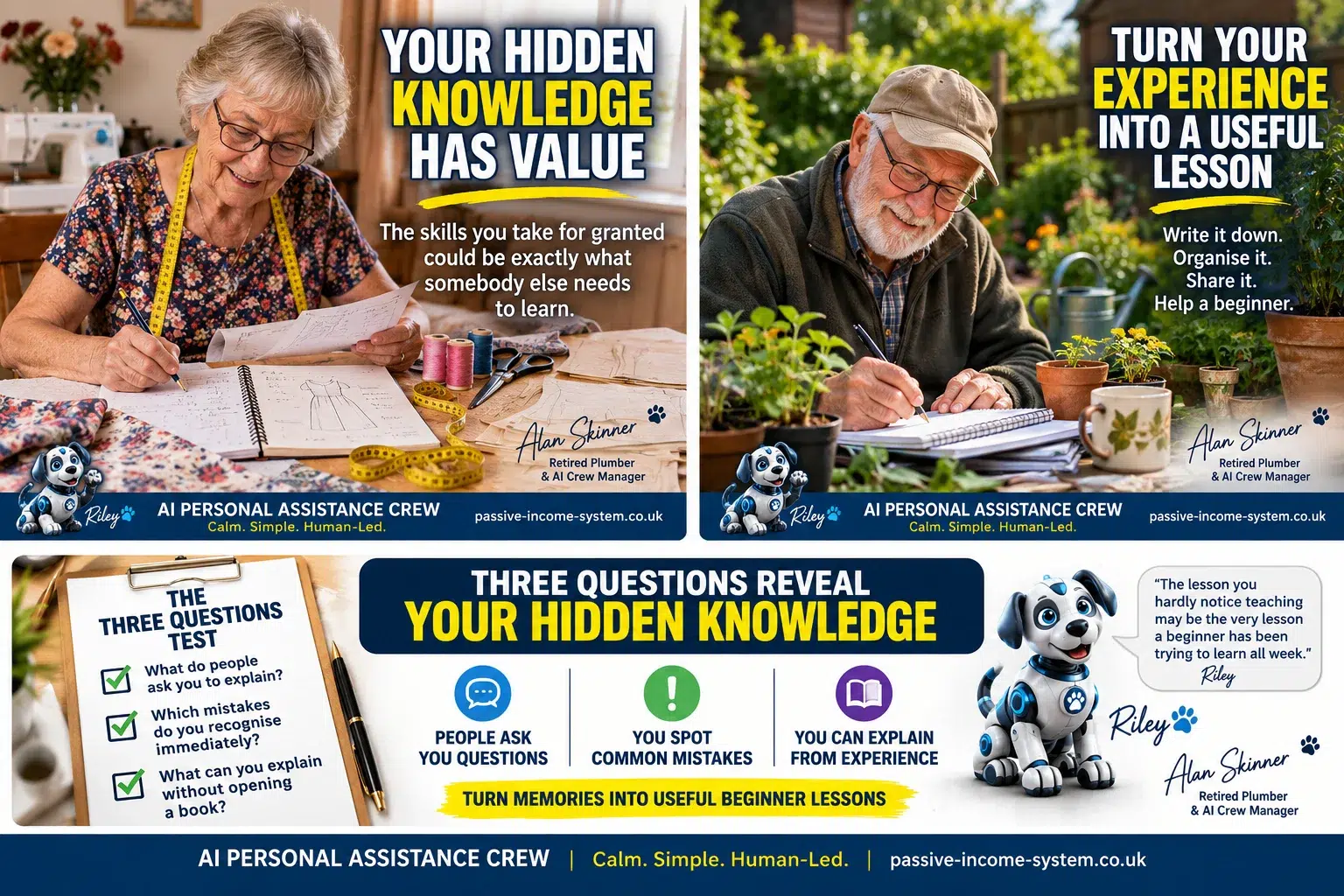
Our AI Personal Assistance Crew uses a simple discovery method called the Three Questions Test. The first question asks, “What have people asked me to explain?” The second asks, “Which mistakes do I recognise immediately?” The third asks, “What practical task can I explain without opening a book?” Each question examines experience from a different direction. The first reveals recurring questions. The second reveals judgements you’ve developed through practice. The third reveals knowledge you can explain confidently. Together, they help separate useful teaching material from the general memories and achievements of a working life. You don’t have to produce dozens of answers. A small collection of genuine examples is more useful than a long list of subjects chosen merely because they sound commercially attractive.
The Three Questions Test Turns Memories Into Lessons
Start with the questions other people have asked you. Perhaps friends regularly seek advice about organising a small garden, recording household information or getting started with a craft. Their questions offer clues about what confuses beginners. Next, think about mistakes you notice almost immediately. A dressmaker may recognise when a beginner has recorded measurements inconsistently. A keen gardener may spot a poor choice of growing position. Finally, consider the tasks you could explain comfortably. Perhaps you can demonstrate how to organise a sewing project or prepare a simple planting diary. Look for an idea that appears in more than one answer. If people ask about it, you recognise the common mistakes, and you can explain a useful first action, you’ve identified a promising teaching opportunity. That still isn’t proof of demand, but it’s a sensible place to begin investigating.
Consider how this exercise works when our retired dressmaker begins writing down her memories. She recalls customers arriving with measurements that weren’t recorded consistently. Another memory concerns a beginner who chose fabric without considering how it would behave in the intended garment. A third involves someone cutting material before carefully checking the pattern instructions. Each memory contains a possible lesson, but none needs to become a product immediately. Instead, she records what happened, what she noticed and what the other person needed to understand. Her notebook now contains three useful teaching candidates. She hasn’t spent money, created a website or opened an online shop. She’s rescued three pieces of experience that might otherwise have remained forgotten, and she can begin comparing which one would be most useful to a beginner.
The same principle works for somebody with a lifetime in the plumbing and heating trade. They may know which questions customers struggle to answer when contacting a qualified professional. Instead of producing a dangerous guide to repairing gas appliances, they could develop a homeowner information sheet. It might help people record symptoms, equipment details and useful questions before making an appointment. That creates practical value without encouraging readers to undertake hazardous work. Another retiree might develop a gardening observation sheet or a beginner’s project planner. The format changes with the subject, but the test stays the same. Identify something you know, figure out what the beginner needs, and design a small resource that supports the right outcome. Valuable experience becomes more useful when it is presented at the point where somebody needs it.
Discover Your Hidden Knowledge And Give It A Job
Finding useful knowledge is only the beginning. The next question is what to do with it. Imagine our retired dressmaker looking at the three ideas in her notebook. She’s recognised several opportunities, but they’re still memories rather than finished teaching resources. Unless she can connect one of them to something another person wants to achieve, the exercise may become another enjoyable afternoon of thinking that never produces a practical result. This is where we introduce an important distinction between a memory, a lesson and a resource. A memory describes something that happened. A lesson explains what somebody can learn from that experience. A resource helps the person apply the lesson. The three are connected, but they’re not interchangeable. Understanding the difference gives our dressmaker a practical way forward.
Three Small Decisions Turn Experience Into Something Useful
Consider the dressmaker’s memory of customers arriving with inconsistent measurements. On its own, that memory is an interesting observation from her working life. The teaching lesson emerges when she explains why the confusion happens, what a beginner should notice and which recording habits make information easier to use. A practical resource could then help somebody apply that explanation. It might be a printable measurement record with clear labels, suitable instructions and spaces for entering information. Notice how the idea becomes progressively more useful without becoming unnecessarily complicated. We haven’t created a complete dressmaking course, selected an online marketplace or promised anybody will pay for the worksheet. We’ve identified a way for one person’s experience to help another person complete a recognisable task. That is a sensible foundation for a digital product experiment.
Now apply those three distinctions to something from your own background. Perhaps you spent years working in administration and remember colleagues repeatedly searching for misplaced documents. The memory concerns the frustration and confusion you observed. The lesson explains how consistent naming and storage make documents easier to retrieve. A possible resource is a clearly labelled household document organiser that people can adapt to their circumstances. Alternatively, a gardener might remember helping a neighbour investigate unsuitable growing conditions. The lesson focuses on which observations matter before changing the care routine. A resource could be a simple plant observation sheet. The practical point is that you’re not trying to sell your memories. You’re investigating whether something you’ve learnt could help a beginner achieve an outcome they currently find difficult.
Discover Your Hidden Knowledge Through Practical Lessons
So many promising ideas remain unfinished because experienced people often move directly from discovering something they know to imagining the biggest possible product they could create. Our dressmaker pictures an illustrated book, a full video course and perhaps an online sewing school. Before long, she’s thinking about recording equipment, website costs, editing software and subjects she hasn’t taught for years. The project becomes bigger than the original problem. She hasn’t even established whether a beginner can follow her measurement instructions. Our Crew takes a different approach. We identify the smallest useful result that could demonstrate the lesson’s value for the dressmaker, that could be a one-page recording worksheet. Completing and testing that resource is more informative than spending weeks describing a course that doesn’t yet exist.
The Beginner’s Result Determines What You Create
A useful digital product must make sense to the person using it, not merely to the person who created it. An experienced dressmaker may understand every label on her worksheet because she has used the terminology for decades. A beginner may interpret the same words differently. That’s why the next stage requires us to look beyond our own experience. Who is this person? What are they trying to make? What information do they already understand? Which part of the process confuses them? The answers help determine whether a worksheet, illustration, short demonstration or fuller explanation would be appropriate. Without that knowledge, even accurate instructions can be difficult to follow. Our next workshop will investigate this problem in detail, because the person you’re helping should influence the shape of the finished resource from the very beginning.
The opportunity becomes more interesting when you realise that the same working method can serve many different experiences. A retired carpenter might help beginners prepare a materials checklist for a simple, low-risk craft project. A former office administrator could create a printable organisation system. A knitter might turn a familiar project-recording habit into a useful pattern worksheet. Each begins with a different kind of knowledge, but the key decision stays the same. What can the beginner actually do after following the lesson? If the answer is vague, the idea needs more thought. If you can describe the outcome clearly and demonstrate it safely, there’s something worth investigating. That doesn’t mean demand has been established or that income will follow. It means the experience has been shaped into a practical teaching opportunity that can now be discussed, checked and tested.
Let Your AI Crew Help Preserve The Knowledge
Once you’ve identified the lesson, an AI assistant can help organise your notes into a clear teaching outline. You might describe a common mistake in your own words and ask the assistant to suggest how a beginner could recognise it. The Crew can prepare a draft worksheet, suggest suitable headings and flag details that need checking. However, artificial intelligence doesn’t automatically know whether your remembered technique is accurate or suitable today. Methods and regulations change, and some subjects involve safety considerations. Human verification remains essential. The AI Crew should make the work easier to organise and communicate, not manufacture qualifications or replace responsible judgement. Our rule is that the human owns the experience, the Crew manages the supporting work, and the human approves the result.
Why Your First Useful Lesson Needs An AI Crew Manager
Now imagine trying to turn all those possible ideas into finished resources by yourself. You’d need to organise your notes, decide which instructions matter, check factual details, prepare illustrations, choose a suitable layout and proofread the result. Some people enjoy every part of that work, but others may feel overwhelmed before they’ve created their first page. This is where our AI Personal Assistance Crew becomes particularly useful. The Crew doesn’t need to invent your expertise or replace your decisions. It needs to help you organise the supporting work. More importantly, somebody must understand the entire assignment before the individual jobs begin. The Crew Manager owns that responsibility. A manager-first approach can reduce the risk of receiving disconnected drafts, unsuitable graphics and lengthy explanations that don’t match what the beginner actually needs.
Our dressmaker could tell her AI assistant everything she remembers about the measurement problem and ask it to write an ebook immediately. The computer might produce pages of plausible information, but that wouldn’t guarantee a useful resource. A better starting instruction would explain that she wants to help a beginner record measurements consistently and that her immediate objective is a small, checked worksheet. A Crew Manager could then organise the information into a teaching brief, identify questions needing verification and determine which writing or illustration tasks are appropriate. The dressmaker would inspect the result against her own experience before approving further production. This division of responsibilities is central to our DIY AI Crew System. The human supplies authentic knowledge and judgement. The Crew organises the work required to make the lesson understandable and usable.
Discover Your Hidden Knowledge With One Simple Exercise
Open a digital diary, use a notebook or make a short voice recording. Write down three questions people have asked you, three beginner mistakes you’ve noticed and three tasks you could explain comfortably. Look for a connection between the answers and choose one practical idea. Then record a memory that illustrates why the knowledge matters. Describe what somebody found difficult, what you noticed and what you learnt from the experience. Now separate the memory from the lesson it contains. Finally, suggest a small resource that could help another person apply that lesson. Don’t worry about building a website, joining a marketplace or selling an ebook. Those steps come later. Your immediate achievement is identifying useful knowledge and giving it a practical purpose. Answering one question well is a more useful beginning than twenty impressive product titles nobody has asked for.
Your Next Discovery Is Finding The Person Who Needs It
There’s something satisfying about discovering your hidden knowledge and realising your lifetime of experience can still help people long after you’ve left formal employment. It gives memories a practical purpose, lets familiar skills reach new learners, and offers the chance to create something useful from home. Some people will enjoy preserving their knowledge without charging for it. Others may later investigate demand for workbooks, patterns, guides or digital lessons. Neither outcome should be assumed before testing. The first achievement is recognising that the ordinary decisions you’ve learnt to make may contain explanations another person hasn’t yet discovered. By capturing those explanations, you begin preserving knowledge that might otherwise disappear. And when you can clearly describe one useful result, you’re ready to investigate who needs it.
This is where our next two workshops become important. In Find Your Ideal Learner, we’ll examine the person who might benefit from your knowledge and discover how their difficulties should shape your resource.
Discover Your Hidden Knowledge Through One Useful Lesson
Then Build Your AI Crew will show you how to commission an organised AI manager to help create the finished material. Those stages belong together because discovering knowledge doesn’t automatically create a product, and creating a product doesn’t automatically create demand. Each achievement requires a different decision. First, discover what you know. Then discover who needs it. Only then commission your Crew to help turn that experience into something practical. By following that order, you begin with a genuine teaching opportunity rather than asking artificial intelligence to invent something you might sell.
Today’s Reader Task: Find Your First Teaching Asset
Open to See This Video, And This Is What’s Already Built, Trained & Waiting For Your First Command.
Complete the Three Questions Test and choose one idea that appears particularly useful. Write down the beginner, their difficulty and the practical result you could help them achieve. Add the memory that revealed the lesson and describe one small resource that could make it easier to apply. Save those answers in your digital diary. This becomes the starting material for the next workshop.
Riley’s Wisdom Drop
“The lesson you hardly notice teaching may be the very lesson a beginner has been trying to learn all week.”
The rule to remember: When something feels too obvious to teach, ask what a beginner needs to notice before they can do it without you.
AI Personal Assistance Crew – Calm. Simple. Human-Led.
Discover Your Hidden Knowledge 3 Amazing Secret Opportunities
1 thought on “Discover Your Hidden Knowledge 3 Amazing Secret Opportunities”

 Imagine a retired dressmaker opening a drawer containing patterns, handwritten measurements and little reminders collected over forty years. She remembers adjusting a shoulder seam that didn’t sit comfortably, helping customers choose fabric and explaining why two apparently identical measurements sometimes produced very different fits. These things seem ordinary to her because she’s dealt with them for decades. But a beginner sitting at a kitchen table with a sewing machine and a first pattern may be struggling with the same questions. The difficulty isn’t that the experienced woman lacks valuable knowledge. It’s that the knowledge has become so familiar that she no longer notices how often she uses it. We call this the Knowledge Blind Spot, and recognising it is the first discovery in our Eight-Window learning journey.
(•‿•) 🍺 (⌐■_■) 🍺 (ᵔᴥᵔ) 🍺